
The essentials in 1 minute
- Oven and steam oven belong in the tall unit at working height: as a practical guide, the lower edge of the oven door sits 80 to 95 cm above the floor.
- The top edge of the oven sits at shoulder height, the tray level at elbow height.
- At Kolev the right height costs €0 extra, because every carcass is drawn individually.
- An oven under the worktop is the most common ergonomic mistake: the hot tray comes from knee height.
- A fixed water connection must be planned before screed and plaster. A steam oven tank needs no preparation.
 Rusi KolevArchitect & Founder
Real Estate Economist (ebs)
Questions in this guide 14

The right height for oven and steam oven
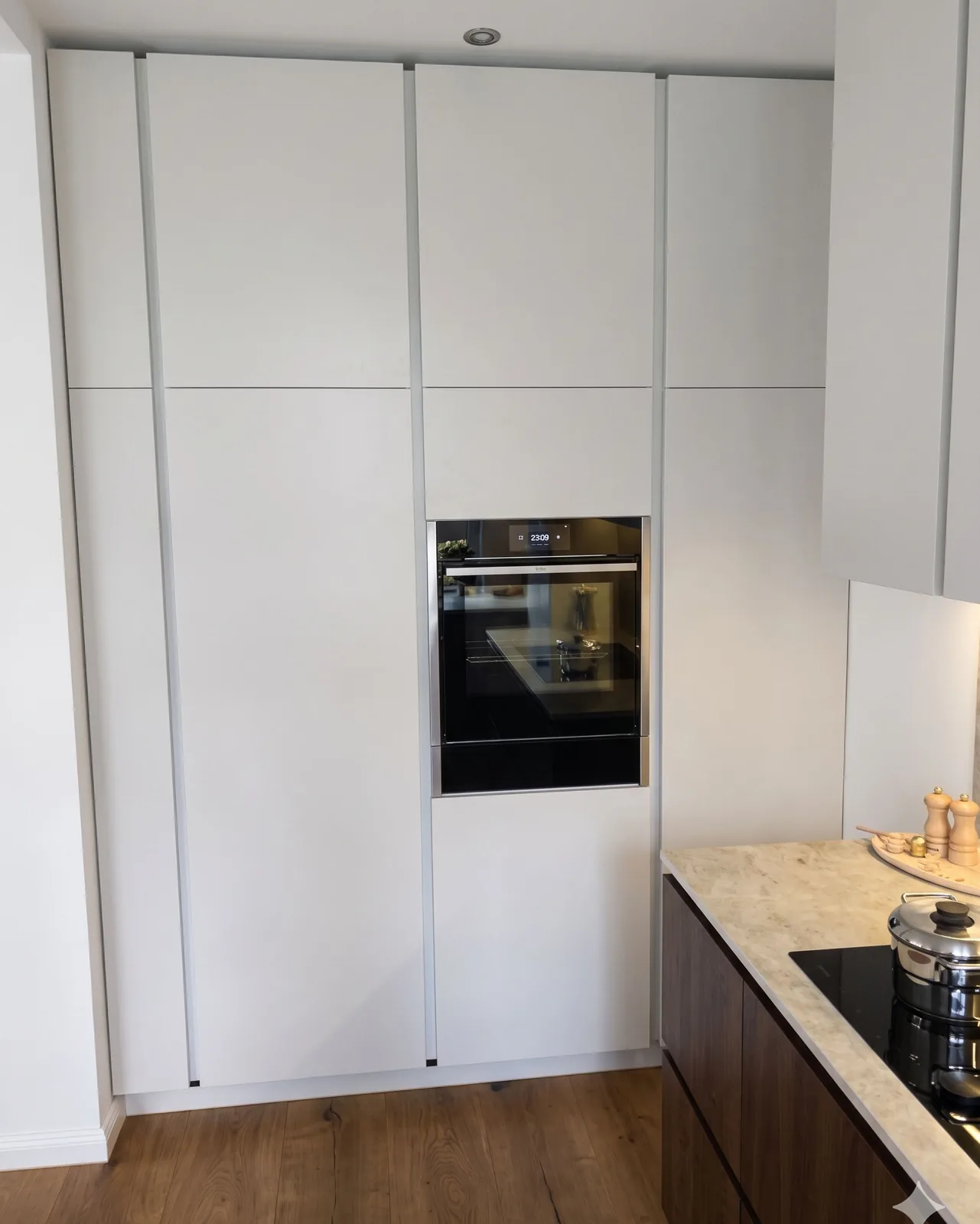
Oven and steam oven belong at working height in the tall unit, because the height above all decides whether you lift a hot tray comfortably or from a crouch. The manufacturer NEFF gives the principle: the top edge of the oven sits at shoulder height. We also plan the tray and pull-out level at elbow height. That is related to the body and not a fixed centimetre measurement. As practical guide values, the lower edge of the oven door sits 80 to 95 centimetres above the floor, usually around the height of the worktop at about 92 centimetres, the tray level for a person of 1.65 metres at around 98 to 103 centimetres, at 1.80 metres around 108 to 112 centimetres, and the handle and tray zone in the tall unit between 100 and 120 centimetres. As a starting point we usually take the top edge of the fronts below the worktop: that is where the oven begins, and the joint lines run straight through. This gives a good working height, because the display sits at a comfortable reading height and the tray level comes out slightly above the worktop, so the hot tray is easy to lift out. Depending on your height and the appliance, we also plan the oven higher or lower. The full formula for the working height by body size is under Worktop height. Here it is only about the height of the appliances. What matters is the order: ergonomics first, then looks, because the free height costs no appliance surcharge, only planning.
| Appliance | Recess (H x W x D) | Installation height (practical guide) | Can be combined | Connection |
|---|---|---|---|---|
| 60 cm oven | 595 x 560 x 550 mm | top edge at shoulder height, door 80 to 95 cm | stackable with a 45 cm appliance | 230 volt, dedicated 16 A circuit |
| 45 cm compact appliance (steam, combi microwave, warming drawer) | 450 x 560 x 550 mm | at eye to elbow height | above or below the oven | 230 volt, dedicated circuit |
| ~14 cm steam drawer (Miele, per the manufacturer from late 2026 in Europe) | 140 mm high | below the 45 cm appliance | adds up to three cooking methods | 230 volt, water tank (per the manufacturer around 0.8 litres) |
| ~14 cm warming / vacuum-sealing drawer | 140 mm high | stacking module | below the oven or compact appliance | 230 volt |
| Induction hob | cut-out ~560 x 490 mm | at the working height of the worktop | its own unit | 400 volt three-phase |
The mistake: oven under the worktop
An oven under the worktop forces you to lift the hot tray from knee and stooping height, and that is the most common ergonomic mistake on the appliance wall. A baking tray with a roast weighs several kilograms, comes out of the oven at around 200 degrees and has to be lifted and turned from about 60 centimetres up, often over an open, hot door. The space under the worktop is there for pull-outs and the dishwasher, not for the oven. In the tall unit at elbow height the stooping disappears entirely. In all these years we have agreed exactly once to set an oven under the worktop, because the room allowed nothing else. Otherwise the higher-mounted oven is a clear matter for us, because who wants to lift a heavy pot out of a hole under the worktop. In the end, though, it always depends on the specific floor plan.
One front, several appliances
An appliance wall holds several appliances in one continuous front, and a 60 cm oven plus a 45 cm appliance stack neatly in a row. The coordination standard DIN EN 1116 ensures that built-in appliances of one recess class fit across manufacturers. The specific recess dimensions are in the installation drawing of the respective manufacturer, not in the standard itself. Per the manufacturers, a 60 cm oven needs a recess of around 595 by 560 by 550 millimetres, and a 45 cm compact appliance such as a steam oven, combi microwave or warming drawer around 450 by 560 by 550 millimetres. There is a new third option: Miele showed a 14 centimetre high steam drawer at IFA 2025. Per the manufacturer the market launch begins in Europe in late 2026. A 45 cm combi appliance plus this 14 cm drawer gives three cooking methods, baking, microwave and steam, in a single 60 cm recess. The classic solution, stacking two 45 cm appliances in a 60 cm recess, remains alongside it.
Self-cleaning: pyrolytic, catalytic, hydrolytic
Pyrolytic, catalytic and hydrolytic cleaning clean the oven at three very different temperatures and with different results. Pyrolytic cleaning heats the oven to around 500 degrees and burns everything to ash, which you wipe out; that uses more electricity and requires an appliance built for it. Catalytic cleaning works continuously at around 200 degrees through coated walls, but cannot cope with sugar and acid. Hydrolytic cleaning softens residues at around 90 degrees with water and a little washing-up liquid and is the mild, energy-saving option for everyday use.
Our clear recommendation is pyrolytic cleaning. The advantage is not only the easier cleaning: an oven with pyrolytic cleaning is built to withstand these high temperatures and, in our experience, is generally built more robustly and fitted with the better components and functions. Whoever intends to keep the oven for a long time anyway is therefore usually better served by a pyrolytic appliance.
Steam and water: tank or fixed connection
A steam oven draws its water either from a tank of 0.7 to 2.0 litres or from a fixed water connection, and that is a planning decision, not purely a question of the appliance. There are three types: the pure steam oven, the oven with added steam and the combi steam oven, which combines baking, steam and sous-vide in one appliance. The tank is refillable and needs no preparation. A fixed water connection on the appliance wall is more convenient, but it has to be in the plan before the screed and the plaster, that is, as preparation. This is where the appliance wall parts ways with the standard kitchen: whoever wants combi steam with a fixed water supply plans the connection in before the wall is closed up.
We prefer the fixed water connection: once it is set up, you never have to think about refilling again. Even so, the tank version has its place, and we say so openly: you do not have to plan a water connection and you save the extra cost twice over, for the connection and for the usually more expensive appliance with a fixed supply. Whoever rarely steams is well served by the tank. Whoever uses the steam oven every day will quickly come to appreciate the fixed connection.
Combi oven microwave
A combi oven microwave combines an oven and a microwave in a 45 cm appliance with 800 to 900 watts of microwave power. The supplied, earthed rack stays in place during operation, and instead of a turntable a rotating antenna distributes the microwaves. The type is built widely, among others by NEFF, Miele, AEG, Küppersbusch and Gaggenau. In an appliance wall such a combi appliance replaces the separate standalone microwave and saves a recess without losing power. For quick reheating alongside the large oven it is the space-saving module.
How we do it at Kolev
We plan the appliance wall as one front with several appliances, whose heights we set at the users’ elbow and shoulder, not at the 90 cm grid. Because every carcass in our Manufaktur (our own production facility) is drawn individually, the right height costs €0 extra. After production it is fixed, which is why it is in the workshop drawing. The oven and compact appliances run at around 3.6 kilowatts, each on its own 230 volt circuit, and only the hob needs 400 volts. Power and any fixed water connection are set out as preparation in the electrical and plumbing plan, and the final connection is made by a licensed trade contractor. Our kitchens start from €14,999 incl. 19% VAT, including planning, delivery and installation.
We work with BORA, Quooker, Elica, Küppersbusch, Bosch, Siemens, Miele, NEFF and Liebherr and recommend without an eye on any margin. For combi steam ovens we plan the fixed water connection in as standard, because it is the more convenient route in everyday use. If you deliberately want the tank, we build the tank. For the oven we advise pyrolytic cleaning. In the end you decide, and we make sure the connection is prepared before the wall is closed up.
Frequently asked questions
How high should an oven be installed?
With the top edge at shoulder height and the tray level at elbow height, and as a practical guide the lower edge of the door between 80 and 95 centimetres above the floor. That is related to the body, not standardised. The full formula by body size is under Worktop height. What matters is that the hot tray does not come from knee height.
Do two appliances fit in one recess?
Yes: two 45 cm appliances stack in a 60 cm recess, for example a compact steam oven above a warming drawer. New to this is the 14 centimetre high steam drawer from Miele, per the manufacturer from late 2026 in Europe. With a 45 cm combi appliance this gives three cooking methods in a single 60 cm recess.
Pyrolytic, catalytic or hydrolytic, what is the difference?
Pyrolytic cleaning burns residues to ash at around 500 degrees, catalytic cleaning breaks down grease continuously at around 200 degrees but cannot cope with sugar and acid, and hydrolytic cleaning softens residues at around 90 degrees with water. Pyrolytic cleaning is the most thorough and uses the most electricity, hydrolytic cleaning is the mildest.
Does a steam oven need a water connection?
Not necessarily: many appliances work with a tank of 0.7 to 2.0 litres. A fixed water connection is more convenient, but it has to be planned as preparation before the screed and the plaster. The final connection is made by a licensed trade contractor.
Can I put a tray in the combi oven microwave?
In a combi oven microwave the supplied, earthed rack stays in place, and the appliance works at 800 to 900 watts with a rotating antenna instead of a turntable. This applies to the combi appliances from NEFF, Miele, AEG, Küppersbusch or Gaggenau. For a simple standalone microwave, different rules apply.
What electrical connection does an oven need?
A 60 cm oven draws around 3.6 kilowatts and needs its own 230 volt circuit with 16 amperes, not three-phase power. Only the induction hob needs 400 volts. Every appliance from about 2,000 watts gets its own circuit, and a residual-current device is mandatory.
Next step: the first consultation
If you would like to know how your appliance wall is planned and at what height your appliances sit, then let’s talk. In the first consultation we look at your room, the heights of the people who will use it and your budget, directly with the architect, 45 to 60 minutes, for Frankfurt and the Rhine-Main region.
And a piece of advice no kitchen studio likes to give: get three offers and compare them. We are one of them.
The height of the work surface: Worktop height. What has to be in place before the screed: Electrical and plumbing plan. Appliances without our own markup: Kitchen appliances.