
The essentials in 1 minute
- The BORA X BO needs a water supply and a drain and belongs above all in a kitchen you plan from scratch.
- At Kolev the Oven Steam costs €2,212 less than the X BO, and you care for it by hand.
- The X BO largely looks after itself with a cartridge: above all, it buys you time.
- With the Oven Steam you buy BORA’s cooking concept and design, but it saves hardly any hand work.
- Neither has top and bottom heat: if you bake a lot of bread, plan a second oven.
 Rusi KolevArchitect & Founder
Real Estate Economist (ebs)
Questions in this guide 28
- Why BORA now offers a second steam oven
- Who each one suits
- BORA X BO and Oven Steam compared
- How the X BO works
- How the Oven Steam works
- What owners write online
- My anchor: how Siemens does it
- Care: what the extra cost gives me back in time
- What this calculation leaves out
- The mistake: choosing the X BO when the walls are already closed
- How we do it at Kolev
- Frequently asked questions
- What is the difference between the BORA X BO and the Oven Steam?
- Can I retrofit the BORA Oven Steam?
- What does the BORA Oven Steam cost?
- Is the extra cost of the BORA X BO worth it?
- Does the BORA X BO need a water connection?
- Is a normal 16 A connection enough for the BORA X BO?
- What do cartridges and filters for the X BO cost per year?
- How often does the BORA X BO need cleaning?
- How often does the Siemens HS958GED1 need descaling, and what does it cost?
- What does a water softener change in the calculation?
- What does care for the BORA Oven Steam cost?
- How often does the BORA Oven Steam need cleaning and descaling?
- Which water can go into the tank of the BORA Oven Steam?
- Which steam oven has the largest cavity?
- Do any of the ovens have top and bottom heat or pyrolysis?
- What do the X BO and the Oven Steam cost at Kolev?
- Next step: the initial consultation
The Oven Steam with its tank also fits an existing one.
Transparency: we supply both BORA and Siemens, without our own mark-up on either, so it makes no difference to us which one you choose. BORA appliances are only available from us together with our kitchens. All BORA amounts in this article are our prices.
Why BORA now offers a second steam oven
The X BO has been on the market for several years. It needs a plumbed-in water supply, a drain and a hard-wired power connection, and all of that is easiest to plan while the walls are still open. In September 2026, BORA presented the Oven Steam. According to BORA, its removable water tank “eliminates the need for a mains water connection”, it can be “easily retrofitted into existing kitchens”, and “a standard grounded socket is sufficient for the power supply”. Whether a tank or a mains connection is right for you depends, according to BORA, “on your kitchen layout and the level of convenience you are looking for”.
That is how I read it too: the X BO is above all for the kitchen you are planning from scratch. The Oven Steam brings BORA into the kitchen that is already there, or into a new one where no water is meant to reach the appliance wall.
Who each one suits
- X BO: a new build or complete renovation, where supply, drain and power go into the plan from the start, or an appliance wall right next to the sink. You steam often and want to leave most of the care to a programme. You still insert the cartridge yourself and wipe the seal.
- Oven Steam: an existing kitchen without water at the appliance wall, or swapping an old oven in an existing 60 cm niche, also under the hob. You want BORA’s cooking concept and design and accept care by hand in return.
- Neither: you bake a lot of bread or cakes with top and bottom heat. Neither of the two has it. Then you need a second, conventional oven and a second niche in the appliance wall, or you look at the Siemens models further down, which do both in one appliance.
BORA X BO and Oven Steam compared
Both are 60 cm steam ovens with three shelf levels and a front without handles or knobs. They differ in water, power, installation, cavity and care. The data come from BORA’s planning documents, the operating manuals of both appliances and bora.com.
| Criterion | BORA X BO | BORA Oven Steam |
|---|---|---|
| Price at Kolev | €4,370, €2,212 more than the Oven Steam | €2,158, €2,212 less than the X BO |
| Water | plumbed-in supply and drain, mandatory | 1.4 l tank, removable, dishwasher-safe up to 60 °C |
| Power | hard-wired: 2 x 16 A for up to 6,100 W, on 1 x 16 A at most 3,600 W | Schuko socket, 3,200 W, 1 x 16 A |
| Installation | plan supply, drain and circuit before installation; not under a hob | standard built-in unit, in a tall unit or under the worktop, also under a hob, can be retrofitted |
| Cavity | 53 l, stainless steel, 3 shelf levels | 64 l, enamel, 3 shelf levels |
| Heating | hot air with steam, fan grill as a mode, air fry with accessory tray, 30 to 230 °C | hot air with steam, air fry with accessory tray, 30 to 230 °C |
| Heating up to 200 °C | under 4 minutes according to BORA | under 6 minutes according to BORA |
| Humidity | 5 levels added, 5 levels extracted, target humidity adjustable | 3 levels added, 3 levels extracted, target humidity adjustable |
| Door | Smart Open: steam is extracted for 10 to 20 seconds, then the door opens | automatic door pre-opening by touch; after steaming, hot steam may escape when you open it |
| Core temperature | built-in four-point food probe | BORA Stick, wireless, as an accessory |
| Controls | 19-inch display, folding, and BORA One app | touch panel and BORA One app |
| Care | intensive cleaning with a cartridge: cleans, descales, dries; the quick clean needs a cartridge too | cleaning programme with oven cleaner, quick clean with steam, descaling programme, work by hand |
| Consumables | cleaning cartridge (I count on one a month), odour filter once a year | oven cleaner and descaler (I count on one cleaning a month and one descaling every two months) |
| Energy efficiency | A, 0.68 kWh per fan-assisted cycle | A, 0.71 kWh per fan-assisted cycle |
Our BORA prices apply together with a kitchen from us, including 19% VAT. For comparison, the RRP according to BORA (price list; for the Oven Steam, BORA’s new-products overview): X BO around €6,724, Oven Steam around €3,320.
How the X BO works
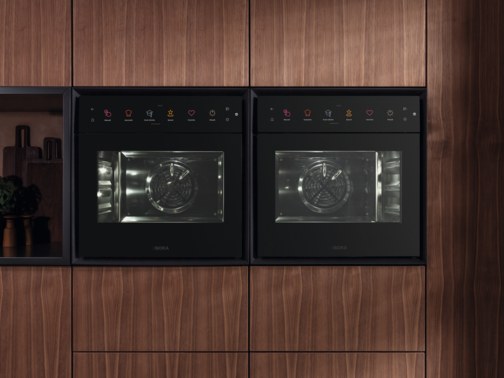
The BORA X BO is permanently connected to the water supply and the drain. While it cooks, the water from the cavity runs through a drain strainer into the waste connection instead of standing in a tray. Before the door opens, it extracts the steam. According to BORA, it therefore will no longer “fog up unit fronts or hit you in the face”, and in an appliance wall with veneer or lacquered fronts that is more than comfort to me, because it protects the fronts. It cooks with hot air and steam: you set the target humidity, target temperature and cooking time, and it adds humidity in five levels or extracts it in five. The built-in probe measures at four points, and you operate it via a folding 19-inch display or the BORA One app.
The real argument is the care. The appliance shows when the intensive cleaning is due. You then prepare the cavity briefly, screw a cartridge into the centre of the rack, and the programme does the rest: it cleans, descales and dries in one pass. Afterwards you wipe away residue and dry the seal by hand. After steaming, you start a drying programme, you clean the drain strainer whenever it is dirty, and once a year you change the odour filter.
How the Oven Steam works
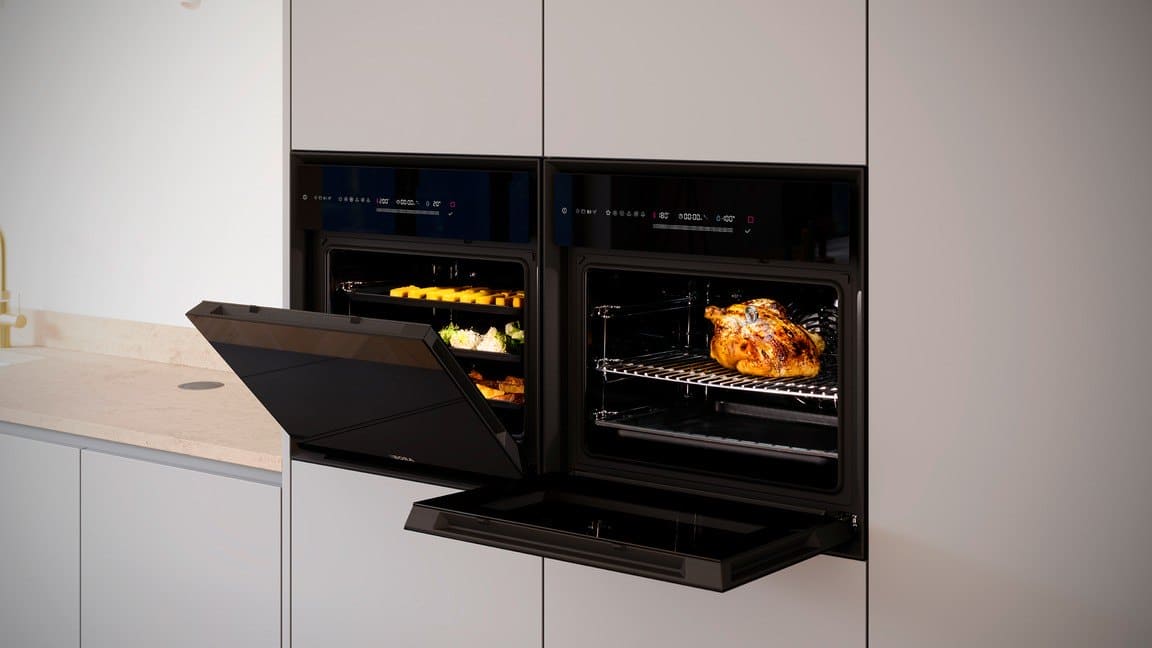
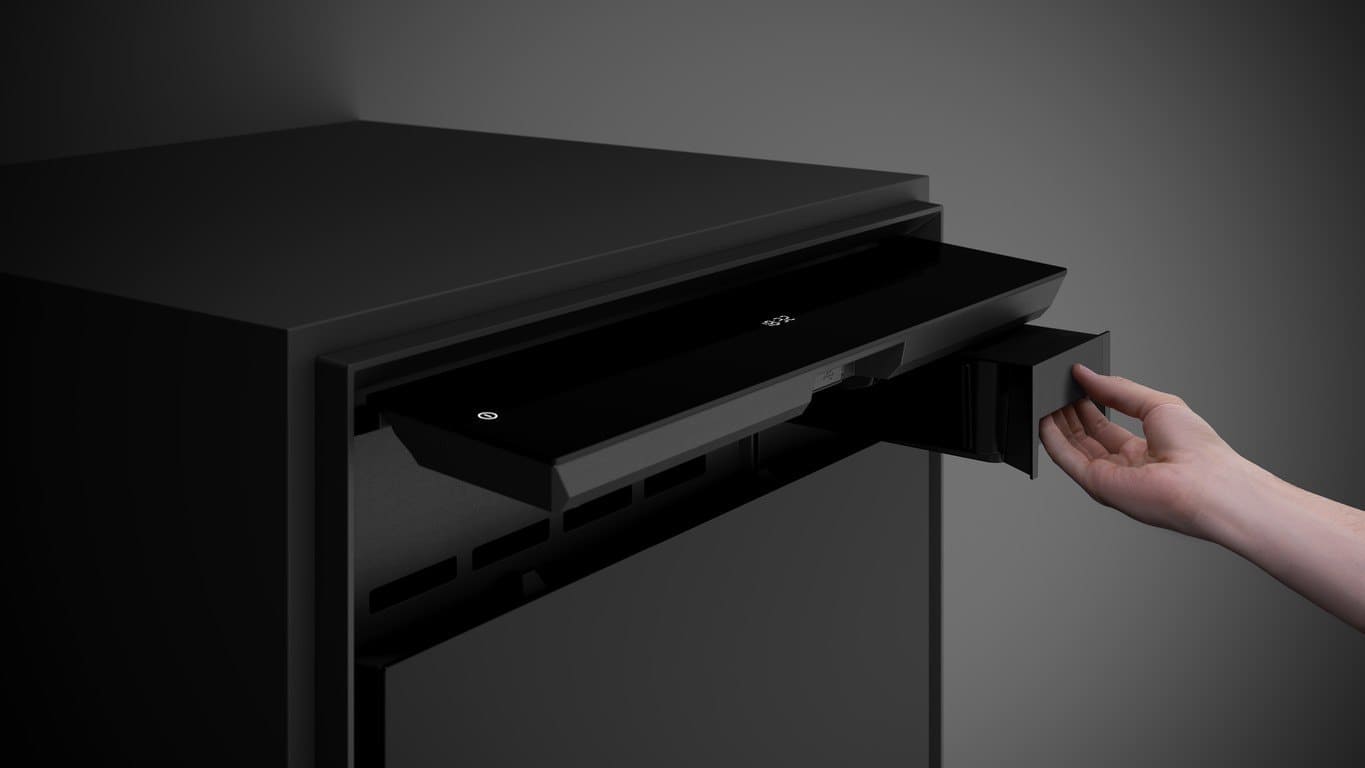
The BORA Oven Steam takes its water from a 1.4-litre tank behind the control unit, which you fold up to fill it. When the water runs low, the appliance tells you, according to BORA also in the BORA One app. It runs off a Schuko socket and fits a 560 mm wide niche, in a tall unit or under the worktop, also two stacked or on the BORA Multi Drawer. At 64 litres, its cavity is larger than the X BO’s and enamelled. The X BO’s is stainless steel. Core temperature is measured by the wireless BORA Stick, which is available as an accessory. Full-extension rails for the left and right (OVENED) are also available as an accessory, at €70.81 from us. According to BORA they are not suitable for the air fry tray.
For cooking, BORA relies on a single heating system, as with the X BO: hot air with steam, “just like in a professional kitchen”, according to BORA. You set the target temperature, target humidity and cooking time, and you can add humidity or deliberately extract it, here in three levels each. The Assist functions in the BORA One app set temperature, humidity and time for a recipe by themselves. Like the X BO, it has no top and bottom heat and no grill element. BORA lists a fan-grill mode only for the X BO.
You care for it by hand, but with help: according to BORA, the cavity has no exposed heating elements, so it is easy to wipe out. On top of that, there are three care programmes for cleaning, drying and descaling, according to the operating manual also a quick clean in which steam loosens the dirt, a matching oven cleaner and a descaler, and the tank and the shelf supports may go in the dishwasher, the tank on a programme of up to 60 °C. The manual gives no fixed intervals. I work out what care costs per year further down.
What owners write online
The points below come from threads in a home-building forum and a barbecue forum and from comments under YouTube videos, almost all of them made by kitchen retailers. I have not found an independent long-term test of the X BO. The sources are in German.
- It is not the refilling that annoys people, it is the drying. In a forum thread on plumbed-in versus tank, steam oven owners call wiping the cavity dry after steaming the real work, and a plumbed-in water supply alone does not take it away. Opinions differ, though: another owner calls it “a job of only 1 minute, but annoying all the same”, and a Siemens owner finds wiping out after the drying function quick. On the X BO, according to BORA, a drying programme does this, but you still dry the seal by hand.
- The X BO’s self-cleaning gets praise. An owner writes in the Grillsportverein forum that after the cleaning cycle the oven looks “as if fresh from the shop”. Even a commenter who is otherwise harsh on the X BO under a retailer’s video concedes that the self-cleaning “really works well”.
- The cavity and the top heat draw criticism. In the same forum thread, members, not all of them X BO owners, point out that 53 litres is small for large gatherings. The critic under the retailer’s video calls the X BO “lousy for baking bread” because it lacks classic top heat. That is a single report.
- There are no owner reports on the Oven Steam yet. It has only just been launched. Everything you can read about it today comes from the manufacturer or from retailers.
My anchor: how Siemens does it
When I buy something expensive myself, I measure it against a counterpart that is built in large numbers. Siemens home appliances come from BSH, which calls itself the leading home appliance manufacturer in Europe. For me, their price is the normal price of a good appliance of this kind: whatever BORA charges above it is the premium, and I want to know what I get for it. So I measure each BORA against a Siemens of the same class: the X BO against one with a plumbed-in supply, the Oven Steam against one with a tank. For the X BO, that is the iQ700 HS958GED1 from the studioLine, the range Siemens sells through specialist kitchen retailers, so the anchor is no entry-level model. As the price, I take the cheapest offer on idealo including delivery, because anyone can check it.
| X BO vs plumbed-in Siemens | Oven Steam vs Siemens with tank | |
|---|---|---|
| Siemens model | iQ700 HS958GED1 | iQ700 HS736G3B1 |
| Siemens on idealo | €2,615 | €1,078.90 |
| BORA at Kolev | €1,755 more | €1,079 more |
| Siemens has more | 71 l, 5 shelf levels, top and bottom heat, grill element, camera, self-cleaning cavity walls (ecoClean Plus), full-extension rail, air fry tray included | 71 l, 5 shelf levels, top and bottom heat, grill element, self-cleaning back panel (ecoClean), air fry tray and meat probe included |
| BORA has more | drain, steam extraction before the door opens, odour filter, self-cleaning with a cartridge, humidity extraction and target humidity, front without a handle | humidity extraction and target humidity, dishwasher-safe tank, cavity without exposed heating elements, front without a handle |
| Care on the Siemens | after every steam use, wipe up the water and wipe out the condensate tray; descaling by programme with a container and a hose | after every steam use, empty, wash and dry the tank, dry the condensate tray and the cavity |
| Care on the BORA | after steaming, drying programme and dry the seal by hand; intensive cleaning with a cartridge | after every steam use, empty and dry the tank, dry the cavity, door glass, seal and drip channel, the cavity and door glass also by programme; cleaning and descaling by programme with work by hand |
Siemens prices: cheapest offer on idealo including delivery on 30 September 2026.
X BO: here you pay €1,755 more than for the plumbed-in Siemens. Above all, that buys you the care concept: the water drains away instead of standing in a tray, the steam is extracted before the door opens, and a programme does the basic care. On top of that, it controls humidity in both directions. The Siemens does have pure steam programmes, but adds steam to its heating modes in only three levels and cannot extract humidity. The Siemens answers with a bigger cavity, top and bottom heat, a grill element and a camera. In the next section I calculate what the care concept gives me back in time.
Oven Steam: here you pay €1,079 more than for the Siemens with a tank, around double. What you get for that is not a bigger oven but a different one: according to BORA, it uses a single heating system of hot air and steam, as in a professional kitchen; you set a target humidity and can also deliberately extract humidity; the Siemens has pure steam programmes, but adds steam to its heating modes in only three strengths. Add to that a tank that may go in the dishwasher, a cavity without exposed heating elements and a front without a handle. The Siemens has more space, more shelf levels, top and bottom heat and a grill element. Nobody can say yet whether BORA’s concept delivers what it promises in daily use: there are no owner reports so far.
Care: what the extra cost gives me back in time
With the X BO, above all I buy myself freedom: I no longer have to think about the care. The appliance shows when cleaning is due, I insert a cartridge, start the programme, and it does the rest by itself, even on a day when I would have done it sloppily myself. I pay for that with money and get time back. Care by hand weighs on me even when I set reminders; it stays something I have to think about. And with an appliance this expensive, I want it to preserve its own quality in the long run as far as it can.
I have a bean-to-cup coffee machine, and I dread its descaling every six months. I never remember in which order and at which intervals I have to press which button, and I would buy a machine that does it for me straight away. Even the prospect of a quarter of an hour of descaling every two months makes me hesitate over the Siemens. I would rather go back to a classic oven with pyrolytic cleaning and forget about steam altogether. But that is me, and I probably have too little patience for maintenance at home.
On top of that, the care is done properly every time. Siemens writes in the manual that you must wipe out the cavity floor and the condensate tray after every steam use, because otherwise the water can overflow and damage furniture fronts or cabinet floors. BORA writes that regular cleaning and care ensures a long service life and that skipped intervals can restrict the function. If you care for it by hand, you do it thoroughly on some days and not on others; the programme does it the same way every time.
Whether that is worth the extra cost to you is your decision. I do the maths against the plumbed-in Siemens. This is how you care for the two according to the manufacturers’ manuals:
| Care | BORA X BO | Siemens iQ700 HS958GED1 |
|---|---|---|
| After every steam use | drying programme when the cavity is damp, then dry the seal by hand | wipe up the water on the cavity floor and wipe out the condensate tray, then dry the cavity by hand or with the drying function |
| Descaling | part of the intensive cleaning: one cartridge cleans and descales in one pass. The manual says every two to four weeks; I count on once a month | its own programme with liquid descaler, around 100 to 120 minutes with a container and a connecting hose in the cavity, then wipe and dry the floor. The appliance warns you when only five steam uses are left; without descaling, steam can no longer be selected after that |
| Longer break | a cleaning before a holiday | flush the steam system after about two weeks without steam use |
| Filter | odour filter once a year | no filter |
| With a water softener | set the water hardness on the appliance; BORA does not hold out a longer cleaning interval, because the cartridge also removes grease and food residue | setting “softened”; Siemens recommends softened water if the tap water is very hard |
So a central water softener does not take the care off either of them. Softer water means descaling the Siemens less often, because according to the manual the frequency depends on water hardness and steam uses. Siemens gives no number per year. For the X BO, BORA bases the cleaning on use and the appliance’s display and holds out no longer interval: the intensive cleaning also removes grease and food residue, and those build up just the same with soft water. With a water softener, an hour saved with the X BO therefore becomes more expensive.
For kitchen appliances in general, 8 to 12 years is a good rule of thumb (more on how long a kitchen lasts). From a top-tier steam oven in this price class I expect more: fifteen years is my floor here. So you can see I am not mad, here is a study on it: the Energieinstitut Vorarlberg gives 12 to 23 years for cookers and other large household appliances and assumes 15 years for an oven. If one breaks sooner, I am annoyed. With a steam oven, it comes down mostly to water and limescale, and that is why care matters there. So I set the extra cost against my time, over fifteen years and, to be safe, over ten as well.
At Kolev, the X BO’s odour filter XBOGF costs €76.64 and lasts a year, twelve cleaning cartridges XBORK/12 cost €42.48, together €119.12 a year, including 19% VAT. It is like a subscription you take on with the purchase.
What the X BO costs me per year on top of the Siemens:
| Item | Per year, over 15 years of use | Per year, over 10 years of use |
|---|---|---|
| One-off extra cost of €1,755, spread over the years | €117.00 | €175.50 |
| plus cartridges and filter for the X BO | €119.12 | €119.12 |
| minus descaler for the Siemens, assumed every two months | €23.88 | €23.88 |
| Extra cost per year | €212.24 | €270.74 |
| Extra cost per month | €17.69 | €22.56 |
Against that I set the time, and here I estimate, because I have not measured it yet. I count only the hand work that differs: you clean the racks, front and door glass the same way on both, and I count the basic cleaning of the cavity as equal (on the X BO the intensive cleaning with its preparation and finishing, on the Siemens humidClean and wiping out). I do not count the X BO’s drain strainer, which you clean whenever it is dirty. That leaves two differences. First, after every steam use: the Siemens drying function does dry the cavity, but according to the manual you first wipe up the water on the floor, and you wipe out the condensate tray after every steam use. I estimate that at around 4 minutes. On the X BO, the water drains away, you start the drying and wipe the seal. I estimate that at around 1 minute. Second, the Siemens descaling with a container and a hose, by my estimate around 15 minutes of hand work, assumed every two months. What that means per hour saved depends on how often you steam:
| Steaming per week | Hand work saved per year | Per hour saved, 15 years | Per hour saved, 10 years |
|---|---|---|---|
| three times | around 9 hours | around €23 | around €29 |
| five times | around 14.5 hours | around €14.50 | around €18.50 |
| daily | around 20 hours | around €11 | around €14 |
The minutes are my estimates. As soon as we can time the care on an installed X BO, we will replace these estimates with measured values and update this article. If the difference is only 2 minutes per steam use, an hour saved costs around €16 to €20 with daily steaming and around €32 to €40 at three times a week. And if you wipe out in a minute, as some owners do, the X BO saves you hardly any time: what remains is mainly the descaling and the certainty that the care is done every time.
I keep the maintenance the same in every row: one cartridge a month, and descaling the Siemens every two months. The X BO manual does say every two to four weeks, but I do not believe anyone keeps starting the intensive cleaning more often than once a month in the long run. If you steam every day and really stick to two weeks, you need a little over twice as many cartridges, but then the Siemens also wants descaling more often, and the two almost cancel out: an hour saved then costs hardly any more.
Everyone values an hour saved differently. For me it is above all a weight off my mind: one maintenance interval and one machine fewer in my reminder calendar.
For me, the calculation works because I am spared the care and it still gets done equally thoroughly every time, and because the X BO controls steam the most finely: five levels each for adding and extracting humidity, and it extracts the steam before the door opens.
I have seen whole kitchens that cost as much as an X BO. It is a very expensive appliance, and not everyone can or wants to spend that much on it. If it fits your budget, it is a wonderful addition in my view: you buy yourself time and an appliance that largely looks after itself. Whether the calculation works for you depends on how often you steam and what an hour is worth to you.
With the Oven Steam, this calculation does not work, and since its operating manual came out, I know why: against the Siemens with a tank, it saves hardly any hand work. After every steam use, you dry the tank and the cavity on both, on the Oven Steam also the door glass, the seal and the drip channel, on the Siemens the condensate tray and the seal on the tank lid. Both have a drying programme for the cavity. The difference is the tank: on the Siemens, you wash it with washing-up liquid every time, and it must not go in the dishwasher. On the Oven Steam, you only clean it when no water has been drawn for five days, and it may go in the dishwasher.
BORA gives no fixed intervals: you clean as required and descale when the appliance tells you to. So I use the same intervals as in the rest of this article: cleaning once a month as with the X BO, descaling every two months as with the Siemens. Each descaling takes a whole BORA descaler at €8.33; on the Siemens it is around €4. Per year, the descaler therefore costs €49.98 on the Oven Steam and €23.88 on the Siemens. On top of that, the Oven Steam needs the oven cleaner. The oven cleaning set costs €21.66, and BORA does not yet say how many cleanings it lasts. I will add that as soon as I know.
So a price per hour saved makes no sense for the Oven Steam: at Kolev it costs €1,079 more than the Siemens with a tank, a little more in care, and it gives you hardly any time back. What you buy is BORA’s cooking concept with humidity in both directions, and the design.
What this calculation leaves out
A few points cannot be put into euros seriously. Check them anyway:
- Repair risk. A plumbed-in supply and a drain mean more parts that can fail or leak. The X BO has both, the plumbed-in Siemens only the supply, the two tank appliances neither. The Siemens supply is protected by an Aqua-Stop. According to the manual, Siemens covers water damage caused by a fault in it for the lifetime of the appliance. The X BO’s manual names no Aqua-Stop.
- Service. How quickly a technician gets to you depends on the service network in your region. Ask before you buy, for BORA and for Siemens alike.
- Warranty. Both manufacturers give a two-year manufacturer’s warranty. BORA extends it to three years for selected appliances after registration, for the X BO explicitly according to its manual, and offers a care package with warranty extension for the X BO (XBOCARE). The warranty requires the appliance to be installed by an authorised BORA dealer and excludes damage caused by not following the operating manual, explicitly including care and cleaning (BORA warranty conditions). With Siemens, more cover is available through additional insurance (Siemens warranty, in German) and at times through promotions, such as five years for studioLine appliances bought in 2025 (further Siemens warranties, in German). Your statutory rights against the seller remain unaffected.
- Cartridges in the long run. Cartridges and filters only come from BORA. Nobody knows today whether they will still be available in fifteen years or what they will cost then. Price increases on consumables are not in the calculation, and the same goes for the Siemens descaler. What BORA does guarantee is software updates for both appliances, for five years after the end of production.
The mistake: choosing the X BO when the walls are already closed
If you only decide on the X BO once tiles and plaster are finished, getting water and a waste connection into the tall unit often takes real effort. It only works without new pipes in the wall if the appliance stands next to the sink, within reach of the supplied 2.5 m hoses: BORA also allows the drain on the appliance connection of the sink trap, but you must not extend or shorten the hoses. Then there is the power: according to BORA, the full 6,100 W is only available on 2 x 16 A, on 1 x 16 A it is at most 3,600 W, and a Schuko plug is not permitted. Supply, trap and circuit therefore belong in the electrical and plumbing plan before anyone chases a wall.
How we do it at Kolev
We set the height of the appliance wall to your elbow and draw the supply, the trap and the circuit into the electrical and plumbing plan before the wall is closed. The final connection is made by the licensed contractor. As a direct architect partner of BORA, we pass our terms on to you without our own mark-up.
Frequently asked questions
What is the difference between the BORA X BO and the Oven Steam?
The X BO is connected to a water supply and a drain, is hard-wired, and cleans, descales and dries itself with a cartridge. It extracts the steam before the door opens. The Oven Steam works with a 1.4-litre tank, runs off a Schuko socket and is cared for by hand, but at 64 litres it has a larger cavity than the X BO with 53. Both cook with hot air and steam, without top and bottom heat. At Kolev, the Oven Steam costs €2,212 less.
Can I retrofit the BORA Oven Steam?
Yes. It works with a 1.4-litre tank, runs off a normal Schuko socket with 1 x 16 A and fits a 560 mm wide niche, 580 mm high in a tall unit or from 600 mm under the worktop, also under a hob, in which case the hob maker’s requirements apply as well. BORA does not allow the X BO under a hob. According to the manual, the socket must be easy to reach, there must be no connections behind the niche, and the oven must not be installed behind a furniture door. Extension cables and multi-plugs are not allowed. If the old oven was hard-wired to the cooker connection, an electrician will fit a Schuko socket next to it, for example in the neighbouring cabinet. For the manufacturer’s warranty to apply, an authorised BORA dealer has to install it.
What does the BORA Oven Steam cost?
The RRP is around €3,320 including VAT; at Kolev it costs €2,158. That is €2,212 less than the X BO and €1,079 more than the Siemens iQ700 HS736G3B1 with a tank, which cost €1,078.90 including delivery in the cheapest idealo offer on 30 September 2026.
Is the extra cost of the BORA X BO worth it?
Compared with a Siemens iQ700 HS958GED1 with a plumbed-in water supply, the X BO costs €1,755 more at Kolev, plus around €120 a year for cartridges and filter. Over fifteen years, my floor for an appliance in this class, that is around €212 a year after deducting the Siemens descaler. If you steam every day, by my estimate you save around 20 hours of hand work a year and pay around €11 per hour saved; if you steam three times a week, you pay around €23.
Does the BORA X BO need a water connection?
Yes, it is mandatory. According to BORA, it needs cold water with a 3/4-inch connection at 2 to 6 bar and a drain to a trap, which can also be the appliance connection of the sink trap. The trap sits at least 100 mm lower than the appliance’s waste outlet. Otherwise the hose runs over a bracket on the back of the appliance. The supplied 2.5 m hoses must not be extended, shortened or concealed in the wall.
Is a normal 16 A connection enough for the BORA X BO?
It runs on 1 x 16 A, but then, according to BORA, at most 3,600 W instead of 6,100 W. For full power it needs a two-phase connection with 2 x 16 A, always hard-wired. In both cases the supply cable needs a cross-section of at least 2.5 mm², and according to the manual the cleaning time also depends on the power connection.
What do cartridges and filters for the X BO cost per year?
At Kolev the odour filter costs €76.64 and is replaced once a year; a cleaning cartridge costs €3.54 in the pack of twelve and €3.83 in the pack of six. With one cartridge a month, that is around €120 a year in total; with one every two weeks, around €170. According to the manual, dishwasher tablets or other makers’ cartridges are no substitute: third-party cartridges can damage the appliance beyond repair.
How often does the BORA X BO need cleaning?
The manual says an intensive cleaning every two to four weeks, depending on use. The appliance shows when it is due. I count on one a month, because I do not believe anyone keeps starting it more often in the long run. If you steam every day and clean every two weeks, you pay around €50 a year more for cartridges. If the Siemens then descales monthly instead of every two months with daily steaming (my assumption; Siemens gives no number), an hour saved with the X BO stays at around €11 over fifteen years and around €14 over ten. The short quick clean, for example after very aromatic food, also runs with a cartridge according to the manual. If you use it often, you need more cartridges.
How often does the Siemens HS958GED1 need descaling, and what does it cost?
According to Siemens, it depends on water hardness and the number of steam uses; the appliance warns you when only five steam uses are left. The programme takes around 100 to 120 minutes. The Siemens liquid descaler costs €9.95 for 500 ml, and according to the manual the HS958 needs 200 ml of it per descaling, so around €4 per descaling. I count on descaling every two months.
What does a water softener change in the calculation?
The Siemens needs descaling less often, while BORA holds out no longer cleaning interval for the X BO, because the cartridge also removes grease and food residue. If the Siemens never needs descaling at all, an hour saved with the X BO costs around €13 to €16 with daily steaming and around €30 to €38 at three times a week.
What does care for the BORA Oven Steam cost?
At Kolev, the oven cleaning set OVENCS costs €21.66, the descaler OVENDE/4 in a pack of four €33.32 and the oven cleaning and descaling set OVENDCS €27.49, each including 19% VAT. Each descaling takes a whole descaler, so €8.33. BORA gives no fixed intervals; as with the Siemens, I count on one descaling every two months, which is €49.98 a year, and as with the X BO on one cleaning a month. BORA does not yet say how many cleanings one oven cleaning set lasts, so I am not counting the oven cleaner yet.
How often does the BORA Oven Steam need cleaning and descaling?
The operating manual gives no fixed intervals. You clean the cavity as required; to stop residue from burning on, BORA advises cleaning it after every use. You can do that by hand with a sponge cloth and warm water, with the quick clean, in which steam loosens the dirt, or for coarse soiling with the cleaning programme: with the cavity cooled down (below 50 °C), apply around 50 ml of BORA oven cleaner, wearing protective gloves, because the cleaner is corrosive, then 45 minutes at 60 °C, wipe out, 10 minutes of steam, wipe out again. You descale when the appliance tells you to: it shows how many hours of steam are left until then, warns two hours and one hour before, and after that adds no more steam until you have descaled; it keeps cooking without steam. For descaling, a whole descaler goes into the empty tank, then the appliance flushes three times, and you empty and refill the tank each time. After steaming, you dry the tank, cavity, door glass, seal and drip channel, the cavity and door glass also with the drying programme. After a break of more than 48 hours, you refill the tank with fresh water. You clean it when no water has been drawn for more than five days. For the care programmes, BORA only allows its own oven cleaner and descaler.
Which water can go into the tank of the BORA Oven Steam?
According to the manual, fresh, cold drinking water, softened water or still mineral water. Distilled water is not allowed, nor is tap water with more than 40 mg of chloride per litre. You set the water hardness on the appliance in three levels. The factory setting is hard, and according to the manual a wrong setting can damage the appliance. Almost the same applies to the Siemens with a tank: fresh, cold tap water, softened water or still mineral water, no distilled water.
Which steam oven has the largest cavity?
The two Siemens iQ700 with 71 litres each on five shelf levels, then the BORA Oven Steam with 64 litres and the BORA X BO with 53 litres, both on three shelf levels.
Do any of the ovens have top and bottom heat or pyrolysis?
Only the two Siemens have top and bottom heat, and none of the four has pyrolysis. If you want both, plan for a second, conventional oven; more on this under oven at working height. For bread and baked goods that would otherwise be baked with top and bottom heat, the Oven Steam manual recommends the +60% humidity level, and there is a burst of steam for the crust. For the X BO, BORA gives a rule of thumb: set temperatures from top-and-bottom-heat recipes 5 to 20 °C lower, depending on the range. Whether that replaces a conventional oven, I will only say once we have baked with it ourselves.
What do the X BO and the Oven Steam cost at Kolev?
Together with a kitchen from us, the X BO costs €4,370 and the Oven Steam €2,158, each including 19% VAT; according to BORA the RRP is around €6,724 and €3,320. For accessories and consumables such as cartridges and filters, we state the prices directly in euros. We do not sell BORA appliances on their own, only with our kitchens.
Next step: the initial consultation
If you would like to know which steam oven fits your appliance wall and where water and power need to go, let’s talk. In the initial consultation we look at your room, your wishes and your budget, directly with the architect, 45 to 60 minutes, for Frankfurt and the Rhine-Main region.
And a piece of advice no kitchen studio likes to give: get three offers and compare them. We are one of them.