
The essentials in 1 minute
- A kitchen stays usable for as long as its carcass holds: appliances run for 8 to 12 years, fronts for 15 to 20, a good carcass for 25 to 30.
- The most expensive component is rarely the longest-lasting, and the carcass is what most people economise on.
- A good carcass carries a second set of fronts and a second generation of appliances.
- The honest comparison of two kitchens is the price per year of use, not the purchase price.
- Whether a single front can be remade years later depends on the finish and the archived workshop drawing.
 Rusi KolevArchitect & Founder
Real Estate Economist (ebs)
Questions in this guide 12
- How long the individual components of a kitchen last
- The component with the longest service life is the carcass
- What ages first: fronts and appliances
- The mistake almost everyone makes: economising on the longest-lasting component
- What a kitchen really costs over the years
- How we do it at Kolev
- Frequently asked questions
- Next step: the first consultation

How long the individual components of a kitchen last
The lifespan of a kitchen is not a single number but the sum of very different service lives: a fridge is an electrical appliance with wearing parts, a front is a coated board, the carcass is the load-bearing furniture. These years are values from experience in practice, not a standard’s figure, because no standard assigns a lifespan: the standards test strength and safety, the years come from use. What matters is the order: the most expensive component is rarely the longest-lasting, and the longest-lasting is exactly the one most people economise on.
| Component | Lifespan (from experience) | What weakens first | What extends the service life |
|---|---|---|---|
| Appliances | 8 to 12 years | electronics, seals, pumps, hinges | repair, as long as spare parts are available (for fridges and dishwashers the EU requires 7 to 10 years); replacement in the EU standard size |
| Fronts | 15 to 20 years | foil lifts, often from the fifth year at the edges and over sources of steam; the finish is discontinued | MDF carrier board with Senosan Supermatt or Decospan Shinnoki; a single front from the archived workshop drawing |
| Worktop | depends on the material, ceramic and natural stone often over 25 years | scratches, heat marks or staining depending on the material | the right material in the right place, solid material rather than a coated carrier |
| Hardware | pull-outs tested to 80,000 opening cycles (EN 15338 Level 3) | runners and hinges with no tested cycle count | named brand hardware, type archived in the workshop drawing |
| Carcass | 25 to 30 years | moisture at an open edge, shelves sagging when the material is too thin | 18/19 mm Egger E1, long shelves secured against sagging, sealed edges |
The component with the longest service life is the carcass
The carcass lasts 25 to 30 years, longer than anything else in the kitchen, and that is what makes it the real decision: if you want new fronts and appliances in 15 years, you need a carcass that carries the second set. A good carcass in 18/19 mm Egger E1, with sturdily built load-bearing shelves secured against sagging, outlasts two generations of fronts and one generation of appliances. A budget carcass in thin material with open edges is, after 15 years, itself the reason for buying anew. What decides 10 or 30 years of service in a carcass is in the guide Kitchen carcass: 16, 18 or 25 mm.
What ages first: fronts and appliances
Fronts and appliances age before the carcass, and both can be replaced without touching the whole kitchen. A foil front often lifts from the fifth year, later depending on the version, first at the edges and over the steam from the hob and dishwasher. An MDF carrier board with Senosan Supermatt or Decospan Shinnoki lasts considerably longer, and which front lasts how long is in the guide fronts compared. Appliances run for 8 to 12 years. As long as the manufacturer keeps spare parts, for fridges and dishwashers 7 to 10 years under EU law, repair is often worthwhile, after that replacement in the EU standard size. Both are a change of individual parts, not a new purchase, provided the carcass still holds.
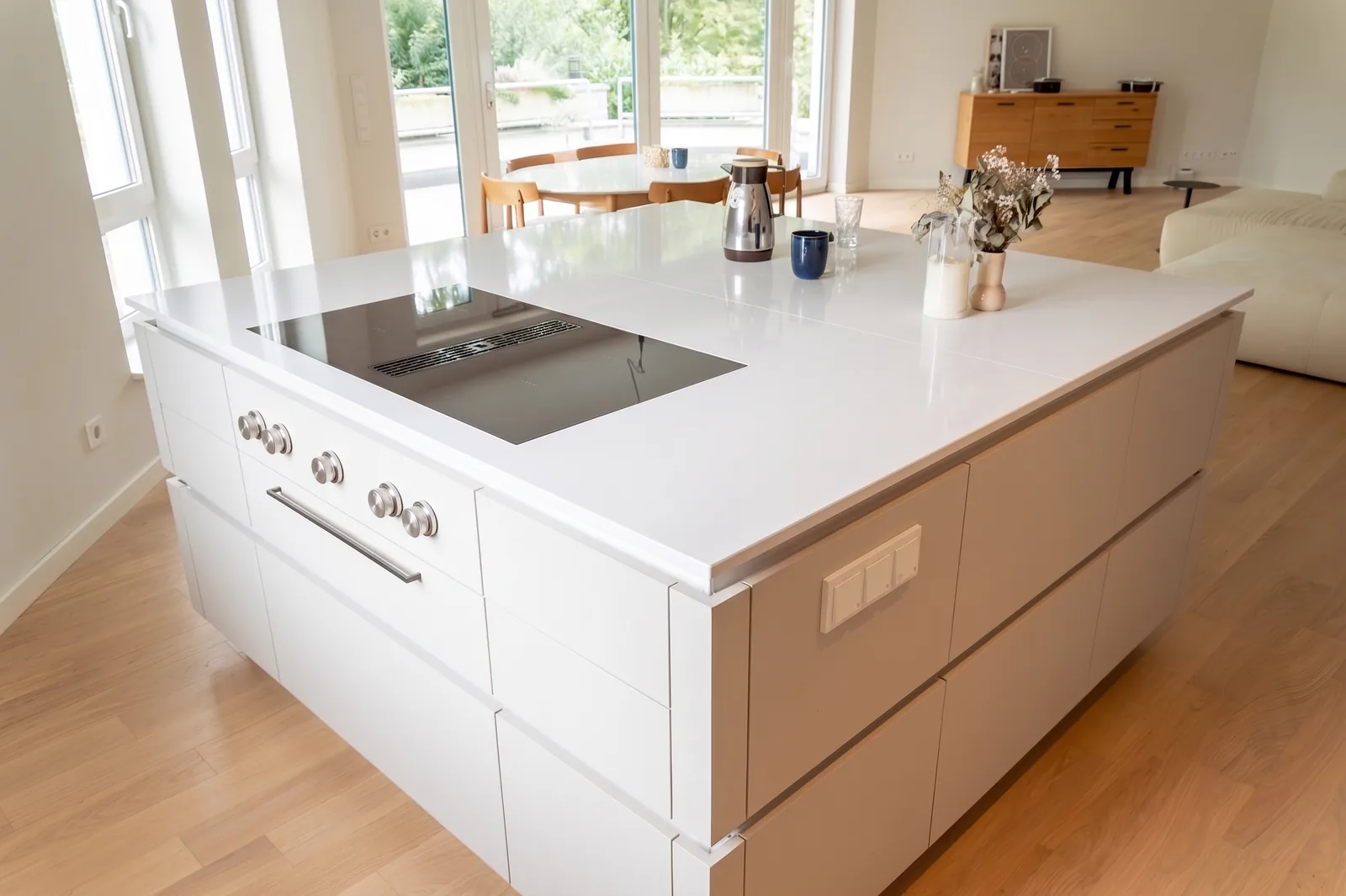
The mistake almost everyone makes: economising on the longest-lasting component
The most common thinking error when buying a kitchen is to allocate the budget in exactly the reverse of the lifespan: appliances expensive, fronts mid-range, carcass never mind, even though the carcass is the component with 25 to 30 years of service. In the 12 Kitchen-Buying Mistakes guide it is mistake number 9. An appliance that fails after 10 years you replace on its own. A carcass that goes out of true after 15 years or swells at the edges is a complete new purchase. The expensive line in the offer and the long-lasting line are rarely the same one.
What a kitchen really costs over the years
The honest comparison of two kitchens is not the purchase price but the price per year of use: a kitchen replaced after 12 years can cost more per year than one that lasts 28 years, as soon as the price difference is smaller than the difference in service life. The lever for this is the replacement front: a single damaged front is about €200 in material value, as long as the finish is available. If it is discontinued, that becomes replacing the whole row from around €3,000, and without an archived workshop drawing the new front often no longer fits the old carcass. This is where it is decided whether a kitchen lasts 15 or 30 years. An Architektenküche with us starts from €14,999 incl. VAT, including planning, delivery and installation. What carries it through the years is the carcass and the archived drawing, not the front.
How we do it at Kolev
At Kolev every workshop drawing is archived permanently: a single front, a shelf or a side panel can be remade even in 15 years, onto the same carcass, because the board brand, thickness and every hardware model are named in the drawing; the front, however, only as long as the finish is available. The carcass is 18/19 mm Egger E1 throughout, long and loaded shelves secured against sagging, the fronts sit on an MDF carrier board with a 3 mm gap. The hardware is Hettich, Blum and Kesseböhmer, each with a named type and therefore reorderable. If a single front is damaged years later, we remake it exactly from the same archived workshop drawing; fitting then takes only minutes, and if the replacement coincides with another job, it sometimes rides along without charge, as long as the finish is available.
The kitchens we replace when we plan a new one are often more than 20 years old and in poor condition. Very often, though, they are only 10 to 15 years old and simply no longer fit: the people living with them have grown older, habits have changed, the kitchen was never well planned, or new appliances would cost so much that a whole new kitchen makes more sense.
When an old kitchen is replaced, the customer usually organises the removal and disposal. On request we take it on as a full service, but by default it is not included. That way the decision stays with you, without paying for a service you might prefer to handle yourself.
Frequently asked questions
How long does a kitchen last on average?
As a value from experience, appliances last 8 to 12 years, fronts 15 to 20 years and a good carcass 25 to 30 years. There is no single figure for the whole kitchen, because the components age very differently. No standard assigns a lifespan; the values come from practice.
What lasts longest in a kitchen?
The carcass, that is the load-bearing furniture of sides, shelves and tops, lasts longest at 25 to 30 years. That is why it should be high quality: it has to be able to carry a second set of fronts and a second generation of appliances. 18/19 mm Egger E1 throughout, with load-bearing shelves secured against sagging, is a good standard for this.
How can you tell a kitchen is at the end of its life?
Typical signs are foil fronts lifting at the edges, shelves sagging under load, swollen boards at an open edge in the sink cabinet, and appliances for which no spare parts are available any more. As long as the carcass is straight and dry, usually only a partial replacement is needed, not a new purchase.
Is an expensive kitchen worth it?
Reckoned over the years of use, often yes: a kitchen that lasts 28 years costs less per year than one that has to be replaced after 12 years. What is decisive is less the price of the front than the quality of the carcass and hardware, and the question of whether individual parts can be remade.
Can you replace individual fronts or parts of a kitchen?
Yes, if the finish is still available and the workshop drawing was archived: a single front is about €200 in material value. If the finish is discontinued, that becomes replacing the whole row from around €3,000. What lies behind this in detail is in the guide Replacing a front.
Next step: the first consultation
If you want to know how much longer your existing kitchen will hold, or how durably a new one can be planned, then let’s talk. In the first consultation we look at your room, your wishes and your budget, directly with the architect, 45 to 60 minutes, for Frankfurt and the Rhine-Main region.
And a piece of advice no kitchen studio likes to give: get three offers and compare them. We are one of them.