
The essentials in 1 minute
- A good kitchen carcass lasts 25 to 30 years, fronts 15 to 20, appliances 8 to 12.
- Do not save on the carcass: it should be able to carry a second set of fronts and appliances.
- At Kolev the carcass is 18/19 mm Egger E1 throughout, and a cross-connector secures long shelves.
- Two offers with the same front can differ in the carcass by 10 or 30 years of service life.
- Ask about board type, edging and hardware model: these lines say more than the millimetre figure.
 Rusi KolevArchitect & Founder
Real Estate Economist (ebs)
Questions in this guide 14
- Why the carcass lasts longer than anything else in the kitchen
- Thickness: what really separates 16, 18, 19 and 25 mm
- The material: Egger E1, P2 or P3, and why MDF belongs on the front
- The hardware: why 18/19 mm is our standard
- The mistake almost everyone makes: reading the offer by the front
- What the carcass costs
- How we do it at Kolev
- Frequently asked questions
- Next step: the first consultation

Why the carcass lasts longer than anything else in the kitchen
The kitchen carcass is the component with the longest service life: 25 to 30 years for a good carcass, against 15 to 20 years for fronts and 8 to 12 years for appliances. These years are values from experience in the industry. No standard assigns a service life. The standards test strength and safety (EN 14749 for the carcass, EN 15338 for the pull-outs), but the years come from practice. The order is nonetheless the heart of the decision: anyone who wants new fronts and appliances in 15 years needs a carcass that carries the second set. Most buyers budget exactly the other way round, appliances expensive, fronts mid-range, carcass whatever. In the 12 Kitchen-Buying Mistakes guide this is mistake number 9.
| Component | Thickness | Material | Hardware / connection | Service life (from experience) |
|---|---|---|---|---|
| Carcass, standard (sides, top, shelves) | 18/19 mm | Egger E1 chipboard, type P2, melamine-coated | Hettich Sensys, Hettich Korrekt plinth foot 450 kg per foot | 25 to 30 years |
| Carcass, long and loaded shelves (island overhang, tall-unit intermediate shelves) | 18/19 mm | Egger E1 chipboard | cross-connector from Hettich, couples front, shelf and back panel, calculated in the workshop drawing | 25 to 30 years |
| Drawer box (base and back) | 16 mm | Egger E1 chipboard | Hettich AvanTech YOU, EN 15338 Level 3, XL 70 kg | 25 to 30 years; runner tested to 80,000 cycles |
| Fronts (Module 6) | 18/19 mm | MDF carrier board with Senosan Supermatt or Decospan Shinnoki | 3 mm gap, Scilm Snap-On recessed grip profile | 15 to 20 years |
| Appliances (Module 4) | recess dimension to DIN EN 1116 | BORA, Quooker, built-in appliances per project | fitting in the workshop drawing | 8 to 12 years |
Thickness: what really separates 16, 18, 19 and 25 mm
Carcass thickness is not a standard requirement but a question of load capacity and hardware compatibility: DIN EN 1116 governs the coordinating dimensions of kitchen furniture and appliances, not the board thickness. The hardware is designed for a range, the Blum AVENTOS HK top for example for a 16 to 25 mm side panel. The debate in the trade revolves around 16 versus 19 mm, and many older kitchens are built from 16 mm vertically and 19 mm horizontally, yet the millimetre figure alone is the wrong question. Vertical sides carry in compression, and there 16 mm is rarely the problem. Horizontal shelves carry through their thickness: for P2 Egger declares a bending strength of 11 N/mm² in the 13 to 20 mm band (EN 310) and 10.5 N/mm² for 20 to 25 mm, but the stiffness of a shelf rises with the cube of the thickness. On the arithmetic, 25 mm instead of 19 mm at the same span would give more than double the stiffness. For long, loaded shelves, however, we do not go via board thickness alone but via a cross-connector from Hettich that couples front, shelf and back panel. This keeps the carcass at 18/19 mm throughout, and we do not save on the thickness in doing so. 16 mm is enough where the hardware carries the load: in the drawer box the base and back sit in the steel sides of AvanTech YOU, and the runner carries 70 kg, not the board.
The material: Egger E1, P2 or P3, and why MDF belongs on the front
Egger E1 is a chipboard of emission class E1 to EN 13986 with a limit of 0.1 ppm formaldehyde. Egger declares its Eurospan board as E1E05, that is, E1 under DIN EN 16516, the stricter test method in force since 2020, in practice about half the former emission. That is the order of magnitude the RAL quality mark Goldenes M requires for box furniture: 0.05 ppm. Since 6 August 2026 an EU-wide limit of 0.062 mg/m³ has applied to furniture and wood-based panels (REACH, Regulation (EU) 2023/1464). Meeting it is mandatory for every supplier, not a quality feature. Two board types are relevant for the kitchen. P2 is the board for dry areas and the norm in the carcass. P3 Hydro is moisture-resistant, with 14 rather than 11 N/mm² bending strength in the 18 mm band and a declared, limited swelling in thickness after 24 hours in water (EN 317) that P2 does not even state. For the sink cabinet, ask about the board type and the edging. The answer says more about service life than any picture of the finish. With us MDF belongs on the front, not in the carcass: MDF stays dimensionally stable and carries Senosan Supermatt or Decospan Shinnoki at a 3 mm gap without warping, while the carcass, as with practically every maker, is chipboard. Which front lasts on which carrier board is covered in the guide fronts compared.
The hardware: why 18/19 mm is our standard
18/19 mm is the standard at Kolev because our system is matched to it: the Scilm Snap-On recessed grip profiles with which we build handleless kitchens sit without visible screws on an 18/19 mm carcass side, the drawers run on Hettich AvanTech YOU with a 16 mm board, and the hinges are Hettich Sensys, in about 15 out of 20 kitchens. That is a system decision, not a ranking of brands: with us lift-up flaps are Blum AVENTOS HK top, corner and food storage Kesseböhmer, pull-outs and hinges Hettich, each with a named type and therefore reorderable. In the end what counts for you is not 18 versus 19 mm but whether the carcass, the hardware and the profile are planned as a system: a pull-out with EN 15338 Level 3 is tested to 80,000 opening cycles, a nameless one carries no number.
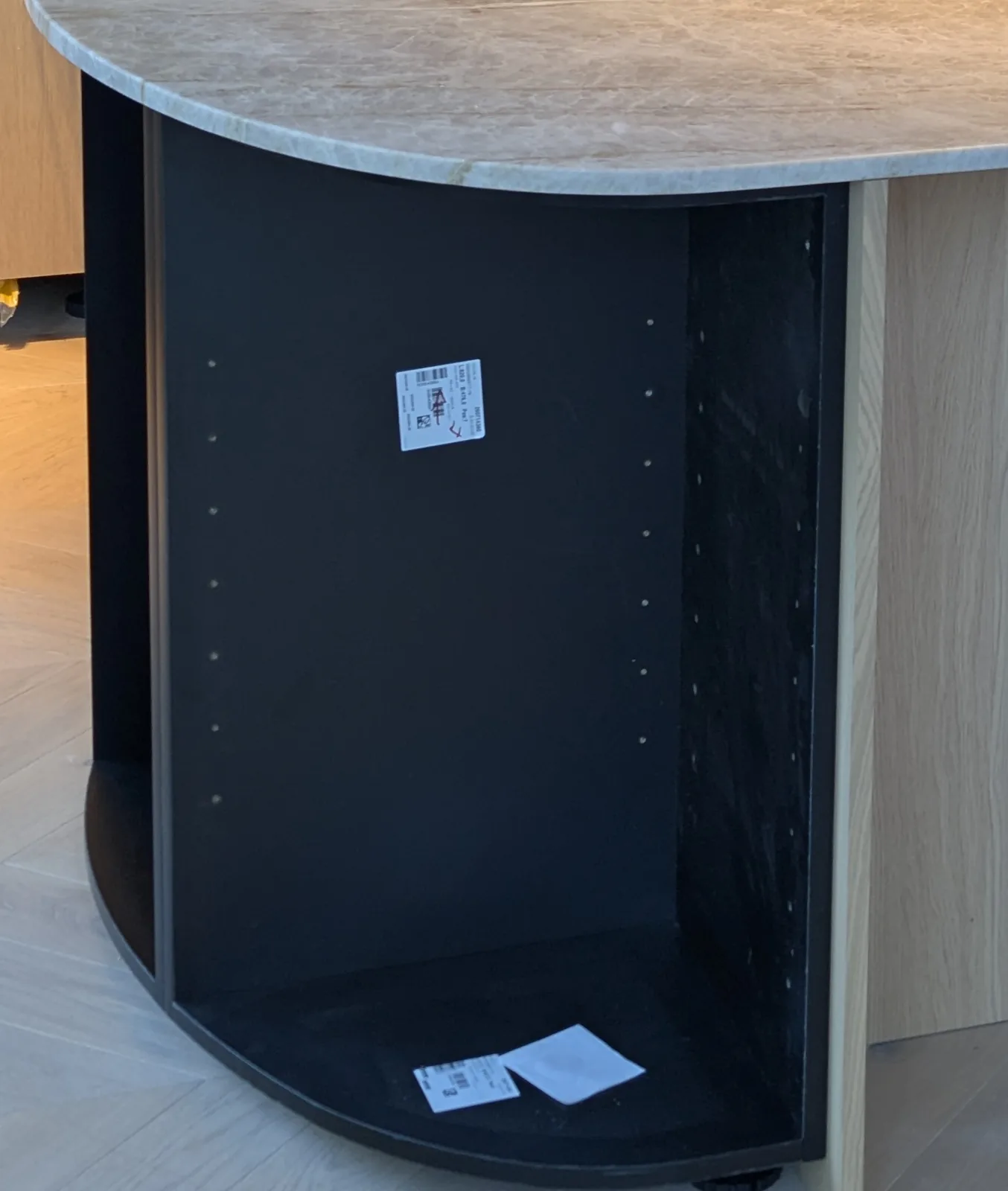
The mistake almost everyone makes: reading the offer by the front
The most common mistake when buying a kitchen is to read the offer by the front and the appliances and to skip the carcass line, even though it describes the component with 25 to 30 years of service life. In many offers it says only “carcass 16 mm, finish white” or “branded hardware”, without the board brand, emission class, board type or hardware model. The following checklist table couples each feature to its real consequence. It is brand-neutral and works for any offer, including one without us.
| Feature in the offer | How you recognise it | Real consequence if it is missing |
|---|---|---|
| Board brand and emission class | “Egger E1” or another maker with a class, not just “chipboard” | without a class, no documented emission; EU-wide legal limit since 6 August 2026: 0.062 mg/m³, Goldenes M 0.05 ppm |
| Board type | P2 (dry) or P3 (moisture-resistant) named, at least on the sink cabinet | P2 with an open edge swells under standing water; a sealed edge or P3 Hydro prevents it |
| Carcass thickness, separated by side and shelf | 18/19 mm sides (16 mm defensible on the sides), long shelves secured against bowing, made thicker or with a cross-connector | a 16 mm shelf across the full cabinet width bows under crockery over the years |
| Edging | ABS or plastic edging on all visible edges and all wet edges, not just the front | the open edge at the back of the sink cabinet is the entry point for moisture; the board swells from there |
| Back panel | grooved in and screwed, not stapled on | a stapled back panel lets the carcass go out of square when it is set up; the 3 mm gap becomes uneven |
| Pull-outs and hinges with a model | “Hettich AvanTech YOU, EN 15338 Level 3, 70 kg” instead of “branded hardware” | without a model, no tested cycle count, no load capacity, no reorderable type |
| Plinth feet with a load rating | model and kg per foot, for example Hettich Korrekt 450 kg | without a load rating you do not know whether the foot carries the carcass, its contents and a stone worktop |
| Wall unit suspension | an adjustable metal rail (height and tilt adjustable) | without a rail, no alignment and no load distribution across the cabinet width; EN 14749 is the standard that tests the static carcass |
What the carcass costs
At Kolev there is no carcass line with a surcharge: 18/19 mm Egger E1 throughout and the named hardware are part of the fixed price, and a kitchen starts from €14,999 incl. VAT, including planning, delivery and installation. On the market the carcass is rarely priced on its own, so it pays to compare via the checklist table rather than the bottom line: two offers with the same front and the same appliances can differ in the carcass by 10 or 30 years of service life without your seeing it in the total. A bargain price there means a new purchase after 15 years instead of a change of fronts. The cross-connector from Hettich lets a shelf carry even without a thicker board: it couples front, shelf and back panel, so that the shelf does not bow.
How we do it at Kolev
After 10 to 15 years of development, industrial modules are very good today and available in a huge range, but they do not give you full freedom in the room. That is why with us you plan your kitchen in 3D over several appointments. At Kolev every carcass is drawn throughout from 18/19 mm Egger E1, long and loaded shelves secured against bowing with a cross-connector from Hettich, drawers with a 16 mm board on Hettich AvanTech YOU. In the workshop drawing every board is listed with its thickness and every fitting with its model, not as “branded hardware”. The Manufaktur, our own production facility, cuts the parts in-house from the 3D site survey. The run ends with 3 to 5 mm of clearance to the wall, and the fronts sit with a 3 mm gap on an MDF carrier board. The workshop drawing is archived permanently: a shelf, a side or a second set of fronts can be remade even in 15 years, to the same carcass; the fronts, though, only as long as the finish is available. The workshop drawing lists the board brand, emission class, thickness and every hardware model by name. If you cannot find these details from a supplier, ask for them.
Frequently asked questions
Which carcass thickness is good for a kitchen?
18/19 mm is a good standard for sides, top and normal shelves. Long, loaded shelves need more stiffness, via a thicker board or a cross-connector against bowing, and in the drawer box 16 mm is enough because the runner carries the load. No standard prescribes a carcass thickness: DIN EN 1116 governs coordinating dimensions, not board thicknesses. What matters is the separation by side and shelf, not 16 versus 19 mm.
What does Egger E1 mean?
E1 is the emission class for formaldehyde to EN 13986 with a limit of 0.1 ppm. Since 2020 testing has been to DIN EN 16516 under stricter chamber conditions. Egger therefore calls its board E1E05, which in practice sits at about half the former emission. The RAL quality mark Goldenes M requires 0.05 ppm for box furniture, the same order of magnitude. Since 6 August 2026 an EU-wide limit of 0.062 mg/m³ has also applied to furniture and wood-based panels. Meeting it is mandatory, not a quality feature.
Is a 16 mm kitchen carcass bad?
No, not automatically: sides carry in compression, and a 16 mm drawer base is standard. 16 mm becomes critical for long horizontal shelves and for a sink cabinet without a sealed edge. Ask about the board type, the edging and the hardware model. These three lines say more than the millimetre figure.
Chipboard or MDF for the carcass?
With practically every maker the carcass is chipboard, with us Egger E1 of type P2. MDF belongs on the front. MDF stays dimensionally stable and carries Senosan Supermatt or Decospan Shinnoki at a 3 mm gap without warping, but in the carcass it brings no advantage.
Which standard governs the quality of kitchen furniture?
DIN 68930 (2025-07) tests the fitness for use of kitchen and bathroom furniture, DIN EN 14749 (2022-07) the safety of storage furniture and worktops, EN 15338 the pull-outs in Level 1 to 3 (Level 3 = 80,000 cycles) and DIN EN 1116 (2018-03) the coordinating dimensions of kitchen furniture and appliances. DIN 68935 is often cited but covers the coordinating dimensions of bathroom furniture. None of these standards assigns a service life in years.
How long does a kitchen carcass last?
A good carcass of 18/19 mm Egger E1 with named hardware lasts 25 to 30 years, a value from experience, not a figure from a standard. That is longer than fronts (15 to 20 years) and appliances (8 to 12 years). The carcass should therefore be able to carry a second set of fronts and a second generation of appliances.
Next step: the first consultation
If you have an offer on the table and want to know whether the carcass line says 16, 18 or 25 mm and which board material is behind it, then let’s talk. In the first consultation we look at your floor plan, your wishes and your budget, directly with the architect, 45 to 60 minutes, for Frankfurt and the Rhine-Main region.
And a piece of advice no kitchen studio likes to give: get three offers and compare them. We are one of them.