
The essentials in 1 minute
- In a handleless kitchen the fridge opens via a vertical recessed grip profile in the carcass beside the appliance, not via a handle or a recess in the door.
- You choose the fixed-door hinge with the appliance. Kolev simply screws the cabinet front onto it.
- Kolev prefers the fixed door to the sliding door, because the joints stay parallel.
- A built-in fridge needs 200 cm² of ventilation for intake and exhaust air, planned in the workshop drawing.
- A freestanding side-by-side breaks the handleless line. It fits integrated or framed with end panels.
 Rusi KolevArchitect & Founder
Real Estate Economist (ebs)
Questions in this guide 15
- Integrated, freestanding or side-by-side
- Opening a fridge without a handle: the profile sits beside the appliance, not on the door
- Fixed door: you choose it with the appliance
- Recess dimensions and the 200 cm² for air supply and exhaust
- Two doors, one joint
- Side-by-side: integrated with end panels or as a standalone unit
- The mistake: the wrong appliance in the handleless run
- What this costs
- How we do it at Kolev
- Frequently asked questions
- Next step: the first consultation
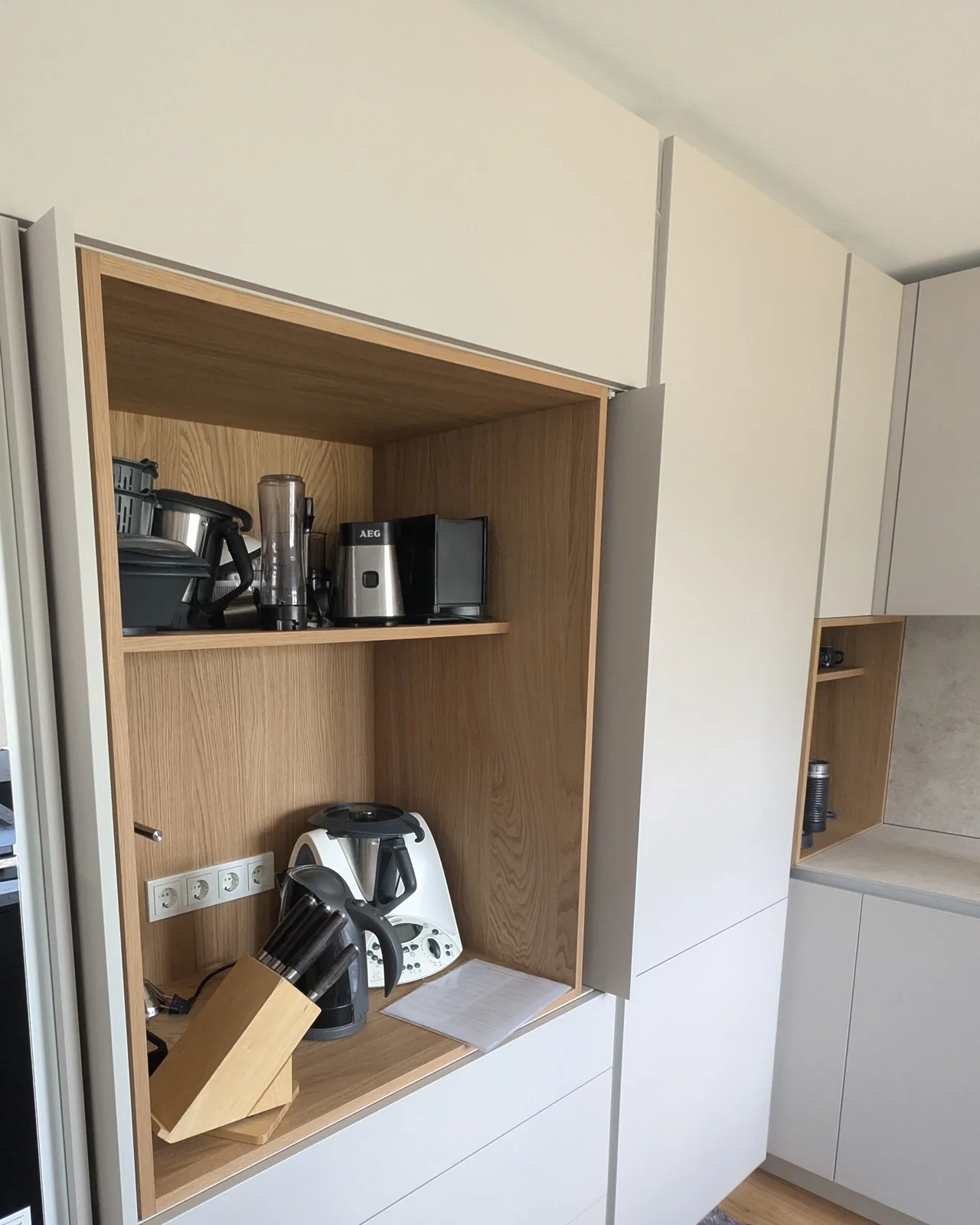
Integrated, freestanding or side-by-side
A built-in fridge differs from a freestanding appliance in the recess: the fully integrated fridge disappears flush behind a continuous cabinet front, the freestanding appliance remains a visible standalone unit, and the side-by-side is a particularly wide standalone unit, and at 70 to 90 cm a deep one too. In a handleless kitchen the look of the front counts first, then the right recess dimension.
| Criterion | Fully integrated (fixed door) | Freestanding | Side-by-side |
|---|---|---|---|
| Look of the handleless front | continuous cabinet front, flush | visible standalone unit, breaks the line | wide standalone unit, deep (70 to 90 cm) |
| Recess dimension | recess height 178/194, width 56 to 57 (some 194 models: 71 to 72), depth min. 55 | no recess | integrated in an XL recess or freestanding |
| Handleless opening | vertical recessed grip profile beside the appliance, door opens normally | handle on the standalone unit | handle on the standalone unit |
| Ventilation | 200 cm² at the plinth, supplies intake and exhaust air | appliance sides clear | appliance sides clear |
| Door / front mounting | fixed door (front weight per the appliance data sheet, 18/19 mm) | none | none (integrated: fixed door) |
| Water (dispenser) | rare | tank | fixed water supply (preparation) or tank |
| RRP range (market) | from approx. €300 into five figures | approx. €600 to €1,200 | approx. €900 to €3,000 |
Opening a fridge without a handle: the profile sits beside the appliance, not on the door
A handleless fridge door opens via a vertical recessed grip profile that sits in the carcass beside the appliance, not via a recess milled into the door: the profile stands behind the edge of the front. You reach behind it and pull the door open, exactly as on any other handleless front. The fridge front itself stays unmilled and runs quite normally on the appliance’s fixed-door hinge. A horizontal profile across the appliance door, by contrast, is not possible, because no horizontal carcass joint runs there. The profile always sits in the carcass, not on the door. The fridge does not need push-to-open for this, but that remains the solution for roughly one kitchen in ten, which is planned without a recessed grip and opens its fronts by push-to-open throughout. How the other fronts open without handles is covered in Handleless kitchen: recessed grip or handles.
Fixed door: you choose it with the appliance
With fixed-door mounting the cabinet front is rigidly connected to the appliance door and runs on the fridge’s fixed-door hinge. With sliding-door mounting a separate cabinet door hangs on hinges on the carcass and is coupled to the appliance door by sliding rails. You choose the fixed-door hinge with the appliance: on built-in fridges in the mid and upper price range it is standard. We do not fit this hinge. We plan the appliance that brings it and simply screw the cabinet front onto it. That keeps the joints parallel, and a heavy decorative front of 18/19 mm material is cleanly guided. How heavy the front may be is stated in the appliance data sheet and varies by Liebherr model; for the ECBNe 8872 it is 12 kg per door. We advise against the sliding door, because the cabinet door runs on two axes and the joints do not stay parallel; there the weight is carried by the carcass fitting. The 4 mm decorative panel belongs to a third system, the decor-ready appliance door, which we do not plan. Important for taking on existing appliances: the door mounting concerns only the cabinet front, not the question of whether an appliance fits the new kitchen at all.
Recess dimensions and the 200 cm² for air supply and exhaust
The built-in fridge is determined by the recess height, not by the appliance dimension: a fridge-freezer works to recess heights of 178 or 194 cm, a single fridge to 72, 88, 102, 122 or 140 cm, and the appliance itself is always slightly smaller than the recess. A 178 model such as the Liebherr IKBP 3554 measures 177.2 cm, and in the 194 XXL recess the appliance sits at about 193.5 cm. The recess width is 56 to 57 cm, 71 to 72 cm for the wide 194 models, and the depth at least 55 cm. What is decisive is the ventilation: a built-in fridge needs 200 cm² of ventilation cross-section, and this one value supplies both intake and exhaust air. The cool air is drawn in at the bottom of the plinth, and the compressor’s heat leaves the cabinet at the top through slots in the wall unit or a shadow gap. If this cross-section is missing, the heat builds up. That is why the order applies: first the recess dimension, then the appliance.
Two doors, one joint
With a fridge-freezer that has two appliance doors one above the other, we place the joint between the fridge and freezer sections exactly on the front line of the base units, so that a single 3 mm joint runs through the whole kitchen. That way no second, offset line appears at the fridge. This is pure planning in the workshop drawing and costs nothing extra.
Side-by-side: integrated with end panels or as a standalone unit
A freestanding side-by-side needs about 5 cm of air all round; it is precisely this surrounding gap that looks restless next to a handleless front and quickly reads as an American-style fridge. Whoever wants to hold the line has two ways: an appliance that can be integrated flush, or end panels in the front material that frame the standalone unit at the sides and visually close the 5 cm. That a side-by-side can sit flush is shown by the Liebherr ECBNe 8872: recess 203.2 to 207.2 x 91.5 x 63.5 cm, fixed door, 522 l usable capacity, RRP per Liebherr €6,999, as of September 2026. This figure is the manufacturer’s price of an example appliance, not a Kolev price.
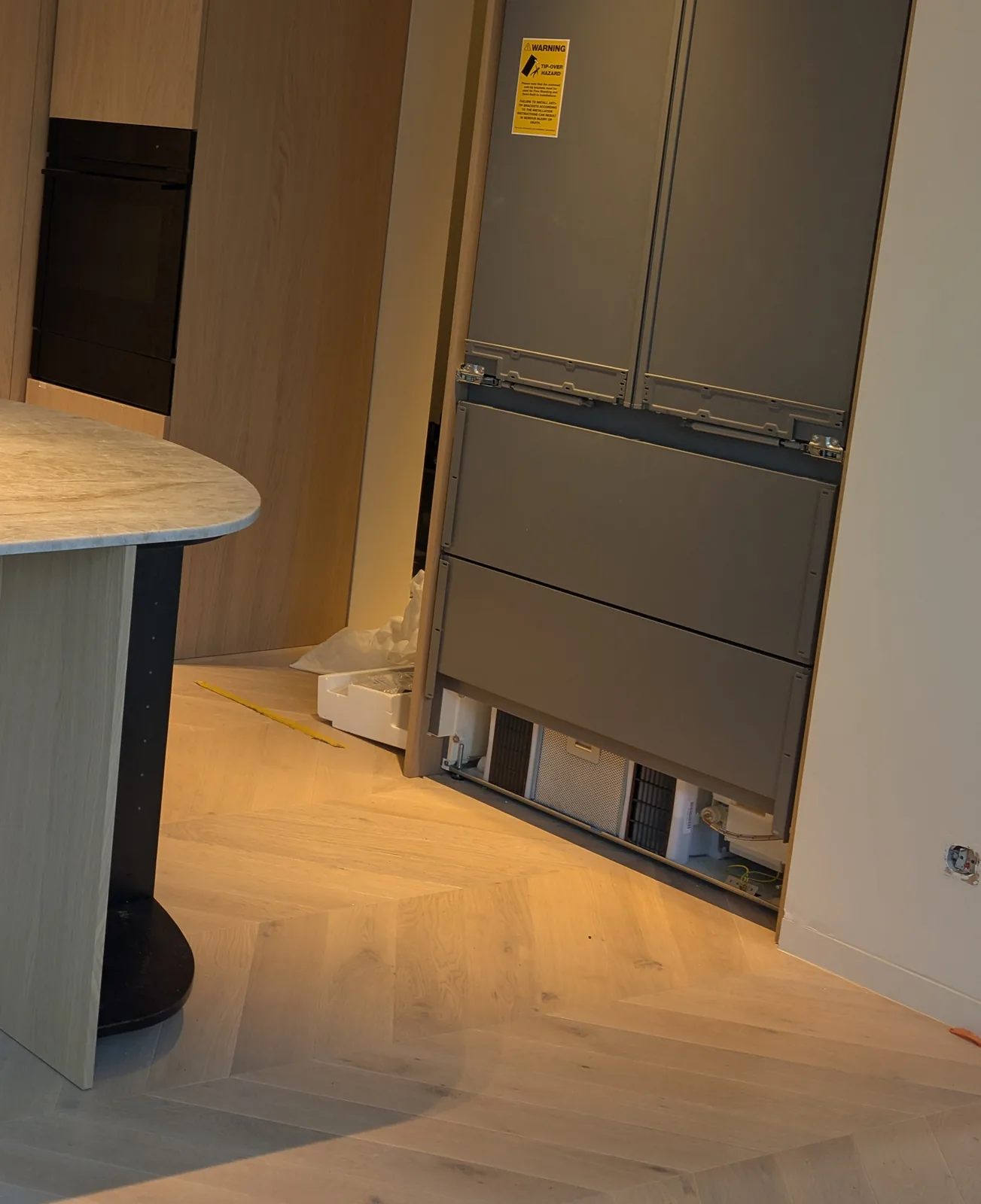
The mistake: the wrong appliance in the handleless run
The most common mistake is forcing a freestanding side-by-side into a handleless run of fronts, or forgetting the ventilation: a 90 cm wide standalone unit breaks the continuous line for which the handleless kitchen was planned, and a blocked ventilation cross-section below 200 cm² makes the compressor run longer and hotter, which costs electricity and service life. The second mistake is the old energy label: an A+++ on the scale before 2021 does not correspond to a present-day A, so the kWh value counts, not the letter.
What this costs
On the market, built-in fridges range from the fully integrated appliance from around €300 up into five figures, freestanding appliances lie between about €600 and €1,200, and a side-by-side between around €900 and €3,000. These ranges are a rough market orientation, not Kolev prices: new appliances we pass on at architect partner terms, without our own markup. The planning cost is decided less by the appliance than by the design: a fully integrated appliance with a fixed door needs the right cabinet front and the planned ventilation cross-section, and a side-by-side with a water dispenser also needs a prepared water pipe. The kitchen starts from €14,999 incl. 19% VAT, including planning, delivery and installation.
How we do it at Kolev
With us the fridge opens without a handle via the vertical recessed grip profile beside the appliance. The door runs on the fixed-door hinge that comes with the chosen appliance, and we simply screw the cabinet front onto it. A heavy decorative front of 18/19 mm material is cleanly guided this way, provided it stays within the front weight the appliance data sheet allows, and the joint runs at 3 mm parallel to the rest of the front. We use push-to-open at the fridge only in the few kitchens that are planned entirely without a recessed grip. The 200 cm² for intake and exhaust air are in the workshop drawing, so that the compressor gets the air it needs. Because the recesses are standardised across the industry, we also take on an existing built-in fridge, more on this under Fitting your own appliances. Water and power for a side-by-side dispenser we prepare, and the final connection is made by a licensed trade contractor. As built-in fridges, Liebherr, Miele, BORA and the brands of the BSH group (Bosch, Siemens, Neff) fit our planning well; new appliances we pass on at architect partner terms, without our own markup.
Frequently asked questions
How does a handleless integrated fridge open?
A handleless integrated fridge opens via a vertical recessed grip profile that sits in the carcass beside the appliance. The door runs quite normally on the appliance’s fixed-door hinge. There is no recess in the appliance door itself, because no horizontal carcass joint runs there. The profile always sits in the carcass, not on the door. The fridge does not need push-to-open for this; that remains the solution for the few kitchens planned entirely without a recessed grip.
What is the difference between a fixed door and a sliding door?
With the fixed door the cabinet front is rigidly screwed onto the appliance door and runs on the fridge’s fixed-door hinge, which comes with the appliance. With the sliding door a separate cabinet door hangs on hinges on the carcass and is coupled to the appliance door by sliding rails. We prefer the fixed door, because the joints stay parallel and a heavy decorative front within the front weight from the appliance data sheet is securely guided. We advise against the sliding door, because the cabinet door runs on two axes and the joints do not stay parallel; there the weight is carried by the carcass fitting. The 4 mm decorative panel belongs to a third system, the decor-ready appliance door, which we do not plan.
Does a side-by-side fit in a handleless kitchen?
A side-by-side fits if it is planned integrated in an XL recess or framed with end panels in the front material. A freestanding appliance, by contrast, needs about 5 cm of air all round and remains a visible standalone unit that interrupts the handleless run of fronts. If the appliance needs a water dispenser, we prepare water and power, and the final connection is made by a licensed trade contractor.
How tall does the recess for a fridge-freezer need to be?
A built-in fridge-freezer works to recess heights of 178 or 194 cm, a single fridge to 72, 88, 102, 122 or 140 cm. These values are recess heights, not the appliance dimensions. The appliance is always slightly smaller. As long as recess height, width and depth fit, an existing appliance can also be taken on; whether it carries a fixed door we check in advance.
Why does a built-in fridge need planned ventilation?
A built-in fridge draws cool air in at the bottom of the plinth and gives off the compressor’s heat at the top. For this it needs 200 cm² of ventilation cross-section, which supplies both intake and exhaust air. If this cross-section is blocked, the compressor runs longer and hotter, which raises the electricity consumption and shortens the service life. That is why the ventilation cross-section is in our workshop drawing.
Next step: the first consultation
If you would like to know how your fridge comes flush and handleless into the new front, then let’s talk. In the first consultation we look at your room, your appliances and your budget, directly with the architect, 45 to 60 minutes, for Frankfurt and the Rhine-Main region.
And a piece of advice no kitchen studio likes to give: get three offers and compare them. We are one of them.
Appliances without our own markup: Kitchen appliances. And how the fronts open without handles: Handleless kitchen: recessed grip or handles.