
The essentials in 1 minute
- Built-in appliances follow a common European grid of dimensions and therefore fit any new kitchen: a 60 cm oven stays a 60 cm oven, regardless of the brand.
- Exceptions are flush-mounted hobs, very old non-standard appliances and proprietary downdraught extractors.
- Kolev builds in your own appliances if they fit and are in good shape, and earns nothing on them.
- For a fridge, consumption decides: co2online puts the point for replacement at about 460 kWh a year.
- You almost always keep occasional-use appliances such as an oven, steam oven or microwave.
 Rusi KolevArchitect & Founder
Real Estate Economist (ebs)
Questions in this guide 12

Why existing built-in appliances fit a new kitchen
Built-in appliances are coordinated through a common European grid of dimensions: the cabinet recess and the appliance follow the same coordination dimensions. The standard EN 1116 describes this principle for kitchen furniture and built-in appliances, which is why a built-in appliance is defined by its recess class and not by the brand. A 60 cm oven is a 60 cm oven, whichever the manufacturer. The manufacturer gives the specific recess dimensions in the installation drawing, not the standard: a single oven needs, according to the manufacturer, a recess of around 595 x 560 x 550 mm, a 45 cm compact appliance around 450 x 560 x 550 mm.
| Appliance | Standard recess (per manufacturer) | Drop-in into the new kitchen | What to check | Saving |
|---|---|---|---|---|
| Oven 60 cm | Recess ~595 x 560 x 550 mm, 230 V | yes | seal, connection | full price of a new one, usually keep |
| Compact appliance 45 cm (steam oven, combi microwave) | Recess ~450 x 560 x 550 mm | yes | seal, water if applicable | full price of a new one, usually keep |
| Dishwasher 60 / 45 cm | Recess 815 x 600 x 550 mm (45 cm: 450 wide), 230 V + water | yes, new cabinet front, appliance stays | consumption, seal, waste | consumption decides |
| Built-in fridge-freezer | Recess height 178 / 194 cm | yes, as long as the recess is planned | consumption (kWh/yr), door mounting | consumption decides |
| Surface-mounted hob 60 cm | Cut-out ~560 x 490 mm, 400 V | yes | connection, worktop thickness | full price of a new one |
| Flush-mounted hob | identical cut-out size needed | no, only an identical model | cut-out size, worktop | usually a new worktop needed |
| Downdraught extractor / hob extractor | proprietary, no grid | no | not applicable | not transferable |
What can be reused without further ado
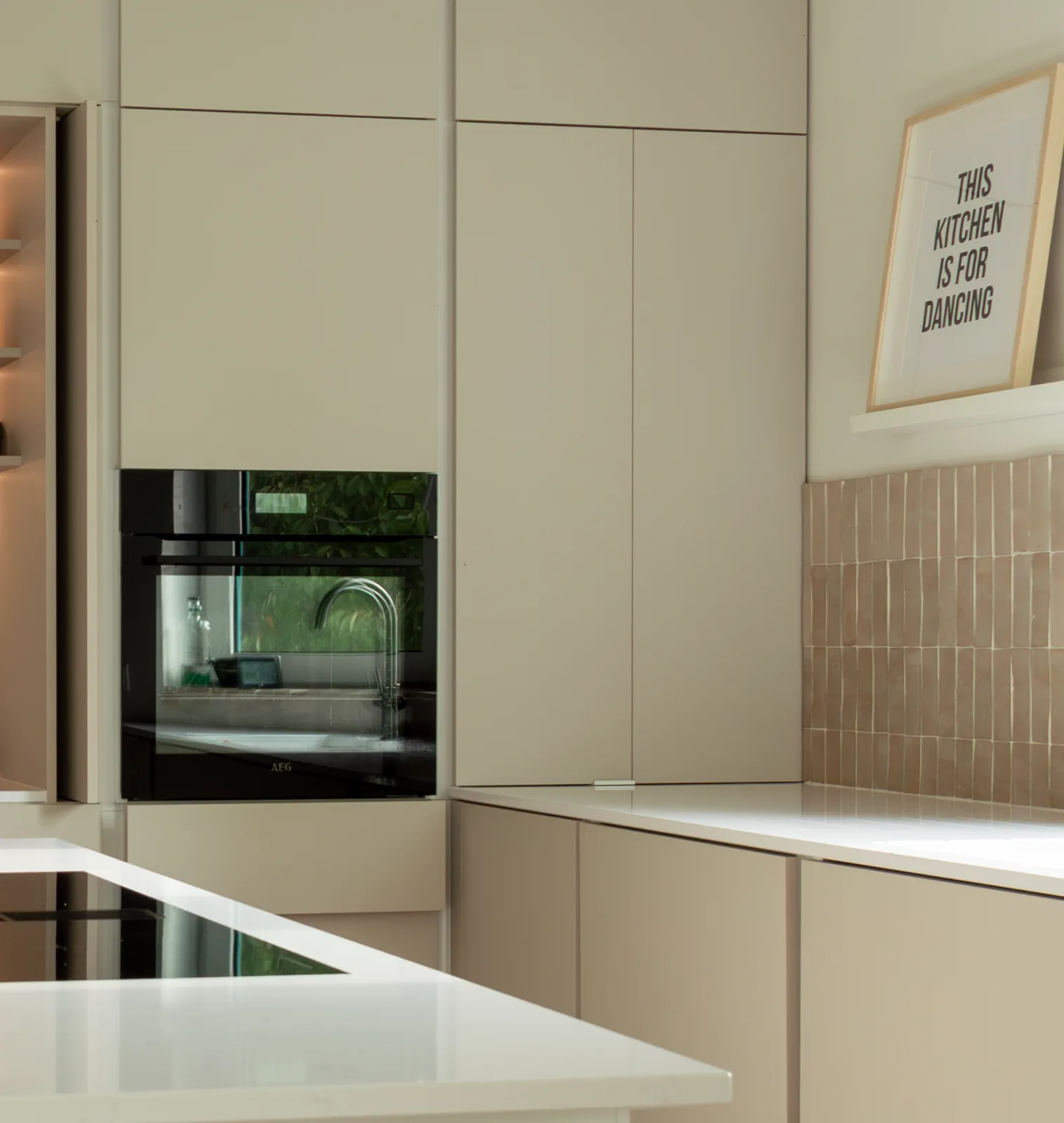
Oven, steam oven, dishwasher, solo microwave, surface-mounted hobs and built-in refrigeration can as a rule be reused, as long as the recess is provided for in the new plan. With a dishwasher the appliance stays, only the cabinet front is remade and screwed on. A single oven moves into its 595 recess in a tall unit, where it sits ergonomically correct at working height. More on that under appliance wall and installation height. With built-in refrigeration, the door mounting, that is fixed-door or sliding-door, decides only the cabinet front and not whether it can be reused. The detail is set out under fridge in a handleless kitchen.
The three exceptions
Three types of appliance are not readily transferable: flush-mounted hobs, very old or non-standard appliances and proprietary downdraught extractors. A flush-mounted hob sits in a precisely milled rebate and can only be replaced by a model with an identical cut-out size. Otherwise a new solid-material worktop becomes due. Which hob is drop-in-capable is set out under induction or gas. Very old appliances from the time before today’s grid of dimensions often do not fit a standard recess, and a downdraught extractor is built to be manufacturer-specific, with no common grid for it. A free-standing side-by-side appliance without a recess is not a built-in appliance and stays a piece of furniture that is planned around.
The honest check: age and consumption
The most important check with appliances that run around the clock is power consumption: according to co2online, an old fridge, for example from 2002, uses up to 330 kWh a year, a new one of the best class 90 to 125 kWh. According to co2online, a replacement is worth it from about 460 kWh a year for a fridge and above about 560 kWh for a fridge-freezer. The letter on the old label is no help here: the EU energy label was rescaled in 2021 (A to G). An old A+++ does not equal a new A, which is why the kWh figure counts and not the class. The consumer advice centre recommends measuring for seven days with an electricity meter. Also to be checked are the door seal, the connected loads and the remaining warranty under the statutory provisions. For refrigeration and dishwashers, spare parts must be available for 7 to 10 years after the last sale under the EU Ecodesign Regulation, delivered within 15 working days. For ovens and hobs there is no such obligation as yet, and here the manufacturer’s spare-parts policy counts. The honest dividing line: replace an around-the-clock appliance with high old consumption, keep an occasional-use appliance such as an oven, steam oven or microwave almost always. At around 30 cents per kilowatt-hour, an old fridge-freezer then costs about €100 to €125 of electricity a year, a new one around €30 to €40. The difference adds up over the years and is exactly the reason to replace an old around-the-clock appliance.
The mistake: new appliances when the old ones fit
Many kitchen studios sell new appliances along with the kitchen, even though the existing ones fit the new kitchen to standard: that is one of the most common mistakes when buying a kitchen. We earn nothing on your appliances, so we advise keeping whatever fits technically and needs no replacement on energy grounds. A two-year-old Miele oven has no energy case for replacement. It belongs in the new kitchen and not on the bulky-waste pile. Which other mistakes belong to buying a kitchen is set out in the 12 Kitchen-Buying Mistakes guide.
How we do it at Kolev
We earn nothing on your appliances, so the recommendation is free: whatever fits to standard and makes sense on energy grounds, we fit without our own markup. The connected loads are in the electrical and plumbing plan that you hand to your plumber as preparation: 400 V three-phase for a self-contained induction hob, 230 V for oven and dishwasher, water and waste for the dishwasher. The final connection is made by a licensed trade contractor. If you want a new appliance, you get it at architect partner terms, without our own markup, and the offer lists the existing and the new appliances separately. Our kitchens start from €14,999 incl. 19% VAT, including planning, delivery and installation; whether an old appliance stays or goes changes nothing about it, because the decision hangs on consumption and not on our margin.
In practice, about half of our customers bring an appliance of their own, usually a good oven or a fridge-freezer that they want to keep, and that is completely fine with us. If you buy your appliances yourself and even carry them to the site for us, we do not say no, we say thank you. Every appliance that is in good shape and that you trust simply keeps working in the new kitchen: it saves us backache, and it leaves you budget for the ceramic worktop you may already have your eye on.
Frequently asked questions
Can I fit my old oven into the new kitchen?
Yes, as long as it is a built-in appliance in an EU standard size, that is, it needs a recess of around 595 x 560 x 550 mm, the door seal is tight and the 230 V connection is right. An oven is an occasional-use appliance and almost never has an energy case for replacement. We set it at working height in a tall unit, not under the worktop.
Does every built-in fridge fit every recess?
No, the recess height is what counts. A fridge-freezer runs to recess heights of 178 or 194 cm, a single fridge to 72, 88, 102, 122 or 140 cm. These figures are recess heights, not the appliance dimensions, and the appliance itself is a little smaller in each case. As long as the matching recess height is planned, the existing appliance is reused.
Is it worth keeping a 15-year-old appliance?
With an around-the-clock appliance such as the fridge, consumption decides: according to co2online, a replacement is worth it from about 460 kWh a year, and for a fridge-freezer above about 560 kWh. An occasional-use appliance such as an oven or steam oven, by contrast, you almost always keep.
Can I reuse a flush-mounted hob?
Only if the replacement model has exactly the same cut-out size, because the rebate in the worktop is milled to the old appliance to the millimetre. If the size does not match, a new solid-material worktop becomes due. A surface-mounted hob with a surrounding frame, by contrast, is no problem and can be reused.
Can I still get spare parts for an older appliance?
For refrigeration and dishwashers, yes: under the EU Ecodesign Regulations, spare parts must be available for 7 to 10 years after the last sale, delivered within 15 working days. For ovens and hobs there is no such obligation as yet. Here the manufacturer’s spare-parts policy counts.
Next step: the first consultation
If you would like to know which of your appliances move into the new kitchen and which are no longer worth it, let’s talk. In the first consultation we look at your room, your appliances and your budget, directly with the architect, 45 to 60 minutes, for Frankfurt and the Rhine-Main region.
And a piece of advice no kitchen studio likes to give: get three offers and compare them. We are one of them.
Appliances without our own markup: kitchen appliances. And the right height for oven and steam oven: appliance wall and installation height.