
The essentials in 1 minute
- A single damaged kitchen front is about €200 in material value.
- The finish decides: if it is still available, a single front comes in 6 to 14 weeks.
- If the finish is discontinued, the whole row or the fronts are replaced, from around €3,000 incl. VAT.
- A finish is typically discontinued after 5 to 8 years.
- Kolev promises no finish forever, but archives the workshop drawing and says openly when one is phased out.
 Rusi KolevArchitect & Founder
Real Estate Economist (ebs)
Questions in this guide 12

What replacing a kitchen front costs
Replacing a single kitchen front, what most people search for as replacement kitchen doors, is about €200 in material value, but what you pay in the end is decided by a single question: is the front’s finish still available? The table below separates the three cases that occur in practice by cost, delivery time and precondition. Only the first allows a single front to be replaced.
| Case | Cost | Delivery time | Precondition |
|---|---|---|---|
| Finish still available | a single front, about €200 in material value per front plus production and travel | 6 to 14 weeks | archived workshop drawing with the cut and build-up, surface still in the supplier’s range |
| Finish discontinued (typically after 5 to 8 years) | replace the visible row of fronts as one, or a planned mix of materials, from around €3,000 | 6 to 14 weeks | a colour-matched single front is no longer possible, hence a whole-row or contrast solution |
| Another firm’s kitchen (a front for a kitchen not built by Kolev) | we do not offer this | not applicable | A new Maßküche (made-to-measure kitchen) is the better value, a better route than re-fronting another firm’s carcass. |
The delivery time of 6 to 14 weeks applies to a replacement front, not to a new kitchen, and depends on the finish, the surface and the supplier’s workload. What a complete kitchen costs is in the guide the cost of an Architektenküche. A kitchen with us starts from €14,999 incl. VAT.
Why the finish decides the price
Whether a front costs €200 or €3,000 depends on the finish, and finishes have a short life cycle: Egger runs its Dekorativ 26+ collection as a rolling collection that is updated at least every two years, and guarantees new finishes for a minimum of four years only. This discontinuation affects every Manufaktur, us included: finish suppliers such as Senosan and Decospan update their surfaces and take individual finishes out of the range after some years. What the permanently archived workshop drawing secures is the exact cut and build-up, that is the dimensions, edge and construction of a front, not the lasting availability of the surface. Which surfaces last how long, and how foil, lacquer, Supermatt and veneer differ, is in the guide kitchen fronts compared.
When the finish is still available
If the finish is still available, the Manufaktur remakes a single replacement front from the archived workshop drawing, matched in colour and size, with a delivery time of 6 to 14 weeks. With foil fronts in particular it pays to act early: the foil often lifts from the fifth year at the edges and near appliances, later depending on the version, and as long as the matching finish is still in the range then, it stays a single-front replacement. The replacement itself takes only minutes. The time is in the production, not the fitting. The precondition is always both: an archived cut and a surface that still exists.
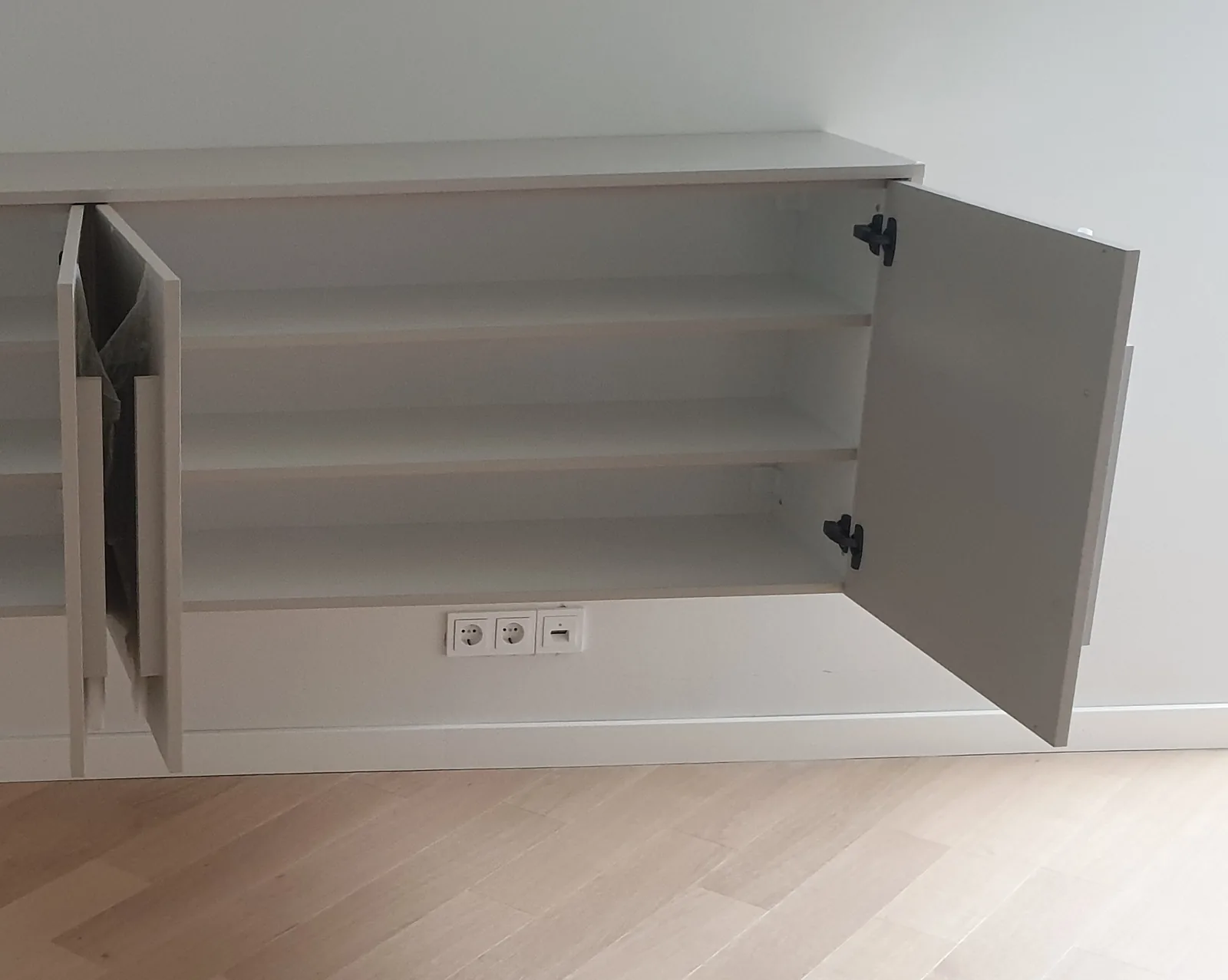
When the finish is discontinued
If the finish is discontinued, a single front can no longer be fitted in matching colour and texture, and the replacement becomes replacing the whole row, or the fronts, from around €3,000. There are then two honest routes. The first replaces a whole visible row of fronts as one, so that all the fronts come from a single batch again and a colour difference does not sit between two neighbours. The second sets a deliberately contrasting front or a different material alongside, a planned mix of materials rather than a failed colour match. A single front reordered from a new batch next to twelve old ones almost never hits the tone exactly. That is not poor production but the nature of discontinued finishes.
The mistake almost everyone makes
The most common mistake when buying a kitchen is to choose the finish by its looks and not by who remakes that one front in eight years. In the 12 Kitchen-Buying Mistakes guide it is mistake number 8. So the right question when buying is not “which finish?” but “is the cut archived, and how long will this surface stay available?”. A supplier without an archived workshop drawing cannot remake even a still-available front to size. A supplier with an archive can, as long as the finish is in the range. The two together, the archive and honest information about availability, are worth more than a promise that keeps a finish available forever.
A second mistake sits behind the front: in a 20 cm wide base pull-out larder, the metal runners were simply made and the connection between the front and the pull-out was plastic. When a child stepped onto the open pull-out, that connection broke and the edge of the front was damaged. The narrow pull-out was designed for light loads such as spices, not for the 70 kg of the Hettich AvanTech YOU we usually fit, which would not even have noticed the child. Nobody likes replacing cheap mechanisms, and the price difference to a solid one is now smaller than the travel costs for the repair.
How we do it at Kolev
At Kolev the workshop drawing for every kitchen stays archived permanently, with the cut, build-up, edge and every fitting by Hettich, Blum and Kesseböhmer, so that a single front can be remade as long as the surface is available. What we do not promise is a finish forever. What we secure is the exact cut and an honest word when a surface is being phased out, together with the two honest routes, replacing the whole row or a mix of materials. The fronts sit on an MDF carrier board and fit the same carcass, which lasts 25 to 30 years. Why the carcass is the longest-lasting component is in the guide Kitchen carcass: material and thickness. We do not make a front for a kitchen that we did not build. On one of our own kitchens a single replacement front is a small item: about €200 in material value plus CNC cutting and edgebanding, and if it happens to coincide with another job or goes in with a bulk order, sometimes even without charge; a whole-row replacement starts at around €3,000.
Frequently asked questions
What does it cost to replace a single kitchen front?
A single replacement front is about €200 in material value, plus production and travel. The precondition is that the cut is archived and the finish is still available. If the finish is discontinued, the replacement becomes replacing the whole row, or the fronts, from around €3,000.
How long does a replacement front take?
A replacement front comes in 6 to 14 weeks, depending on the finish, the surface and the supplier’s workload. This delivery time applies to a single front, not to a new kitchen. Fitting the finished front takes only minutes.
Why does a reordered front sometimes not match in colour?
Finishes have a short life cycle: Egger updates its Dekorativ 26+ collection at least every two years and guarantees new finishes for a minimum of four years only. When a finish is phased out, the new front comes from a different batch and rarely hits the old tone exactly. Then replacing the whole row as one, or a deliberate mix of materials, are the honest routes.
Can a foil front be repaired?
No, lifted foil cannot be repaired. Only the whole front can be replaced, and only as long as the finish is available. Foil often lifts from the fifth year at the edges and near appliances, later depending on the version. If the finish is discontinued by then, replacing the whole row remains.
What does the archived workshop drawing secure, and what does it not?
The workshop drawing secures the exact cut and the build-up of a front, that is the dimensions, edge and construction, so that it can be remade to size. What it does not secure is the lasting availability of the surface. Finishes are discontinued by the suppliers after some years. As long as the finish is in the range, a single front can be remade; after that, replacing the whole row or a mix of materials remains.
Next step: the first consultation
If you want to know whether a damaged front can be replaced on its own or whether replacing the whole row is due, then let’s talk. In the first consultation we look at your kitchen, your wishes and your budget, directly with the architect, 45 to 60 minutes, for Frankfurt and the Rhine-Main region.
And a piece of advice no kitchen studio likes to give: get three offers and compare them. We are one of them.