
The essentials in 1 minute
- With a sink, the fitting decides more than the material: an inset sink fits any worktop, an undermount or flush-mounted one needs a solid-material slab.
- With stone and ceramic slabs undermount is standard: no rim joint forms to scale up and grow mould.
- There is no joint at all when the basin is milled from the same slab as the worktop.
- The cut-out size comes from the manufacturer’s drawing and goes into the workshop drawing to the millimetre.
- Stainless steel is the most robust, SILGRANIT the most colour-stable, and ceramic looks the most high-quality.
 Rusi KolevArchitect & Founder
Real Estate Economist (ebs)
Questions in this guide 12

Modern sinks: the materials compared
Four materials shape the market for modern sinks: stainless steel, composite (Blanco calls its through-coloured blend of quartz and acrylic SILGRANIT), ceramic, and natural stone or Dekton from the slab material. Each material has a typical fitting, its own behaviour with scratches and heat, and its own price position on the market.
| Material | typical fitting | scratches, stains, heat | care | RRP entry (market) |
|---|---|---|---|---|
| Stainless steel (satin, brushed, PVD) | inset or undermount | the most robust, heat and stains no problem, shows water marks and fine scratches | easy, insulating mat against the tinny sound | cheap only as inset, undermount from approx. €300 |
| Composite (quartz blend, e.g. SILGRANIT) | inset or undermount | through-coloured and colour-stable, SILGRANIT up to 280 °C per Blanco (brand-dependent), dark tones show limescale more | Blanco DailyClean+, metal marks with a little oil | from approx. €200 |
| Ceramic | inset or undermount (around 20 kg, support needed) | glazed, heat-resistant, prone to chipping at edge and corner | easy, sealed, stain-resistant | from approx. €300 |
| Natural stone or Dekton from the slab | from the slab material (0 mm) | stain- and heat-resistant on the surface, prone to thermal shock at the thin edge | seamless, easy to wipe | part of the slab fabrication, no separate basin price |
Stainless steel is the most robust choice, but it is only cheap as an inset sink, and it loses out on looks, because it shows water marks and fine scratches. Blanco SILGRANIT withstands up to 280 °C briefly according to the manufacturer, Schock CRISTADUR up to 180 °C per the manufacturer. There is no blanket composite figure, because the recipe varies by brand. Ceramic is the most high-quality in appearance, but weighs around 20 kg and is prone to chipping at the edge and corner, where a support belongs under the sink.
The fitting decides more than the material
The fitting of a sink decides the joint, the cleaning and the look more than the material itself, and not every fitting suits every worktop. An inset sink rests on its rim and works on any worktop, including laminate or compact laminate. An undermount sink sits beneath the worktop and needs a solid-material worktop of stone, composite, glass or stainless steel, never wood or chipboard, because the chipboard core draws in water at the open cut edge and swells. With ceramic and stone slabs the undermount is the standard. Flush-mounted, the sink sits in a precise rebate at the same height as the worktop, which requires a waterproof, dimensionally accurate solid-material worktop. Cut from the slab material is the most consistent solution: here the basin is worked from the same slab and there is no joint left at all, which is only possible with solid material such as ceramic, Dekton or natural stone from factory fabrication. Which worktop carries which fitting is set out under ceramic and Dekton from the slab. Which of the three worktop types suits your budget and everyday life is shown by the decision fork under worktop: material and cost. The test standard EN 13310 governs only the function of the sink, namely drainage, temperature change, loading and chemical resistance, not the fitting dimension. The exact cut-out size comes from the manufacturer’s installation drawing and moves into the workshop drawing to the millimetre.
Scratches, stains, heat and care by material
Scratches, stains and heat affect each sink material differently. Stainless steel shrugs off hot pots and the acids in coffee, tea or lemon, but in everyday use shows water marks and fine scratches. An insulating mat underneath takes away the tinny sound. Composite is through-coloured and therefore colour-stable, a scratch exposes no other colour; in dark tones, though, SILGRANIT shows limescale more clearly in hard water, and Blanco DailyClean+, plus a little oil for metal marks, keeps the surface in shape. Ceramic is glazed, sealed and stain-resistant, but forgives no knock on the edge. Natural stone and Dekton from the slab are stain- and heat-resistant on the surface. At a thin, milled basin edge, thermal shock remains the only nuance, which is why the material thickness is taken into account there in the workshop drawing.
The most common mistake when buying a sink
The most common mistake when buying a sink is an inset sink where an undermount would be possible: over the years the surrounding rim joint between sink edge and worktop scales up, greys and grows mould, exactly the joint that an undermount or a milled solution never lets form in the first place. The second mistake is a material that does not suit the worktop, such as a heavy ceramic sink without a support, or a dark composite sink in a region with very hard water, where the limescale stands out. In an existing kitchen with a laminate-on-chipboard worktop, by the way, an undermount cannot be retrofitted, because the chipboard core swells. The honest swap route is then a new inset sink into the existing cut-out, and the biggest quality lever without a new cut-out is the tap.
What modern sinks cost
Modern sinks cost very differently depending on the material and the fitting: on the market, cheap sinks only come as inset sinks; an undermount sink starts at around €300, stainless steel included; composite sinks start from around €200, ceramic sinks from around €300. A sink from the slab material has no separate appliance price of its own: it is part of the slab fabrication, whose cost per metre is set out under ceramic and Dekton from the slab. These ranges are market guide values for the material class, not a model price. Which sink ends up in your kitchen depends on the worktop and the site survey. The free cost calculator lists the sink cut-out in ceramic as its own line.
How we do it at Kolev
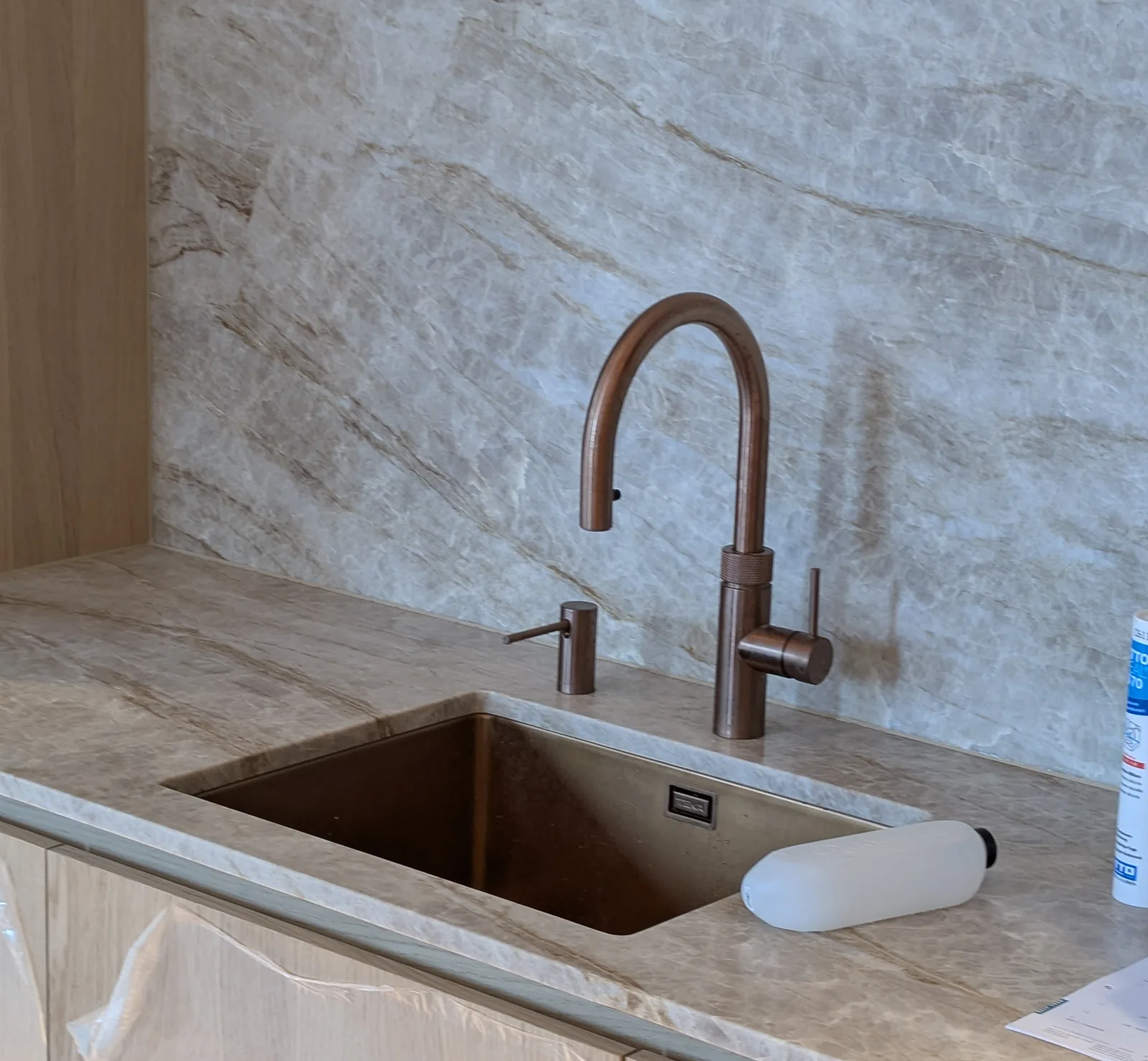
At Kolev we plan the sink and the worktop from one site survey, so that basin, cut-out and joint fit together. Our standard is the Blanco range for the sink, at architect partner terms, without our own markup. Where the worktop allows it, we build the sink as an undermount or have it made at the factory from the slab material, in the same material as the worktop, so that the scale-prone rim joint disappears entirely; that runs through our stone partner. The cut-out is set out in the workshop drawing to the millimetre, the function is tested to EN 13310, the fitting dimension comes from the manufacturer’s installation drawing. Personally, of late our favourite is to plan the natural stone Taj Mahal with a sink and a tap in a copper tone to go with it, a very special combination, which does however need a client who will still find it beautiful in ten years’ time. Our kitchens start from €14,999 incl. 19% VAT, including planning, delivery and installation. Whichever sink and fitting you choose changes nothing about our neutrality, because we earn nothing on the recommendation.
Frequently asked questions
Undermount or inset: which is better?
Undermount is the standard with stone and ceramic slabs, because the sink sits beneath the worktop and no surrounding rim joint forms to scale up and grow mould. The inset sink stays right when the worktop is not solid material, such as laminate on chipboard, because there the rim covers the cut edge and protects the core from water. The most joint-free option is a sink cut from the slab material.
Which sink material is the easiest to care for?
Stainless steel and ceramic are the easiest to care for, because both are sealed and stain-resistant. Stainless steel, however, shows water marks and fine scratches. Composite such as Blanco SILGRANIT is through-coloured and colour-stable. In dark tones it shows limescale more in hard water and occasionally wants Blanco DailyClean+. Reaching often for a microfibre cloth keeps any of the four material classes in shape.
Can I fit a sink flush-mounted in any worktop?
No, flush-mounted and undermount only work on a waterproof solid-material worktop of stone, ceramic, Dekton, glass, engineered stone or stainless steel. A laminate worktop on chipboard is unsuitable for it, because the chipboard core draws in water at the open cut edge and swells. On a worktop like that, the inset sink is the right choice.
Does a composite sink withstand hot pots?
Blanco SILGRANIT withstands up to 280 °C briefly according to the manufacturer, Schock CRISTADUR up to 180 °C per the manufacturer. There is no universally valid figure for all composite sinks, because the recipe differs by brand. Ceramic is heat-resistant too, stainless steel in any case. Anyone who regularly sets down very hot pots should check the manufacturer’s figure for the specific range.
Can I get a sink made from the slab material?
Yes, from a solid-material worktop such as ceramic, Dekton or natural stone the basin can be milled from the same slab. The result is seamless and looks all of a piece. This requires factory fabrication and an exact site survey and is part of the slab fabrication, whose cost per metre is set out under ceramic and Dekton from the slab. In an existing laminate kitchen this cannot be retrofitted.
Next step: the first consultation
If you would like to know which sink and which fitting suit your worktop and your everyday life, let’s talk. In the first consultation we look at your room, your wishes and your budget, directly with the architect, 45 to 60 minutes, for Frankfurt and the Rhine-Main region.
And a piece of advice no kitchen studio likes to give: get three offers and compare them. We are one of them.
More on the water zone: Quooker or tap. A sink from the slab material: ceramic and Dekton from the slab. Appliances without our own markup: kitchen appliances.