
The essentials in 1 minute
- A ceramic worktop from Kolev costs around €3,000 to €7,500 incl. VAT, complete with cut-outs, edges, delivery and fitting, depending on length and island.
- The free cost calculator below works out your complete price, item by item.
- Dekton, Neolith and Laminam are brands of the same material, sintered stone.
- The 1,200°C is only the sintering temperature. You may set a hot pot down without a trivet.
- Cracks almost always start at the cut-out: a matter of fabrication and fitting, not of the material.
 Rusi KolevArchitect & Founder
Real Estate Economist (ebs)
Questions in this guide 16
- Cost calculator: what will your ceramic worktop cost?
- What ceramic, sintered stone and Dekton actually are
- Heat: the 1,200°C myth
- Thermal shock at the cut-out edge: the real caveat
- Thickness, slab size and overhang
- Dekton or ceramic: what is the difference?
- Ceramic, granite or quartz: in brief
- What a ceramic worktop costs
- When ceramic is not the right choice
- How we do it at Kolev
- Frequently asked questions
- Next step: the first consultation
Cost calculator: what will your ceramic worktop cost?
12 mm ceramic. All prices incl. 19% VAT.
plus items on request
Guide price incl. delivery and fitting. We work out the fixed price after the site survey.

What ceramic, sintered stone and Dekton actually are
Ceramic, sintered stone, Dekton, Neolith and Laminam all name a single material category: clay, feldspar, quartz and mineral oxides are pressed under high pressure into a raw slab, sintered at around 1,200°C and then calibrated to an exact thickness. In sintering, the mineral grains fuse into a practically non-porous mass with no resin as a binder. That is what gives the material its resistance to heat, stains and UV light. Dekton is the brand from Cosentino in Spain, Neolith comes from TheSize, also Spain, and Laminam from Italy. Anyone who asks whether you want “ceramic or Dekton” is asking about the brand, not the material.
| Brand | Manufacturer | Thickness for worktops | Max. slab format | Notable |
|---|---|---|---|---|
| Dekton | Cosentino (ES) | 12 or 20 mm (also 8 and 30; 4 mm as a separate slim line) | 320 x 144 cm | wide range of finishes |
| Neolith | TheSize (ES) | 12 or 20 mm (also 3, 6) | 320 x 160 cm (also 320 x 150 and 360 x 120) | 16 cm more width than Dekton, helps with deep islands |
| Laminam | Laminam (IT) | 12+ (12.5 mm) or 20+ (20.5 mm); 3 and 5.8 mm (Laminam 3 and 5) only on a supporting base | 324 x 162 cm | “+” = fibreglass mesh on the underside |
Heat: the 1,200°C myth
The 1,200°C is the sintering temperature in manufacture. In everyday use it is no benchmark, and you may set a hot pot down without a trivet. A pot and a pan can go straight from the hob onto the slab, because there is no resin in it that could discolour or melt. With quartz composite, by contrast, the resin discolours under heat. Anyone who sells you “withstands 1,200°C” is confusing the kiln with the kitchen.
Thermal shock at the cut-out edge: the real caveat
Cracks in ceramic worktops almost always start at the hob or sink cut-out, not in the surface. There the load-bearing surface is interrupted, stress concentrates at a sharp internal corner, and if the cut-out is not supported around its full perimeter, or the hob expands against the ceramic as it heats with no gap, a stress crack can form. Laminam names missing support explicitly in its Technical Guide as a cause of hairline cracks. This is not a material failure but a matter of fabrication and fitting. It is solved like this: internal corners at the cut-out rounded, never 90 degrees; the radius the corner gets is set by the appliance or sink manufacturer, so that the appliance fits and no stress cracks form, about 5 mm for BORA, 20 mm for Blanco, and this radius is at or above the slab material’s minimum of 5 mm for Dekton, Neolith and Laminam, with Neolith explicitly recommending larger radii because they make the slab stiffer; the cut edge is polished or chamfered by at least 2 mm, so that no micro-cracks from sawing remain; the hob sits with a thermal gap of at least 2 mm to the ceramic, so that the glass can expand without pressing on the edge; the cut-out is supported from below around its full perimeter and sits at least 50 mm from the slab edge. These four points belong in the workshop drawing. This is where the specialist firm parts ways with the DIY store.
Thickness, slab size and overhang
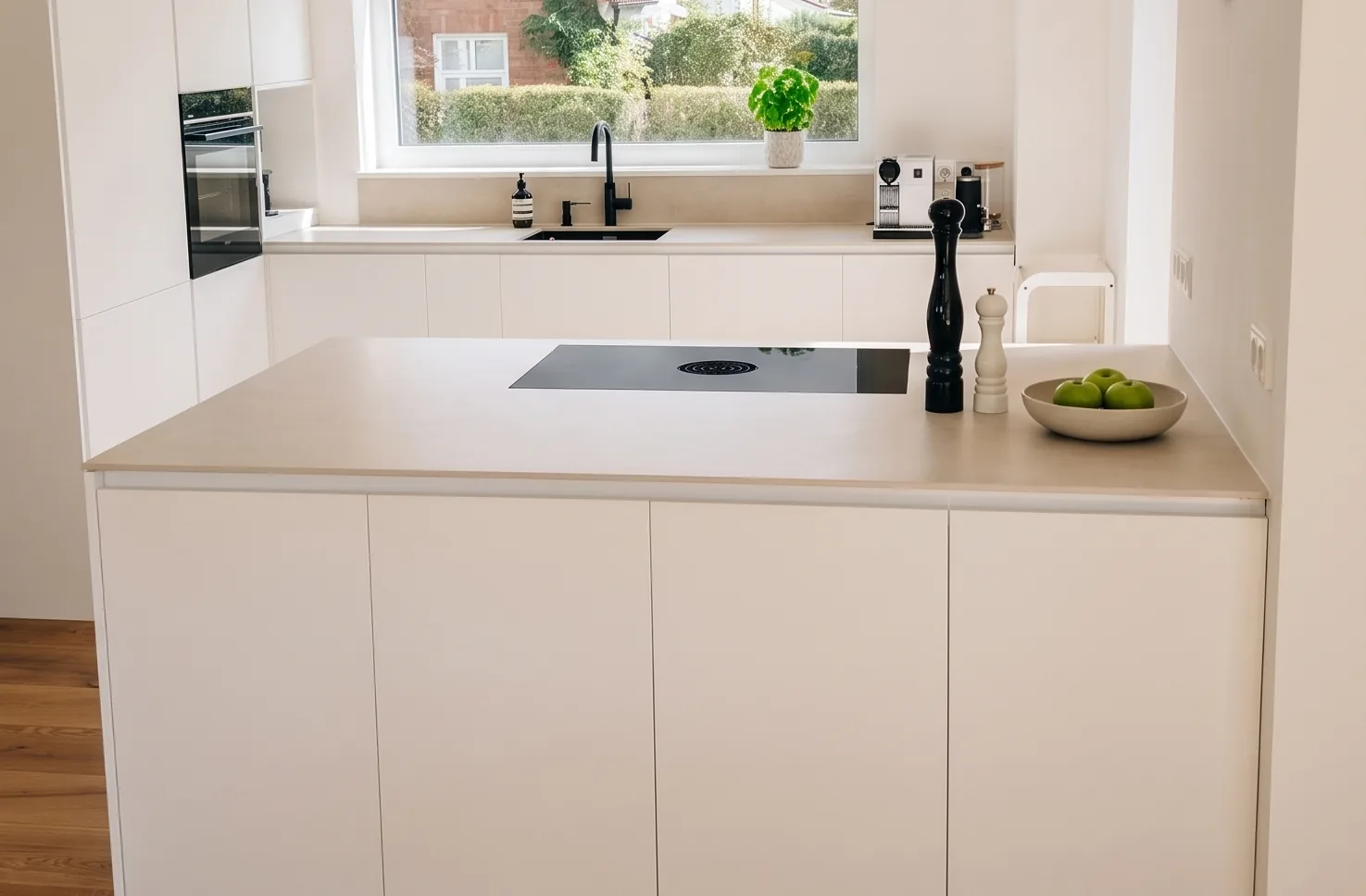
For worktops, 12 or 20 mm is standard; 3 to 6 mm only works on a supporting base. 12 mm looks delicate, but it is rigid in bending and impact-sensitive: at the cut-out and the overhang the slab needs a load-bearing substructure. Laminam sets the rule down in its Technical Guide: steel profiles or cross-members with a support spacing of no more than 1,200 mm and a cut-out supported around its full perimeter, otherwise hairline cracks threaten. With us that means a continuous load-bearing substructure of 18/19 mm Egger E1 or a steel cross-member, and a seating overhang from about 30 cm always gets steel. 20 mm is far less critical structurally and carries an overhang of up to about 30 cm with no additional substructure, but weighs more for it. The visible cut edge gets, with us, a 45-degree chamfer on the top 2 to 3 mm or so, rounded on request, so that the thin edge does not stay sharp. Anyone who wants the solid look without the weight takes the mitre: slab and edge strip are cut at a 45-degree angle and bonded, with a reinforcement behind, and 12 mm becomes a visible edge of usually 3 to 8 cm. The slab size sets the second limit: Dekton ends at 320 cm, a longer run gets a joint, and where it lies is decided in the 3D site survey, not on site. The structural detail is in the guide to the slim 12 mm worktop, the joint position in the guide to made-to-measure work. With us, ceramic is 12 mm with a load-bearing substructure more than half the time. We take 20 mm when the chosen colour is only available in 20 mm.
Dekton or ceramic: what is the difference?
There is none: Dekton is a ceramic brand from Cosentino, just like Neolith and Laminam. The differences between the three brands lie in the range of finishes, in the slab format with a width of 144, 160 or 162 cm, in the surface and in the price, not in the material. A manufacturer’s assurance belongs in the comparison all the same: Neolith gives a 25-year guarantee on 12 and 20 mm worktops if the slab is registered soon after purchase (Neolith documents give a period of 60 days to 6 months). Our experience with Dekton after years in use: knives and pots leave no marks, red wine and lemon none either, but the edge is the only place where a falling cast-iron pot can do damage. Alongside Dekton we also fit our stone partner’s own line: the same class of material, straight from the factory without a brand name and so without the surcharge for the brand, in Limburg for example in the Piedra Jura finish.
Ceramic, granite or quartz: in brief
Ceramic is the most scratch-resistant of the three materials and the only one without resin and without sealing. The Mohs 6 to 8 hardness is a trade figure: the manufacturers themselves test to abrasion and flexural-strength standards, not to Mohs.
| Material | Heat in use | Scratches | Care | Outdoors |
|---|---|---|---|---|
| Ceramic / sintered stone | high, pot straight on | Mohs 6 to 8 (trade figure) | water, washing-up liquid | yes, UV-stable |
| Granite | high, pot straight on | high, below ceramic | seal per the manufacturer’s instructions, water-drop test; 30 mm weighs ~80 kg/m² | yes |
| Quartz composite | resin heat-sensitive, a trivet is essential | high, below ceramic | no sealing | no, the resin yellows |
Granite wins if you want a one-off in natural stone. The next step in the series covers that. Quartz we tend to advise against: it loses on exactly the three points, heat, UV and stains, where ceramic wins.
What a ceramic worktop costs
Fabricated and fitted, ceramic costs €350 to €900 per linear metre at 60 cm depth on the German market, including cutting to size, edges, cut-outs, delivery and fitting. Three figures circulate online for the same material, because they measure different things: the raw slab at the block in €/m², the fabricated and fitted slab in €/linear metre, and the surcharges for an island, a mitred edge, several cut-outs and a premium finish that push the upper end. Only the second figure belongs in an offer.
At Kolev our stone partner fabricates, delivers and fits the worktop on our behalf. We remain your contract partner and carry the warranty. A complete ceramic slab therefore comes to around €3,000 incl. VAT for a simple straight run and about €7,500 for a large kitchen with an island, a splashback and a high-end finish. With 12 mm Dekton with an island and a mitre, the price per metre reaches the upper end of the market range. It appears as a separate line item in the offer. The kitchen itself starts at €14,999 incl. VAT including planning, delivery and installation. The slab is added, by every supplier, even where it is hidden in the catalogue price.
When ceramic is not the right choice
If you want a flush-mounted hob and an undermount sink, but not €3,000 or more for the slab, take a compact laminate from Fundermax: 12 mm solid core, no swelling core, complete with us at around €1,500 to €1,900 incl. VAT, fitting included, a compromise on heat at about 180°C briefly. If the budget allows the step up, take ceramic. Our part then is mainly making sure that colour and pattern suit the rest of the kitchen. If you want the grain of a real stone, you only get it with granite or marble. Which of the three solid-material slabs, compact laminate, ceramic or natural stone, suits your budget is settled by the decision fork in the guide Which worktop: comparison and cost. We name the residual risk of ceramic too: a hard blow to the outer or cut-out edge can chip, and in transport the thin slab breaks more readily than in use. That is why ceramic is set exclusively by a specialist firm.
How we do it at Kolev
The slab is drawn from the 3D site survey: cut-outs with rounded internal corners to the appliance or sink manufacturer’s specification, at least to the slab’s own minimum of 5 mm, polished cut edges, a hob with a thermal gap of at least 2 mm, a cut-out at least 50 mm from the slab edge, a continuous load-bearing substructure of 18/19 mm Egger E1, a steel cross-member with a support spacing of no more than 1,200 mm to support the cut-out and for seating overhangs beyond about 30 cm, no steel under an overhang of up to 30 cm, a joint from 3.2 m in length placed where it interferes least in the workshop drawing. The carcass comes from our Manufaktur, our own production facility, the slab from our stone partner, fitted on our behalf. The warranty under the statutory provisions stays with us. The stone partner fits the stone slab after a second site survey, usually about two weeks after the cabinet installation. Until then we put temporary worktops in place. A compact laminate we fit ourselves. The splashback comes from the same slab, seamless, with socket cut-outs from the electrical plan. How that works is in the guide to the splashback. How this looks in a real floor plan is shown by the renovation in Frankfurt.
Frequently asked questions
Dekton or ceramic: which is better?
Both are the same material. Dekton is Cosentino’s brand name for sintered ceramic, and Neolith and Laminam are the two other big brands. Decide by finish, slab format (Dekton 320 x 144, Neolith 320 x 160 or 320 x 150, Laminam 324 x 162 cm) and price, not by the word in the brochure.
What is the real-world experience with Dekton worktops?
On the surface, Dekton is unchanged after years: no scratches from knives, no stains from wine or lemon, no discolouration from hot pots. Complaints almost always concern the cut-out, and there a sharp 90-degree internal corner, an unpolished cut edge, a hob without a thermal gap or a cut-out without support around its full perimeter. That is a question of fabrication, not of the material.
What does a ceramic worktop cost per metre?
Fabricated and fitted, €350 to €900 per linear metre at 60 cm depth. Raw-slab prices in €/m² are a different unit and include neither cutting to size nor edges, cut-outs or fitting. At Kolev the complete slab costs around €3,000 to €7,500 incl. VAT, depending on length, island and finish, made through our stone partner.
Can a ceramic worktop break or scratch?
Scratch practically not, the trade figure of Mohs 6 to 8 is above granite and quartz. It can break in two places: at the cut-out through stress, when the thin edge is made without a radius, without a polished cut edge, without a thermal gap to the hob or without support around its full perimeter, and at an outer edge through a hard blow. Both are a question of the workshop drawing and the fitting.
How do you care for a ceramic worktop?
With water and a mild washing-up liquid. Ceramic is non-porous, acid-resistant and needs no sealing. Vinegar, lemon and red wine do no harm. A trivet is not essential, but a good habit at joints and at the cut-out edge.
Next step: the first consultation
If you would like to know whether ceramic or compact laminate suits your budget and your kitchen, then let’s talk. In the first consultation we look at your floor plan, your wishes and your budget, directly with the architect, 45 to 60 minutes, for Frankfurt and the Rhine-Main region.
And a piece of advice no kitchen studio likes to give: get three offers and compare them. We are one of them.
A made-to-measure worktop is part of a bigger whole: made-to-measure kitchen.