
The essentials in 1 minute
- A granite worktop, fabricated and fitted, costs around €250 to €600 per linear metre.
- Granite is slightly open-pored and is sealed per the manufacturer’s instructions, tested with a drop of water.
- Granite takes a hot pot directly, because it contains no resin that could discolour.
- Natural stone at Kolev is usually 20 mm thick and, because of its weight, needs a load-bearing base.
- You choose the actual raw slab, not a finish; its grain exists nowhere else.
 Rusi KolevArchitect & Founder
Real Estate Economist (ebs)
Questions in this guide 16
- What defines a granite worktop: natural stone and a one-off
- You choose the slab, not the finish
- Open pore, closed pore: granite, quartzite, marble
- Sealing: per the manufacturer's instructions, tested with a drop of water
- Heat, scratches and weight: where granite is strong
- What a granite worktop costs
- When granite is not the right choice
- How we do it at Kolev
- Frequently asked questions
- Next step: the first consultation
It is the right material for a genuine one-off in natural stone.

What defines a granite worktop: natural stone and a one-off
A granite worktop is solid natural stone, with us usually 20 mm thick and thus around 54 kg/m² in weight, 30 mm on request. Every slab is a one-off: the grain does not repeat, because the stone is grown and not printed. Granite forms over millions of years from cooled magma. Colour and marking depend on the site and cannot be reproduced. That is the emotional reason to buy and at the same time the most important consequence for planning, which the next section deals with. By contrast, ceramic, also called sintered stone, is a material fired industrially at around 1,200°C, whose finish can be reordered as long as it is in the range. Dekton is the brand from Cosentino, Neolith comes from TheSize, Laminam from Italy, and all three are brands of the same material. Comparing the three materials of the upper segment: granite €250 to €600 per linear metre, seal per the manufacturer’s instructions, pot straight on; quartz composite €250 to €700, no sealing, but heat-sensitive; ceramic €350 to €900, non-porous, pot straight on.
| Material | Heat in use | Scratches | Care (sealing) | Stains | € per linear metre | Outdoors / UV |
|---|---|---|---|---|---|---|
| Granite (natural stone) | high, pot straight on | very hard | seal per the manufacturer’s instructions, water-drop test | open-pored, pale stone more sensitive | €250 to €600 | yes, UV-stable |
| Quartz composite (e.g. Silestone) | resin heat-sensitive, a trivet is essential | hard | no sealing | easy to clean, the resin partly stain-sensitive | €250 to €700 | no, the resin yellows |
| Ceramic / sintered stone (Dekton, Neolith, Laminam) | high, pot straight on | extreme, knife-proof | no sealing, non-porous | non-porous, acid-resistant | €350 to €900 | yes, UV-stable |
You choose the slab, not the finish
With natural stone you choose the actual raw slab, not a finish. That exact slab is the one installed, and its grain exists nowhere else. Granite is grown stone and not a printed finish, so even a second slab from the same deposit differs in grain and colour. The most common misconception is the expectation that the delivered slab will look exactly like a small hand sample from the showroom. The clean solution is to select the actual raw slab at our stone partner’s warehouse, and that is the one installed. That is also why a damaged natural-stone slab can never be remade to match: a replacement is always a new, distinct slab. With ceramic it is different. There the finish can be reordered as long as it is in the range.
Open pore, closed pore: granite, quartzite, marble
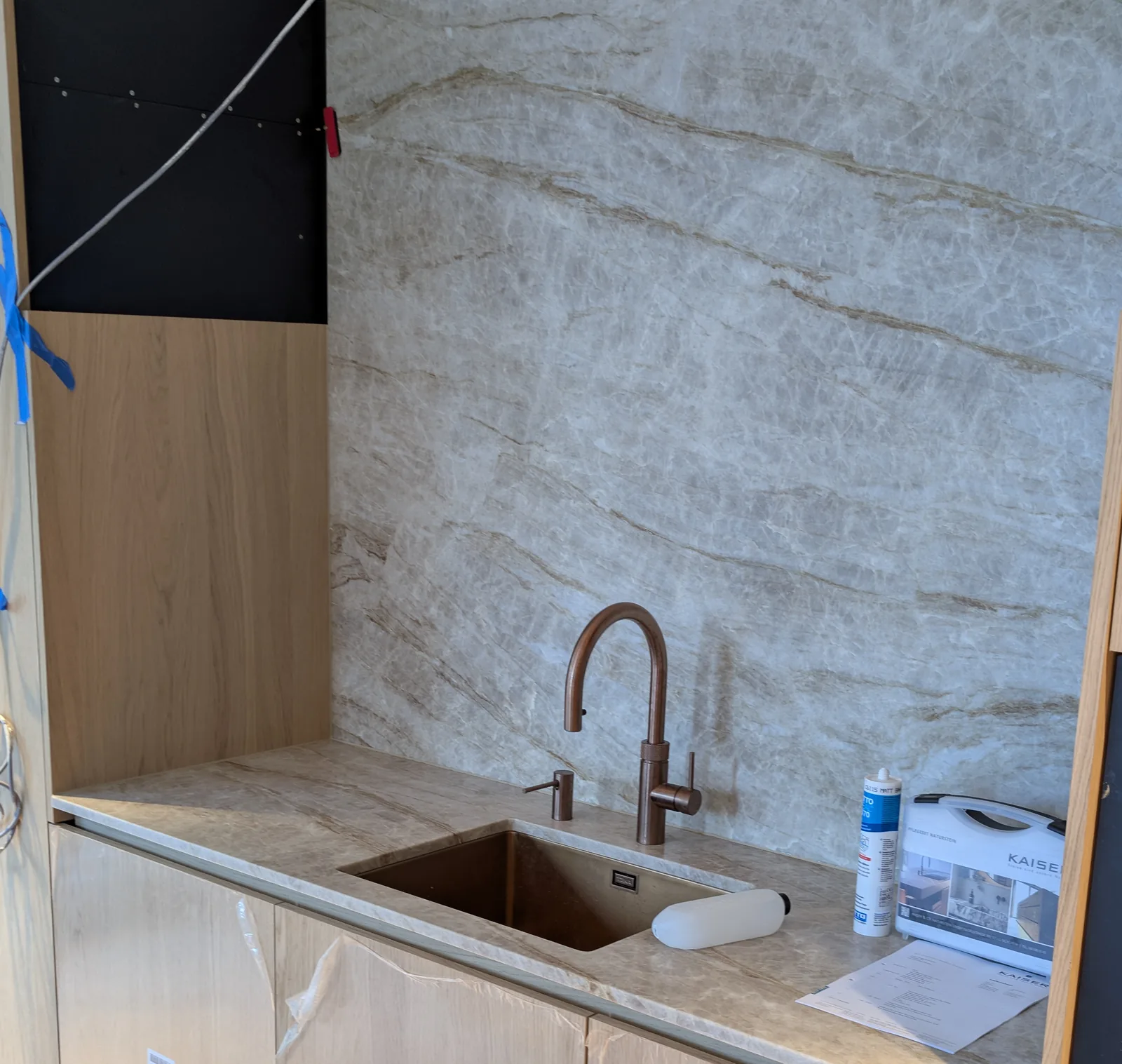
With natural stone the pore decides the care: pale, open-pored granite needs sealing the most often, a dense quartzite like Taj Mahal takes up hardly any water and needs it rarely, and marble is calcareous and acid-sensitive, against which no sealing helps. Pale, open-pored granite most readily takes on oil, grease or colour stains as long as the seal is not fresh, and needs the protection most often. Marble sits at the other end: it is calcareous and acid-sensitive, lemon or vinegar leave matt rings in the polish, and no sealing helps against that. It is only worth it for someone who consciously accepts that etching as a patina. Granite itself, unlike marble, is largely acid-resistant, so lemon, vinegar and wine do not etch it.
In one of our projects the choice fell on Taj Mahal, a dense quartzite: a genuine natural stone that takes up hardly any water and rarely needs sealing. The clients wanted exactly that warm, living grain that no printed finish quite reaches, and still say today how glad they are of the real stone.
Sealing: per the manufacturer’s instructions, tested with a drop of water
How often natural stone is sealed is told by the drop of water, not the calendar: if it beads up, the protection is intact; if it soaks in and the stone darkens, resealing is due, per the manufacturer’s instructions. Sealing means: a penetrating stain protection sinks into the pores without forming a visible film, the stone stays breathable and keeps its feel. A topical film sealer, by contrast, lays a film on top, changes the feel and is mostly unsuitable in a food area. Pale, more open-pored granite needs the protection more often than darker, denser stone or a dense quartzite. Ceramic takes this cycle off your hands entirely, because it is non-porous, and that is the central difference in everyday use.
Heat, scratches and weight: where granite is strong
Granite takes a hot pot straight off the hob without a trivet, is very hard against scratches and weighs, in our standard thickness of 20 mm, around 54 kg/m². On heat, granite plays to its natural-stone strength: it contains no synthetic resin that could discolour or melt, so a hot pot leaves no marks. Quartz composite, by contrast, binds the quartz in synthetic resin, which discolours under heat, so a trivet is essential. Ceramic also takes a hot pot directly. Against scratches granite is very hard, but stays below knife-proof ceramic. The weight is the practical price: around 54 kg/m² need a stable, load-bearing base, and in transport and setting the slab takes several hands. The 30 mm made on request weighs around 80 kg/m².
What a granite worktop costs
A granite worktop, fabricated and fitted, costs around €250 to €600 per linear metre at 60 cm depth, including cutting to size, edges, cut-outs, delivery and fitting. At Kolev natural stone starts at around €200 per linear metre; at the top the chosen stone sets the price. Three figures circulate online for granite, because they measure different things: the raw-slab price of the whole slab in euros per square metre, the price per metre of the fabricated slab, and the price per metre of the fabricated and fitted slab including edges and cut-outs. Only the third figure belongs in an offer, because otherwise processing, the edge profile and every cut-out are added on top of the raw slab. For comparison: ceramic, fabricated and fitted, is €350 to €900 per linear metre, a complete ceramic kitchen slab at Kolev around €3,000 to €7,500 incl. VAT. In the project with the Taj Mahal the real stone was around 20% above the ceramic in the same finish, but a manageable extra in relation to the whole worktop price. At Kolev we pass the stone slab on to you without our own markup: our stone partner fabricates, delivers and fits it on our behalf, and we make nothing on the stone itself. We remain your contract partner and carry the warranty. The kitchen itself starts at €14,999 incl. VAT including planning, delivery and installation. The worktop is added by every supplier, even where it is hidden in the catalogue price. What the whole kitchen, an architect-designed kitchen, costs is in the guide Cost of an Architektenküche.
When granite is not the right choice
Granite is not the right choice if you want an easy-to-clean, stain-resistant and UV-stable surface with no sealing cycle at all. Then ceramic, with its non-porous €350 to €900 per metre, is the more fitting material. If you do not strictly need the natural-stone feel but want a surface that demands neither a trivet nor sealing and does not yellow in the sun either, you will rest easier with ceramic. If, on the other hand, you are after exactly the grown, unmistakable one-off and understand the care as part of a natural material, granite is right for you. And if you are planning a kitchen under €15,000, natural stone is rarely the first job on the list. In the end it is usually a question of budget and of how long the worktop is meant to stay. For a kitchen that stays for 20 years, I would personally find a way to pay the extra for ceramic. The free ceramic cost calculator shows how big it is for you.
How we do it at Kolev
We offer natural stone at Kolev Architektenküchen by project only, because every slab is a one-off and is selected via the raw slab at our stone partner’s warehouse. The carcass comes from our Manufaktur, our own production facility, the granite slab from our stone partner, fitted on our behalf; the warranty under the statutory provisions stays with us. Our contribution is not the price on the stone but the precision before it: from the 3D site survey comes a workshop drawing with the position of every cut-out edge, every edge profile and, where the run runs longer than the slab format, the joint, which lies where it interferes least. That way the heavy slab fits at the first setting, with no reworking of the grown surface. How the materials of a slab compare in detail is in the guide Which worktop: comparison and cost. The technically best choice, ceramic, is covered by the guide Ceramic worktop.
Frequently asked questions
What does a granite worktop cost per metre?
Fabricated and fitted, €250 to €600 per linear metre at 60 cm depth, including cutting to size, edges, cut-outs and fitting. Raw-slab prices in euros per square metre are below that, but include neither processing nor edges, cut-outs or fitting. At Kolev the slab runs through our stone partner without our own markup.
Does granite have to be sealed?
Yes. Granite is slightly open-pored and is sealed per the manufacturer’s instructions, tested with a drop of water: if water beads up, the protection is intact; if it soaks in, resealing is due. Pale, open-pored stone needs it more often than dark, dense stone. Ceramic and quartz composite need no sealing. Marble is acid-sensitive on top of that, and no sealing helps against that.
Granite or ceramic: which is better?
That depends on the care. Granite is a genuine natural-stone one-off, heat-resistant and acid-resistant, but has to be sealed and weighs around 54 kg/m² in 20 mm. Ceramic is non-porous, knife-proof and lower-maintenance, but an industrial, reorderable material. If you shy away from care, take ceramic; if you want the grown one-off, take granite.
Is quartzite lower-maintenance than granite?
Usually yes. A dense quartzite like Taj Mahal takes up hardly any water and needs sealing less often than pale, open-pored granite. But it remains natural stone and is tested per the manufacturer’s instructions, with a drop of water. If you want to live with no sealing at all, take ceramic.
Is granite heat-resistant?
Yes, a hot pot may be set down directly, because granite contains no resin that could discolour. Quartz composite, by contrast, discolours under heat and needs a trivet. Ceramic also takes a hot pot directly.
How heavy is a granite worktop?
Around 54 kg/m² in 20 mm thickness, our standard thickness for natural stone; 30 mm made on request weighs around 80 kg/m². That is why granite needs a stable, load-bearing base and several hands when setting it. A slim 12 mm slab in granite barely exists; there, ceramic and solid-core HPL compact laminate are the lighter materials.
Does granite stain?
Pale, more open-pored granite can take on oil and colour stains as long as the seal is not fresh. Dark, dense stone is less sensitive. Against acid, granite, unlike marble, is largely insensitive, so lemon and vinegar do not etch it.
Next step: the first consultation
If you would like to know whether granite, ceramic or compact laminate suits your kitchen and your budget, then let’s talk. In the first consultation we look at your floor plan, your wishes and your budget, directly with the architect, 45 to 60 minutes, for Frankfurt and the Rhine-Main region.
And a piece of advice no kitchen studio likes to give: get three offers and compare them. We are one of them.
A made-to-measure worktop is part of a bigger whole: made-to-measure kitchen.