
The essentials in 1 minute
- What a kitchen worktop costs follows the material and the work involved, not the catalogue.
- On the market a fitted metre costs, incl. VAT: laminate €40 to €150, compact laminate €150 to €500, ceramic €350 to €900.
- A flush-mounted hob or an undermount sink needs a solid material. Laminate on chipboard is ruled out.
- Compare fitted prices only: raw-slab prices leave out edges, cut-outs and fitting.
- Settle the hob and the sink first, then the material that carries them.
 Rusi KolevArchitect & Founder
Real Estate Economist (ebs)
Questions in this guide 13
- What makes up the cost of a worktop
- Laminate or compact laminate: when the solid core is worth the extra
- Granite, quartz composite or ceramic: the three stone slabs
- The mistake almost everyone makes: comparing prices per metre that measure different things
- Kitchen worktop: price per metre, and what it includes
- Compact laminate, ceramic or natural stone: how to decide
- How we do it at Kolev
- Frequently asked questions
- Next step: the first consultation

What makes up the cost of a worktop
A kitchen worktop is costed by the linear metre at 60 cm depth, and the price per metre holds three things: material, fabrication (cutting to size, edges, cut-outs for sink and hob) and fitting. The cost websites mix these three levels, which is why you find prices for the same material that differ by several times over. The table therefore quotes the finished, fitted slab throughout.
| Material | Market range €/linear metre (incl. VAT, 60 cm deep, fabricated and fitted) | Scratches | Heat | Stains / care | Thickness | Made to measure |
|---|---|---|---|---|---|---|
| Laminate on chipboard | €40 to €150 | low to medium | briefly to about 180°C | chipboard core swells with water at edge and cut-out | 38 mm | flush-mounted no, undermount sink no |
| Compact laminate (solid-core HPL, Fundermax) | about €150 to €500 | high, impact-resistant | briefly to about 180°C, a glowing pan only on a trivet | low-porosity, acid-resistant, easy to clean | 12 mm | yes, to the millimetre, flush-mounted and undermount |
| Granite (natural stone) | about €250 to €600 | very hard | high | porous, seal per the manufacturer’s instructions, water-drop test | 20 to 40 mm, 20 mm with us | yes; around 54 kg/m² at 20 mm |
| Quartz composite (e.g. Silestone) | about €250 to €700 | hard | the resin discolours under heat, a trivet is essential | easy to clean, the resin partly stain- and UV-sensitive | 12 to 30 mm, typically 20 mm | yes |
| Ceramic / sintered stone (Dekton, Neolith, Laminam) | €350 to €900 | extreme, knife-proof | high, pot straight on | non-porous, no sealing, UV-stable | 12 or 20 mm | yes, seamless; a joint from 3.2 m in length |
| Marble (natural stone) | €300 to €800 | soft, delicate | high, but acid-sensitive | care-intensive, seal | about 30 mm | yes |
In the bare raw-slab or cut-to-size price, by contrast, the edge profile (€10 to €40 per metre) and each cut-out for sink or hob (€50 to €100 apiece) are usually still missing. In the fabricated-and-fitted range quoted above they are included.
Laminate or compact laminate: when the solid core is worth the extra
Laminate on chipboard costs €40 to €150 per linear metre and has a weak point that no sample in the kitchen showroom reveals: the chipboard core. The surface takes about 180°C briefly and most stains, but at every edge and every cut-out there is chipboard under the decorative layer, and chipboard swells the moment water gets into it. A flush-mounted hob in laminate is therefore not a question of looks but of service life: the cut-out lies open, the silicone ages, the water finds its way.
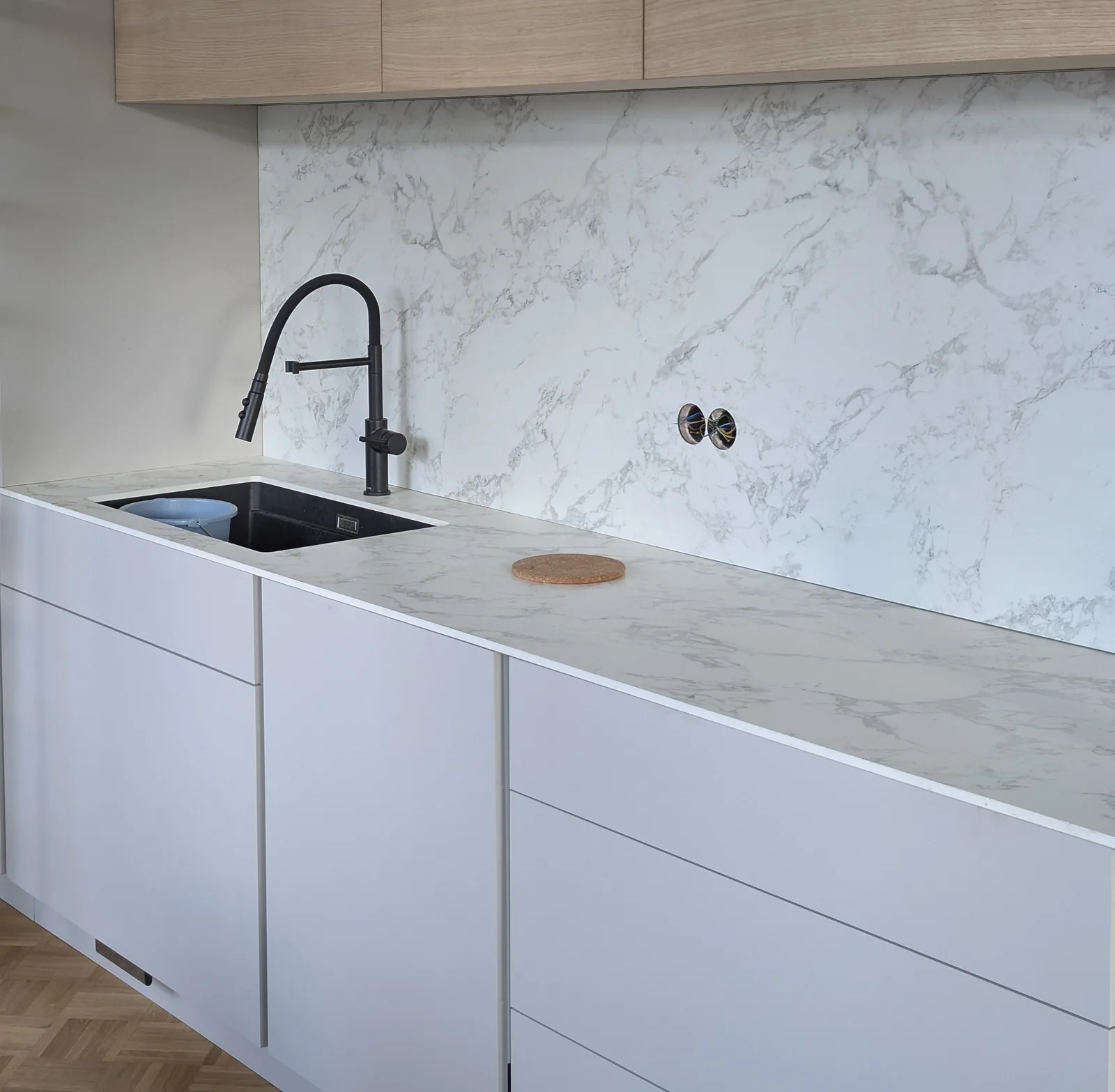
Compact laminate solves exactly this problem: a 12 mm solid-core HPL, from Fundermax in our case, pressed in one piece, with no wood-based carrier board. There is no core that could swell, so a flush-mounted hob and an undermount sink are possible to the millimetre. The 12 mm compact laminate can cantilever unsupported by up to about 15 cm without a substructure. That is Egger’s figure for 12 mm. It weighs around 17 kg/m² and needs full-surface support on closed carcass tops. In terms of heat it remains an HPL: a boiling pot is no problem, a glowing pan straight off the hob belongs on a trivet.
Granite, quartz composite or ceramic: the three stone slabs
Granite, quartz composite and ceramic differ on two questions: does the slab contain resin, and does it have pores. Granite is natural stone without resin, very hard, heat-resistant and, at 30 mm, around 80 kg/m² in weight. It has pores and is sealed per the manufacturer’s instructions, tested with a drop of water. Quartz composite is ground quartz in resin. The resin makes the slab easy to clean and uniform in colour, but it discolours under heat and is UV-sensitive in some finishes, so a trivet is essential.
Ceramic, also called sintered stone, is fired at around 1,200°C, and that figure is the production temperature, not what you may set down in everyday use. Any pot may go straight from the hob onto the slab, because there is no resin in it. The slab is non-porous, knife-proof, UV-stable and needs no sealing. Dekton is not a material of its own but the brand from Cosentino. Neolith and Laminam are the two other big brands of the same material. The formats are 320 x 144 cm (Dekton), 320 x 160 cm (Neolith) and 324 x 162 cm (Laminam), which is why a run from 3.2 m in length needs a joint. Cut-outs get rounded internal corners with a radius of at least 5 mm, never 90 degrees. Details on Dekton, formats and fabrication are in the ceramic guide in this series.
The mistake almost everyone makes: comparing prices per metre that measure different things
The most common mistake when comparing worktops is to treat three figures as one price: the raw-slab price in €/m², the price per metre of the fabricated slab, and the price per metre of the fabricated and fitted slab including edges and cut-outs. Only the third figure belongs in an offer. Anyone who reckons with the raw-slab price later sees the surcharges that were missing from the comparison: the edge profile (€10 to €40 per metre) and every cut-out (€50 to €100 apiece), plus delivery and fitting. The second mistake is the order: choose the finish first and the hob afterwards, and you set a flush-mounted induction hob into a laminate slab. Settle the hob and the sink first, then the material that carries their installation.
Kitchen worktop: price per metre, and what it includes
As a market range, incl. VAT, 60 cm deep, fabricated and fitted: laminate €40 to €150, compact laminate about €150 to €500, granite about €250 to €600, quartz composite about €250 to €700, ceramic €350 to €900 per linear metre; premium finishes, islands and mitred edges push the upper end. At Kolev there is compact laminate, ceramic and natural stone by project, without our own markup and as a separate line item in the offer, fitting included in each case. The compact laminate we fit ourselves; fitted and finished it comes to around €1,500 to €1,900 incl. VAT. Ceramic and natural stone run through our stone partner, who fabricates, delivers and fits on our behalf; we remain your contract partner and carry the warranty: a complete ceramic slab costs around €3,000 to €7,500 incl. VAT depending on length and island, and natural stone starts with us at around €200 per linear metre. The free cost calculator works out your ceramic worktop at our real prices. The kitchen itself starts at €14,999 incl. VAT including planning, delivery and installation, but the worktop is added by every supplier, even where it is hidden in the catalogue price. How the total price of a kitchen is made up is in the cost guide with a cost calculator.
Compact laminate, ceramic or natural stone: how to decide
All three slabs we build are solid material: a flush-mounted hob and an undermount sink work with any of them, so the choice comes down to budget, with everyday use as the cross-check. If the finished slab is to stay under €2,000, compact laminate is the honest route: 12 mm solid-core HPL, around €1,500 to €1,900 incl. VAT, fitting included; only the glowing pan belongs on a trivet. If the budget is higher, ceramic is our standard, and Dekton is one brand of it: from €350 per linear metre, a complete slab around €3,000 to €7,500 incl. VAT, pot straight off the hob, knife-proof, no sealing. You choose natural stone not on price but because you want this particular stone, its grain and its feel: from around €200 per linear metre with us, €250 to €600 on the market, but sealed per the manufacturer’s instructions, tested with a drop of water. Ceramic and natural stone come through our stone partner, fitting included.
How we do it at Kolev
Our standard is ceramic in 12 mm, alternatively the compact laminate from Fundermax, natural stone by project. Quartz composite we do not offer and advise against, because the synthetic resin discolours under heat and some tones fade under UV. The slab is drawn from the 3D site survey. Every cut-out is set out in the workshop drawing to about 1 mm tolerance: position, the radius of the internal corners, the expansion gap of at least 2 mm that Laminam requires around a hob in ceramic, and the position of the joint when the run runs longer than 3.2 m. Under the 12 mm slab lies a continuous load-bearing top of 18/19 mm Egger E1. From about 30 cm of unsupported overhang a steel substructure is added. The splashback can come from the same slab, seamless, with socket cut-outs from the electrical plan. As a lighter, pale alternative to a stone slab on the wall we prefer a thin compact-laminate splashback in RAL 9010. How the template, cut-outs and joint position are planned is in the guide to the made-to-measure worktop.
In one of our projects a Taj Mahal ceramic was planned at first, a printed finish. We also worked out an offer with the real natural stone, around 20% dearer than the ceramic in the same finish, but a manageable extra in relation to the whole worktop price, and the clients chose the real stone. They still say today how glad they are of it: the living feel brings a warmth into the room that a printed finish does not quite reach.
Frequently asked questions
What does a kitchen worktop cost per metre?
Fabricated and fitted, incl. VAT, 60 cm deep: laminate €40 to €150, compact laminate about €150 to €500, granite about €250 to €600, quartz composite about €250 to €700, ceramic €350 to €900 per linear metre. Raw-slab prices in €/m² are well below that, but include neither cutting to size nor edges, cut-outs or fitting.
Which worktop is the most heat-resistant?
Ceramic, on which a hot pot may be set down directly. Granite takes heat well too. Quartz composite discolours under heat, laminate and compact laminate take about 180°C briefly. The 1,200°C from the ceramic brochures is the firing temperature in production, not the limit in everyday use.
Is Dekton a ceramic?
Yes. Dekton is Cosentino’s brand name for sintered ceramic; Neolith and Laminam are brands of the same material. So compare finish, slab format and price, not the brand names.
Does a granite worktop have to be sealed?
Yes, granite has pores and is resealed per the manufacturer’s instructions, tested with a drop of water. Marble is acid-sensitive on top of that. Ceramic, compact laminate and quartz composite need no sealing.
Which worktop suits a flush-mounted hob?
Any solid material: compact laminate, ceramic, quartz composite, granite. Not laminate on chipboard, because the chipboard core lies open at the cut-out and swells. For ceramic the manufacturers require rounded internal corners with a radius of at least 5 mm. Laminam adds an expansion gap of at least 2 mm around the hob.
Next step: the first consultation
If you would like to know which worktop suits your hob, your sink and your budget, then let’s talk. In the first consultation we look at your floor plan, your wishes and your budget, directly with the architect, 45 to 60 minutes, for Frankfurt and the Rhine-Main region.
And a piece of advice no kitchen studio likes to give: get three offers and compare them. We are one of them.