
The essentials in 1 minute
- Most kitchen corners are best solved by a good corner unit: with us, over 80% of corners get a corner pull-out such as MagicCorner or LeMans, usually with a shelved recess above it.
- The mechanism decides, because a corner unit opens only through a 45 to 50 cm wide door.
- Only LeMans brings the shelves fully out in front of the carcass. A carousel leaves the corner wedges empty.
- The corner is designed out only sometimes, for example with a tall unit, corner sink or island.
- At a column, offset or sloping wall, a corner carcass is made to measure with no custom-size surcharge.
 Rusi KolevArchitect & Founder
Real Estate Economist (ebs)
Questions in this guide 13
- Why the corner is a problem in the catalogue
- Which corner cabinet systems exist
- Designing the corner out: four ways without a corner unit
- When the corner falls outside the grid: the made-to-measure corner unit
- What it costs
- When a catalogue corner unit is enough
- How we do it at Kolev
- Frequently asked questions
- Next step: the first consultation

Why the corner is a problem in the catalogue
A standard corner base unit takes up around 0.81 m² of floor and opens through a 45 to 50 cm wide door. Everything behind it is reachable only with a mechanism. The grid knows only 90 degrees and fixed widths, but your corner is rarely exactly 90 degrees, so a cover panel of 5 to 25 cm usually sits between the carcass and the wall. The rest of the corner is paid-for but dead space: in the 12 Kitchen-Buying Mistakes guide this is mistake number 12, the Tetris cabinet.

Which corner cabinet systems exist
Three systems dominate: the carousel (a rotating shelf), LeMans (a swing-out pull-out from Kesseböhmer) and MagicCorner from Kesseböhmer (a pull-out with a follower unit). Only LeMans brings the shelves fully out in front of the carcass. I do not like the carousel, and that is not a matter of taste: a 3/4 rotating shelf of 75 to 80 cm diameter offers around 0.35 m² of storage per level in a carcass with 0.81 m² of floor, the four corner wedges behind it stay empty, and whatever stands at the edge tips over as it turns. LeMans II carries up to 25 kg per shelf and swings both shelves completely out of the cabinet. MagicCorner pulls two baskets out and lets two follow behind. That is why our corner units hold LeMans, MagicCorner or a comparable pull-out, not the rotating carousel.
| Solution | Floor space | Reach | Mechanism / brand | Surcharge (market) | When it makes sense |
|---|---|---|---|---|---|
| Corner designed out | 0 (no corner) | full | none | 0 | sometimes, when the floor plan allows it |
| Made-to-measure corner unit (Tetris cabinet) | whole corner usable | high | full-extension drawers to the geometry | in the fixed price, no custom-size surcharge | at a column, an offset or a sloping wall |
| Kesseböhmer LeMans II | 90 x 90 cm | high (shelves swing out) | LeMans | its own surcharge line (market) | the norm with us, usually with a recess above |
| Kesseböhmer MagicCorner | 90 x 90 cm | medium to high | pull-out with a follower unit | a mid-range surcharge | equally the norm with us |
| 3/4 carousel | 90 x 90 cm | medium | rotating shelf | low | a tight budget |
| Diagonal unit / corner sink | 90 x 90 cm | medium | front across the corner / sink | low | when the sink is to go in the corner |
| Dead corner with a cover panel | 90 x 90 cm | none | none | lowest | never recommended |
Designing the corner out: four ways without a corner unit
Sometimes the corner can be designed out altogether: a tall unit or appliance wall in the corner, a corner sink, an island instead of an L-shape, or a run of units that ends before the corner and uses the rest as an open recess. A 60 cm deep tall unit in the corner is reachable across its full door width rather than through 45 cm, and the second run meets it with 3 to 5 mm of clearance. A modern kitchen with a corner sink sets the bowl on the diagonal and fills the depth with the trap and the waste system, that is, with things that need no pull-out anyway. And where 100 to 120 cm of circulation space remains all round an island, the island instead of the L-shape is often the better answer: two straight runs, no corner, all pull-outs straight. A small room often rules these routes out, and then the corner unit is the right solution.
When the corner falls outside the grid: the made-to-measure corner unit
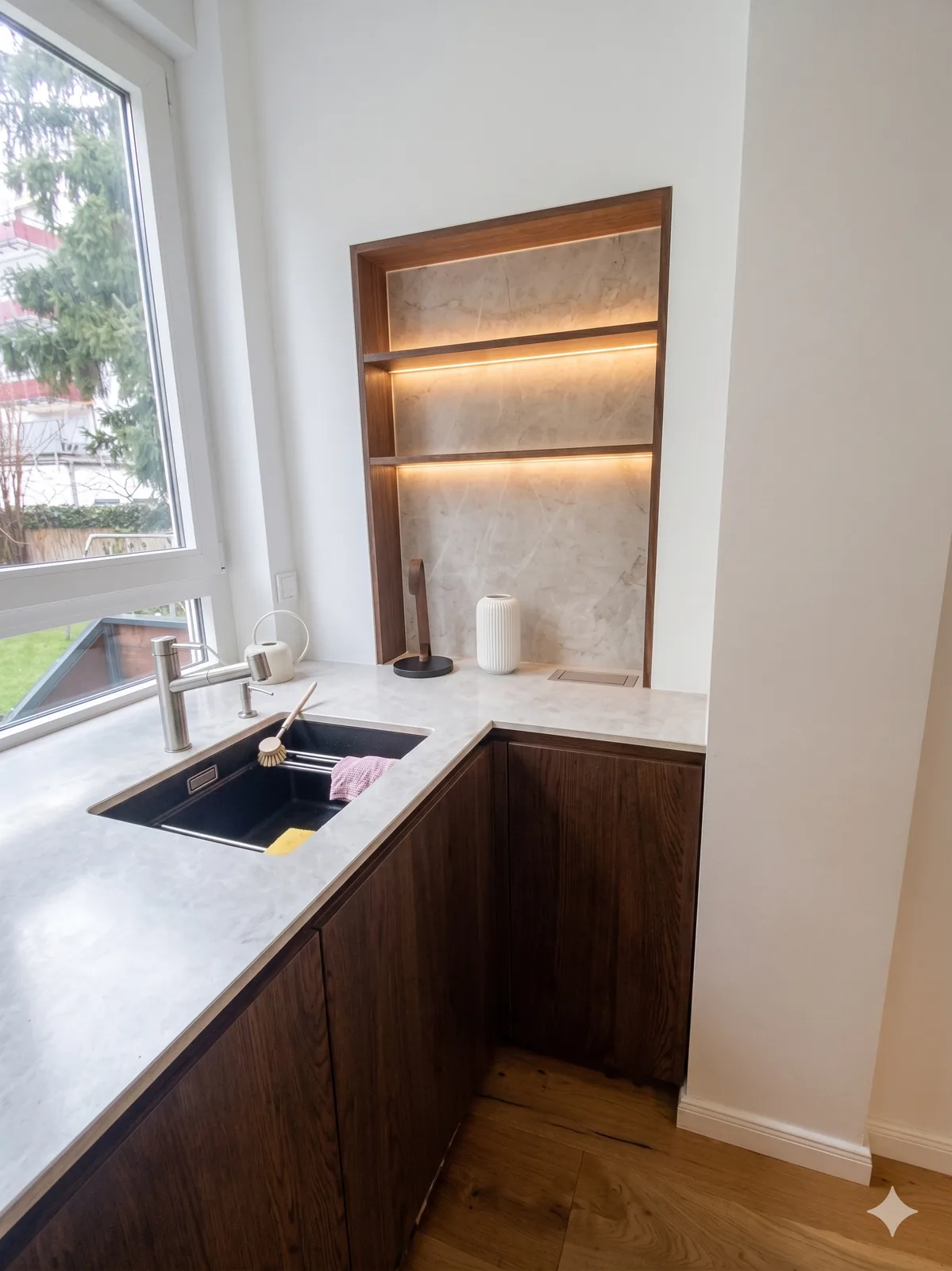
A normal 90-degree corner is solved cleanly by a good corner unit with a LeMans or MagicCorner fitting, even if the room is out by a degree or two. A made-to-measure corner carcass pays off where the corner is not a plain catalogue corner: at a column, an offset or a sloping wall, where a catalogue unit gives away storage. There it uses the full depth. That is how the Tetris cabinet came about. The carcass is drawn from the 3D site survey, with load-bearing shelves in 18/19 mm Egger E1, long shelves secured with a cross-connector, and full-extension drawers from Hettich (AvanTech YOU or ArciTech) whose widths and depths come from the geometry, not from a 90 cm width in the catalogue. What this looks like in a real floor plan is shown by the renovation in Frankfurt. There, to the right of the sink, a niche in the wall runs below and above the worktop, and the worktop reaches into it. Above it, wooden shelves with lighting open up the small space. Below it, a T-shaped cabinet with shelves fills the gap like a Tetris piece. The T-cabinet may not have been strictly needed for those 30 x 50 cm, but it is a small effort that will be used for over 20 years.
What it costs
On the market a corner pull-out is its own surcharge line over a standard corner unit. With us too it is a separate line in the offer, so that you choose for yourself: a LeMans costs around €290 with us, a MagicCorner around €400, both incl. VAT and without our own markup. A made-to-measure corner carcass, by contrast, is part of the fixed price at Kolev, with no custom-size surcharge. The reason is our in-house production: in our Manufaktur, our own production facility, every carcass is drawn individually anyway, and a carcass built around a column costs the workshop drawing nothing extra. A kitchen at Kolev starts from €14,999 incl. VAT, including planning, delivery and installation, and the solved corner is not a surcharge in it but the norm.
When a catalogue corner unit is enough
If the room is rectangular, the corner borders a tall unit and storage is not tight, a catalogue corner unit is enough. With a LeMans II in a 90 cm corner carcass you then lose little, and the modest LeMans surcharge is money well spent on a budget under €15,000.
How we do it at Kolev
The corner is measured in the 3D site survey, the video offer shows two or three variants, and the carcass is built for the geometry, not the geometry around the carcass. In the first consultation we check what the corner needs: in over 80% of our kitchens that is a corner unit with MagicCorner, LeMans or a comparable pull-out, usually with a shelved recess above it. A tall unit, corner sink or island resolves it only sometimes. If a column, an offset or a sloping wall calls for more, its own carcass is built with load-bearing shelves in 18/19 mm Egger E1, long shelves secured with a cross-connector, and full-extension drawers, 3 to 5 mm of clearance to the wall, with no cover panel. The workshop drawing is archived permanently, and a single pull-out can be remade from it as long as the finish and the fitting are available.
Frequently asked questions
How much storage is lost in a kitchen corner?
A catalogue corner cabinet takes up around 0.81 m² of floor, reachable through a 45 to 50 cm wide opening. With a 3/4 carousel about 0.35 m² of rotating shelf remains per level, with LeMans considerably more, because both shelves swing out in front of the carcass. Made to measure, the whole corner is usable, because the carcass follows the real geometry, even around a column or an offset, and the drawers run to the full depth.
Is a carousel still up to date?
In my view no, and the numbers back it up: rotating shelves of 75 to 80 cm diameter leave the four corner wedges of the 90 x 90 cm carcass empty, and whatever stands at the edge tips over as it turns. For a modest surcharge a LeMans II brings the shelves completely out in front of the carcass. A made-to-measure carcass uses the corner fully, with no mechanism at all. A carousel remains sensible only where the budget will not stretch to the surcharge.
What is a LeMans corner unit?
A LeMans corner unit is a corner base unit with a swing-out pull-out from Kesseböhmer: two kidney-shaped shelves swing completely out in front of the carcass as it opens, each carrying up to 25 kg. It fits 90 cm and 100 cm corner carcasses with a 45, 50 or 60 cm door width. Of the three catalogue systems it is the only one where you do not have to fish anything out of the depth.
Is a corner sink a good idea?
Yes, if the corner would otherwise stay dead and the window and services allow it. A modern kitchen with a corner sink sets the bowl diagonally into the 90 x 90 cm corner. Beneath it sit the trap, the waste system and the prepared connection for the Blanco tap, that is, exactly the things that need no pull-out. Allow at least 40 cm of landing space on either side of the bowl, or the diagonal becomes cramped.
Can a corner unit be handleless?
Yes, with a continuous recessed grip profile or push-to-open. With LeMans or MagicCorner the 45 to 50 cm wide door opens like any other front. A made-to-measure carcass with full-extension drawers gets the same recessed grip profile as the run beside it, with a continuous 3 mm gap between the fronts. If the corner is to stay behind a door, a pull-out solution from Sige suits the handleless line: the door opens, then the inner carcass extends automatically, so that the vertical recessed grip profile runs unbroken instead of disappearing into a whole pull-out front. Push-to-open (with us, Hettich Push to open Silent) needs about a 2.5 mm release gap. Which option suits when is explained in the guide to handleless fronts in Module 6 of this series.
Next step: the first consultation
If you want to know whether your corner should be designed out or built, then let’s talk. In the first consultation we look at your floor plan, your wishes and your budget, directly with the architect, 45 to 60 minutes, for Frankfurt and the Rhine-Main region.
And a piece of advice no kitchen studio likes to give: get three offers and compare them. We are one of them.
More on a real project with a solved corner: renovation in Frankfurt. Made to measure always also means the made-to-measure kitchen (Maßküche).