
The essentials in 1 minute
- For a hob in the island, the downdraught extractor is usually the right choice: it keeps the sightline clear and draws off the steam where it is produced.
- In return it costs one pull-out in the base unit, because the fan and filter sit there.
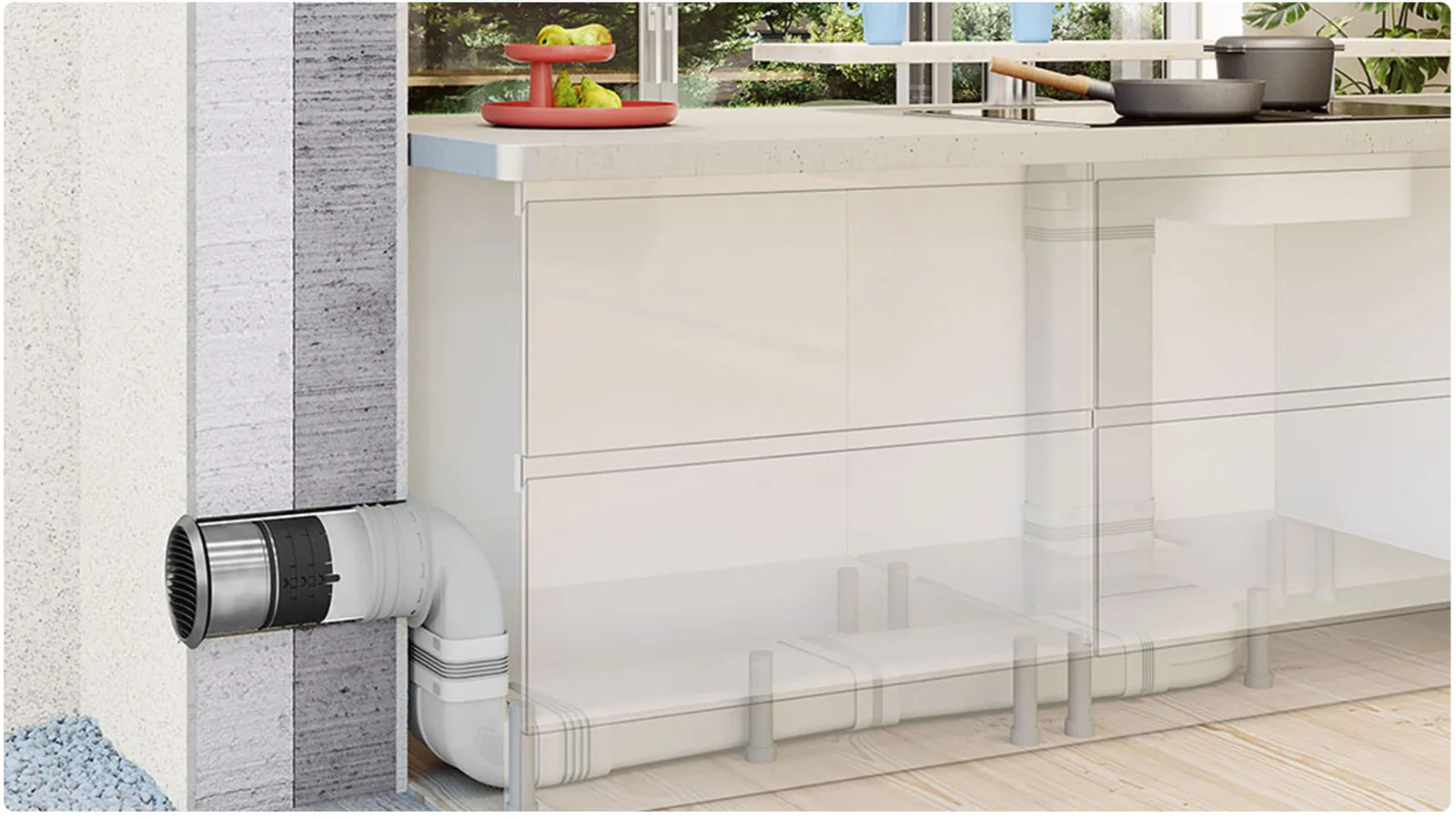
- Along a wall run, the ducting goes through the roughly 10 cm high plinth to the outer wall.
- A free-standing island gets a floor duct before the screed or, more often, recirculation with a plasma filter.
- The only argument for a hood is budget: hob and hood from around €600, the Elica Alpha B with us around €928.
 Rusi KolevArchitect & Founder
Real Estate Economist (ebs)
Questions in this guide 14

What a downdraught extractor is
A downdraught extractor is a hob extractor: the fan sits in the middle or at the edge of the hob and draws the steam off horizontally, instead of letting it rise 50 to 65 cm up into a hood. The motor, grease filter and, in recirculation mode, the activated-charcoal filter sit in the base unit below. The common systems come from BORA (Pure, X Pure, Professional) and Elica (NikolaTesla). Hob and extractor are one system here, and that is the point when it comes to comparing prices later.
| Criterion | Downdraught extractor | Ceiling extractor | Head-clearance / island hood |
|---|---|---|---|
| Sightline to the living area | clear | clear | interrupted |
| Effect with tall pots | weaker upwards | good | good |
| Lost base-unit storage | yes, one pull-out (which one depends on the fan position) | no | no |
| Ducted extraction possible | yes, usually in the plinth under the carcasses, in the island a floor duct before the screed is also possible | yes, ceiling duct | yes |
| Recirculation filter | activated charcoal | activated charcoal | activated charcoal |
| Retrofittable | hardly | difficult | yes |
| RRP range (common systems, as of September 2026) | approx. €2,250 to €10,000 | approx. €1,500 to €6,000 | approx. €400 to €3,000 |
What it does better in the island than a hood
In the island, the downdraught extractor replaces the island hood, which otherwise hangs 50 to 65 cm above the hob and, at 90 cm wide, blocks exactly the sightline for which the island was planned in the first place. Steam and smells are drawn off directly at the rim of the pot, not only once they have drifted through half the room. Whoever stands at the hob has nothing overhead: no hood edge at forehead height, no grease filters visible from the sofa.
Where it is weaker
With pots whose sides rise around 20 cm or more, and with a wok, the downdraught extractor loses steam upwards: the pull acts horizontally at hob level, and what rises from the pot 20 cm above that it only partly reaches. The second price is storage: in recirculation mode the BORA X Pure, our standard, needs no plinth fan; as with most systems, the fan and filter sit directly under the hob, so it is the top pull-out that is lost. With Elica, the cleaned air comes out through a slim profile in the plinth. With ducted extraction it depends on the fan configuration: with a plinth fan the bottom pull-out is lost, with an outer-wall fan the top one. The filter box takes up around 10 cm of depth at the back for the airflow, so the pull-outs below lose depth. Neither counts against the system, but both belong on the table before the purchase, not after installation.
Ducted or recirculating: plinth, floor or filter
Ducted extraction carries the cooking vapour and its moisture outside through a pipe and is the more effective design. Recirculation cleans the air through grease and activated-charcoal filters and returns it to the kitchen. Both designs exist for hoods and downdraught extractors. For a free-standing island a flat channel in the floor build-up is one option. It then has to be in place before the screed goes down, provided on site, to our plan. It is not the usual way, because the duct under the carcasses in the plinth is considerably cheaper and unproblematic. Without one of these routes it stays recirculation with activated charcoal or a plasma filter, and because recirculation returns the moisture to the room, the home then needs a ventilation concept to DIN 1946-6. Ducted extraction must also not be led into a smoke or flue chimney that is in use, as BORA specifies. If a room-air-dependent heating appliance stands in the same room, such as a wood-burning stove, the Hessen Feuerungsverordnung applies in section 4(2), which requires safe pressure conditions for the combined operation: in practice the verification threshold is a negative pressure of no more than 4 Pa, which the district chimney sweep checks in the 4 Pa test and must approve before operation. BORA provides for the necessary peripherals in its connection diagram, for example the connection for a window contact switch that only lets the extractor run when a window is open, or for a pressure monitor.
We build both recirculation and ducted extraction, depending on the situation. We ourselves prefer ducted extraction, because there is no activated-charcoal filter to change. Normally we lead the ducting along the wall run under the carcasses through the roughly 10 cm high plinth cavity to the outer wall, without touching the floor: we plan the carcasses with a 10 cm plinth anyway, so this is considerably cheaper and unproblematic. The 200 cm² plinth opening through which the fridge and other built-in appliances get their air supply and exhaust stays clear in the process. It is different with a free-standing island that has no route to the wall: there an extraction duct in the floor before the screed is possible, or it becomes recirculation with a plasma filter, which is the frequent choice for islands with us. In a new build, ducted extraction is usually not possible because of the insulation standard. There are solutions such as Naber’s THERMOBOX, a wall sleeve that protects the opening in the outer wall against heat loss, or systems with heat recovery, but in a new build it is usually recirculation. The plasma filter costs noticeably more as a one-off, but it has no replaceable filter, so there are no ongoing filter costs. The recirculation filter supplied with the hob is replaced every one to two years depending on use, and that adds up. Over the life of the kitchen the plasma filter is usually cheaper.
What this costs
According to the manufacturers’ price lists, the common downdraught systems with a hob cost from around €2,250 RRP, and large set-ups with several hobs up to around €10,000 (as of September 2026); on the market, ceiling extractors sit between €1,500 and €6,000, head-clearance hoods between €400 and €3,000, and a simple under-cabinet hood starts from around €180. What gets compared, though, is not appliance against appliance but the whole installation, because the downdraught extractor is hob and extractor in one system: whoever chooses a hood also buys a separate induction hob, the wall unit or housing above it, the adapted carcass and the ducting up to the ceiling or wall.
In my view, the only argument for a cooker hood is budget. Until now, a tight budget usually meant a hob and a hood. With basic models the two together cost around €600. With a kitchen from us, the 78 cm version of the Elica NikolaTesla Alpha B downdraught extractor costs around €928 incl. 19% VAT. The 60 cm version is even below €900, but the saving is under €50. The narrow version only makes sense if your worktop already has a matching cut-out and you are retrofitting a newer model.
A hood wastes the wall unit and the space above the hob, and it is much louder because it runs right next to your head. That is why I no longer plan cooker hoods, not even on a tight budget. Compared with a hob and hood, the Alpha B costs around €300 more, which I try to make up in other ways. If I count the wall unit the hood needs, which also takes longer to design and fit, the two might be on a par in total.
At the top end, by contrast, the downdraught extractor is clearly the more expensive system: a Professional build of hob and extractor costs considerably more than the comparable hood solution.
BORA and Elica we pass on at architect partner terms, without our own markup and valid with a kitchen bought from us. You can see the Elica prices directly in our shop. The kitchen starts from €14,999 incl. 19% VAT, including planning, delivery and installation.

Which systems we fit
Our standard is the BORA X Pure, which combines surface induction and extractor in one appliance. Alongside it we fit Elica NikolaTesla, from the Alpha B as the entry model up to the larger ranges, and for higher demands the modular BORA Professional. In the island we plan hobs 80 to 90 cm wide and build the base unit around the filter box, not the filter box into a standard 60 cm carcass. Because every carcass in our Manufaktur (our own production facility) is drawn individually, the pull-out that would be lost becomes a shallow custom pull-out where the geometry allows, and the remaining pull-outs get, with Hettich full-extension drawers, the depth that really remains after the 10 cm duct. What an island with a hob extractor looks like in an existing building is shown by the renovation in Frankfurt.
How we do it at Kolev
We do not earn on the appliance, so the recommendation is free: BORA or Elica at architect partner terms, the model by floor plan and budget, not by margin. Duct, socket and filter box are set out in the electrical and plumbing plan, which you give to your installer as preparation before the screed goes down. The connection is made by a licensed trade contractor. In the video offer you see the base unit open, with the filter box, duct and the pull-outs that actually remain, and the sightline to the living area in the 3D model, before a single worktop is cut.
And we factor in the filter costs over the years: with ducted extraction they disappear entirely, because there is no filter to change. If the choice falls on recirculation, we plan in a plasma filter where possible, so that a regularly recurring expense becomes a one-off purchase.
Frequently asked questions
Is a downdraught extractor loud?
In cooking use the appliance itself is in the region of a good hood. Depending on the version, the fan sits in the base unit or in the plinth, usually around a metre lower than the motor of an island hood 50 to 65 cm above the hob, that is, under the worktop rather than at ear height. Whoever runs the extractor at level 1 to 2 in everyday use barely hears it over a conversation at the counter. With the decibel figures it is worth looking at which quantity is meant: the sound power level is the value on the EU label, the sound pressure level is what you hear at the hob, and it is considerably lower. The sound power level is measured to DIN EN 61591, and BORA derives the sound pressure from it to EN 60704-2-13. To put the performance in context: BORA Professional 3.0 moves about 560 to 670 m³/h, depending on the version and setting. The binding figures are in the data sheet of the appliance in question, Elica included.
How often is the activated-charcoal filter changed?
BORA gives the service life not in months but in operating hours: on the BORA X Pure the recirculation filter lasts a maximum of 150 operating hours according to BORA, about a year. The ULB3X filter box of the Professional line is a separate system bought on top and is set at the factory to 600 hours. Assuming one hour of cooking a day, as the EU does for the energy label of cooker hoods, that is around 20 months. In our kitchens this box is in practice changed more like every three years. BORA filters are replaced. The stainless-steel grease filter goes in the dishwasher. Elica, by contrast, uses regenerable activated-charcoal filters, according to the manufacturer.
In everyday life the change is easily forgotten: without a reminder it even happens to me. In our recirculation kitchens we therefore often fit a plasma filter instead of the standard activated-charcoal filter: it does not have to be changed every year, so the ongoing filter costs disappear.
Can a downdraught extractor be retrofitted?
Hardly: the cut-out in the worktop, the base unit with the filter box and the duct all have to be planned in advance. A Dekton or compact-laminate worktop cannot be re-cut on site, and a standard 60 cm base unit has neither the 10 cm of depth for the duct nor the room for the filter box. What can be retrofitted in an existing kitchen is the head-clearance hood, which needs only a wall and a socket.
Is ducted extraction possible in an island in a period building?
Rarely: without a floor duct it stays recirculation with an activated-charcoal or plasma filter. Along a wall run the ducting goes through the roughly 10 cm high plinth to the outer wall anyway, without opening the floor. The free-standing island, by contrast, needs a flat channel in the screed, and in a period building that means opening the screed. With a full renovation and a new screed it is possible. Otherwise we plan recirculation and say so in advance.
Are there downdraught extractors for gas?
In a limited way: BORA offers a gas variant with the BORA gas module, and Elica offers its own gas hob extractor with the NikolaTesla FLAME EVO. The remaining systems are pure induction systems. With gas, the flame additionally carries the vapour upwards, working against the horizontal pull. In recirculation mode every system needs a return-air opening in the cabinetry, at least 500 cm² for the BORA X Pure. For a gas hob the figure in its installation instructions applies. More on this in the next step: Induction or gas.
Hob extractor and downdraught extractor, the same term?
Yes: hob extractor is the umbrella term, downdraught extractor the common name. BORA speaks of the hob extractor system, Elica of the hob with integrated extraction. What is always meant is a hob that draws the steam downwards, as opposed to a hood (above) and a ceiling extractor (ceiling). A table extractor that rises up behind the hob is a third system and not a downdraught extractor.
Next step: the first consultation
If you would like to know whether your island gets a downdraught extractor or a ceiling extractor, then let’s talk. In the first consultation we look at your floor plan, your wishes and your budget, directly with the architect, 45 to 60 minutes, for Frankfurt and the Rhine-Main region.
And a piece of advice no kitchen studio likes to give: get three offers and compare them. We are one of them.
More on the island: Planning a kitchen island. What has to be in place before the screed: Electrical and plumbing plan. Appliances without our own markup: Kitchen appliances.