
The essentials in 1 minute
- Anyone who wants to plan kitchen lighting plans three layers, and the task lighting decides it: at least 500 lux on the worktop, warm white and dimmable.
- A recessed LED light baffle must be in the plan before production. The routing is done in the Manufaktur.
- Retrofitted, kitchen light costs noticeably more, shows cabling, and the separate switching of layers is lost.
- The contrast when cutting comes from the colour rendering: look for CRI 90 at least.
- The task light belongs at the front, on the underside of the wall unit, not at the back against the wall.
 Rusi KolevArchitect & Founder
Real Estate Economist (ebs)
Questions in this guide 13
- Planning kitchen lighting means planning three layers
- Task lighting: from 500 lux, warm white, at the front edge
- Light baffle: recessed or stuck on
- The mistake almost everyone makes: most only notice the light does not suit the kitchen once it is finished
- What it costs
- How we do it at Kolev
- Frequently asked questions
- Next step: the first consultation

Planning kitchen lighting means planning three layers
A kitchen lighting concept has three layers: ambient lighting at around 300 lux for the room, task lighting at a minimum of 500 lux on the worktop, hob and sink, and accent lighting at 150 to 200 lux for shelving, recess and dining area. A single ceiling light does none of the three jobs: it is too weak for the worktop and, when you cut, stands behind you, so in your own shadow. The 500 lux come from the workplace standard DIN EN 12464-1, which is not binding for private kitchens but remains the sensible benchmark. For light colour, all three layers stay warm white: ambient and accent light at 2700 to 3000 K, the task light warm white with high colour rendering.
| Lighting layer | Technology | Kelvin / CRI | Switching | Included at Kolev |
|---|---|---|---|---|
| Ambient lighting, ~300 lx | ceiling spots on a grid of ~50 cm (max. 80 cm), pendants over the island | 2700 to 3000 K / CRI 90 or more | wall switch, dimmable | ceiling outlets in the electrical plan (preparation) |
| Task lighting, from 500 lx | COB LED 24 V in an aluminium profile, routed into the light baffle, at the front edge of the cabinet | warm white / CRI at least 90 | own push switch, PWM-dimmable | recessed light strip, power supply, dimmer, pre-wired |
| Accent lighting, ~150 to 200 lx | LED in the plinth, recess, shelving, display cabinet, cabinet interior | 2700 to 3000 K / CRI 90 or more | dimmer, door contact inside the cabinet | plinth and recess lighting pre-wired, door contact in the cabinet |
Task lighting: from 500 lux, warm white, at the front edge
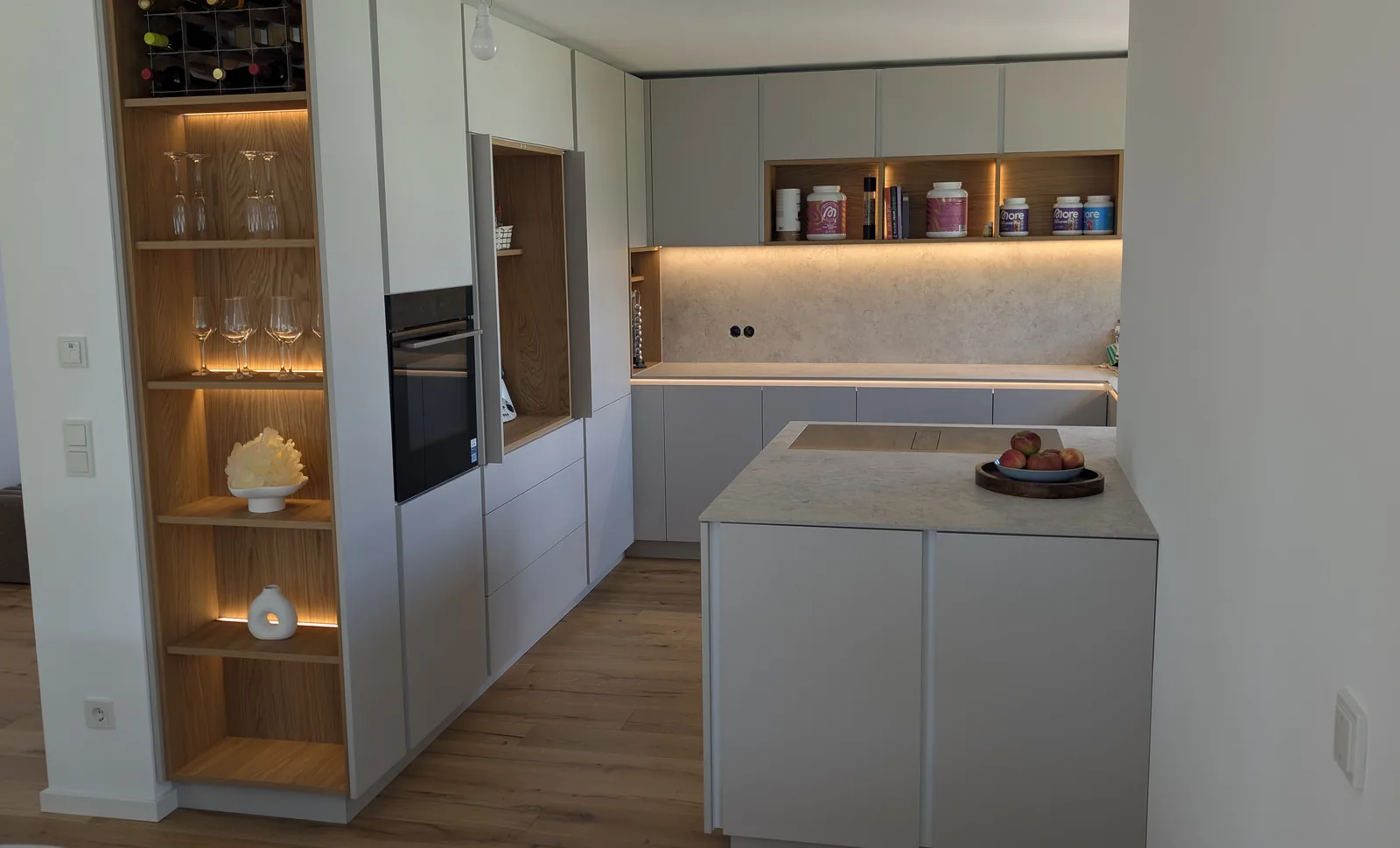
The task lighting decides safety and visual comfort: at least 500 lux on the worktop, as a rule of thumb around 1,000 lumens per linear metre of worktop, warm white with high colour rendering. The contrast when cutting comes not from a cooler light colour but from the colour rendering: the second figure that hardly any supplier quotes is the colour rendering index, and in the kitchen it belongs at CRI 90 at least. Two warm-white fittings can look completely different: under Ra 80 tomatoes and meat look dull, at Ra 95 natural. We plan the whole kitchen in warm white, the task light included, and get the contrast from the high CRI rather than from cooler light. And the position: the profile belongs at the front, on the underside of the wall unit, not at the back against the wall. Mounted at the back, you stand in your own shadow and the splashback glares back. In a kitchen without wall units this edge disappears. Then ceiling spots 30 to 50 cm in front of the wall take over the job, and those belong in the electrical plan, not in the moving-in week.
For me, 500 lux is the lower limit. I plan the task light considerably brighter and give it a dimmer, so you can turn it well down or fully up, whatever the situation calls for. A dimmer only works downwards: it can never add light that the built-in strip does not deliver. Our task-light strip, at around 1,540 lumens per metre, delivers by calculation around 900 lux onto the worktop from a height of 60 cm, almost twice the standard value. DIN EN 12464-1 itself provides for this headroom and allows the value to be raised by one or two steps, to 750 or 1,000 lux, for instance for older eyes or fine, low-contrast detail. Light planned this way does not have to run at full power all the time and may be dimmed.
In everyday use you need not think about dimming, because the dimmer remembers the last value you set. A short press on the push switch turns the light on and a second turns it off. It always comes back at the stored value. Most of the time that is around 500 lux, the standard’s value, and a little over half the output is enough for it. If you need more light, you turn it up. The reserve for special occasions costs nothing extra and is included in the fixed price.
Light baffle: recessed or stuck on
A light baffle is the panel on the underside of the wall unit into which the LED profile is set; recessed, it sits flush with a satin cover, while stuck on or screwed on an aluminium profile sits visibly under the cabinet base. The components are the same in both cases: a 24 V strip, an aluminium profile that conceals and cools, a power supply with headroom and a controller for dimming. Four numbers decide the quality. First, the voltage: from a strip length of 3 to 5 m, 24 V rather than 12 V as a matter of principle, because at 24 V the same cable reaches about four times as far before the end of the strip becomes visibly darker than the start. Second, the power: LED strips come in fixed steps of 4.8, then 7.2, 9.6, 14.4 and 19.2, up to 24 and 28.8 W/m; 24 W/m is the standard high-output step, while a catalogue value such as 26 W/m is not a standard rung. 4.8 W/m is enough for the plinth and a drawer, not for the worktop. Classic SMD strips need about 15 to 24 W/m for task light. Third, the form: a COB LED in an aluminium profile lights without dots, without the spotting effect of individual diodes, and does so on about 8 to 14 W/m. Fourth, the IP rating: at the sink and hob at least IP65, on the dry run IP20 is enough. Dimming is by PWM, and the strip, power supply and controller must all run at the same voltage. The difference between recessed and stuck on is therefore not in the light but in the timing: the routing is done in the Manufaktur before installation and can practically never be added cleanly to a finished kitchen.
The mistake almost everyone makes: most only notice the light does not suit the kitchen once it is finished
The most common mistake is to order the light as an accessory after the kitchen; that it is then not really made for the kitchen is something most people only notice once everything is finished and standing. In the 12 Kitchen-Buying Mistakes guide this is mistake number 7, light was not in the price. The consequence shows up in three places. The ceiling outlet over the island is missing, and there is no pendant light without a chase in the ceiling. The power supply has no room in the cabinet and lies loose behind the plinth or visibly on top of the wall unit. And the profile is screwed under the finished panel, with a cable running down the side of the cabinet. A screwed-on profile under a lacquered panel is not to my taste, and that is not a matter of taste: it is the visible sign that a trade came too late. For the forgotten corner there are now battery LED strips that stick on, and they are surprisingly bright. If I had to use one of those in one of my kitchens, I would rather change careers. Retrofitted, kitchen light costs about €800 to €2,500 in our experience, depending on whether only strips and power supplies are added or the electrician opens up wall and ceiling again. A flush-mounted socket alone comes to around €150 to €350 after the fact, a new circuit to around €400 to €800. I plan light in several layers that stay separately switchable, so that depending on the time of day and the mood you can choose whether you are cooking or sitting at the table. That way everything is rarely on at once, each layer can be dimmed on its own, and what you do not need you switch off entirely. It is exactly this separation that is lost when the light is only added after the kitchen is finished.
What it costs
On the market, retrofitted kitchen lighting costs noticeably extra depending on strip length, power supplies and ceiling work. At Kolev the recessed light strip, power supply, dimmer and the pre-wiring are part of the fixed price.
Our standard for task light is a COB strip at 24 V, 14 W/m, 512 LEDs per metre, 10 mm wide, warm white, colour rendering CRI Ra over 90, around 1,540 lumens per metre. For accent and secondary light, that is open shelves and the zones under the worktop in the Gola profiles, we use a finer COB strip at 12 V, 10 W/m, 480 LEDs per metre, 8 mm wide, likewise warm white, Ra over 90, around 900 lumens per metre, fed in short segments. Both light without dots. The recessed light strip for the task light is included in the fixed price with power supply and dimmer.
A kitchen at Kolev starts from €14,999 incl. VAT, including planning, delivery and installation. The routing for the profile costs nothing extra in the workshop drawing, because every baffle is drawn individually anyway. Ceiling spots and pendant lights run off the building’s wiring: we put the outlets into the electrical plan, that is preparation, and the connection is made by the qualified electrician.
How we do it at Kolev
At Kolev the light is part of the workshop drawing, not of the accessories: the LED strip is routed into the light baffle in the Manufaktur, not stuck on, as a 24 V strip in an aluminium profile, dimmable, with its own push switch. Cabinet interior lighting switches via a door contact, and the plinth and recess get their own warm-white strip. The pre-wiring comes from the electrical plan, which is drawn up early in the planning, before screed and plaster: the position and ventilation of the power supplies in the cabinet, ceiling outlets for spots and the island pendants, and conduit for later. That is preparation. The connection to the mains is made by your qualified electrician. Because the routing is done in our own production, the light baffle is a component like any front, and the workshop drawing is archived permanently.
If a zone is to be open underneath, that is usable while seated, we plan the task light accordingly lower for it; because everything is made-to-measure work anyway, planning an accessible zone costs no surcharge with us.
Frequently asked questions
How many lux does a kitchen need?
Around 300 lux as ambient light in the room, at least 500 lux on the worktop, hob and sink, 150 to 200 lux as accent at shelving, recess and dining area. The 500 lux is the DIN EN 12464-1 value for kitchen workplaces. The standard is not binding for private kitchens but is a sensible benchmark. For 500 lux from a height of 60 cm, reckon on around 1,000 lumens per metre of worktop. We plan the task light at around 900 lux with a dimmer.
Which light colour is right in the kitchen?
Warm white, in all three layers: ambient and accent light at 2700 to 3000 K, the task light warm white as well. The contrast when cutting comes not from a cooler light colour but from the colour rendering: look for CRI 90 at least. Warm-white light also makes food look appetising.
What is a light baffle in the kitchen?
A light baffle is the panel on the underside of the wall unit that carries the LED profile and lights the recess. Recessed, the profile sits flush in the baffle, with a satin cover and no visible cable. Stuck on or screwed on, it sits visibly under the cabinet base. The routing is done in production, which is why the light must be settled before the order.
12 V or 24 V for LED strips in the kitchen?
24 V, as soon as the run exceeds 3 to 5 m, and with a continuous run that is almost always the case. At double the voltage the current halves. Because the permissible voltage drop is also referenced to the higher voltage, the same cable reaches about four times as far: a 12 V strip drawing 72 W on a 1.5 mm² cable hits the three-percent limit after a good 2.5 m, at 24 V only after around 10 m. The strip, power supply and dimmer must all run at the same voltage.
How high should a pendant light hang above the kitchen island?
About 70 to 80 cm above the worktop, so higher than above the dining table (there at least 60 cm), so that the view across the island stays clear. The exact height depends on body height, ceiling height and the beam spread. What matters is the ceiling outlet: it must be in the electrical plan. After the fact you only get it with a chase in the ceiling.
Is an illuminated splashback task lighting?
No, an illuminated splashback is accent lighting. It shines from the plane of the wall, not from above onto the worktop, and therefore does not replace the profile at the front edge of the cabinet, but it is lovely as a second, separately dimmable layer. How the recess itself is planned is in the guide to the splashback.
Next step: the first consultation
If you would like to know whether your light belongs in production or whether your electrician can handle it, let’s talk. In the first consultation we look at your floor plan, your wishes and your budget, directly with the architect, 45 to 60 minutes, for Frankfurt and the Rhine-Main region.
And a piece of advice no kitchen studio likes to give: get three offers and compare them. We are one of them.