
The essentials in 1 minute
- Plan every base unit from 45 cm wide as a full-extension drawer, not as a door with a fixed shelf.
- Behind a door you comfortably use only the front 30 cm. Whatever stands behind that you reach only kneeling.
- A full-extension drawer brings the full nominal length of 550 mm in front of the carcass in one movement.
- The door with internal pull-outs remains the right choice for fronts under 45 cm wide and for tall units.
- At Kolev full-extension drawers are the norm, not an option, and are included in the fixed price.
 Rusi KolevArchitect & Founder
Real Estate Economist (ebs)
Questions in this guide 12
- What a full-extension drawer is, and why the door wastes 30 cm
- Full-extension drawers: which pull-out belongs in which cabinet
- The door with internal pull-outs: when it is ergonomically the better choice
- The mistake almost everyone makes
- What it costs
- How we do it at Kolev
- Frequently asked questions
- Next step: the first consultation

What a full-extension drawer is, and why the door wastes 30 cm
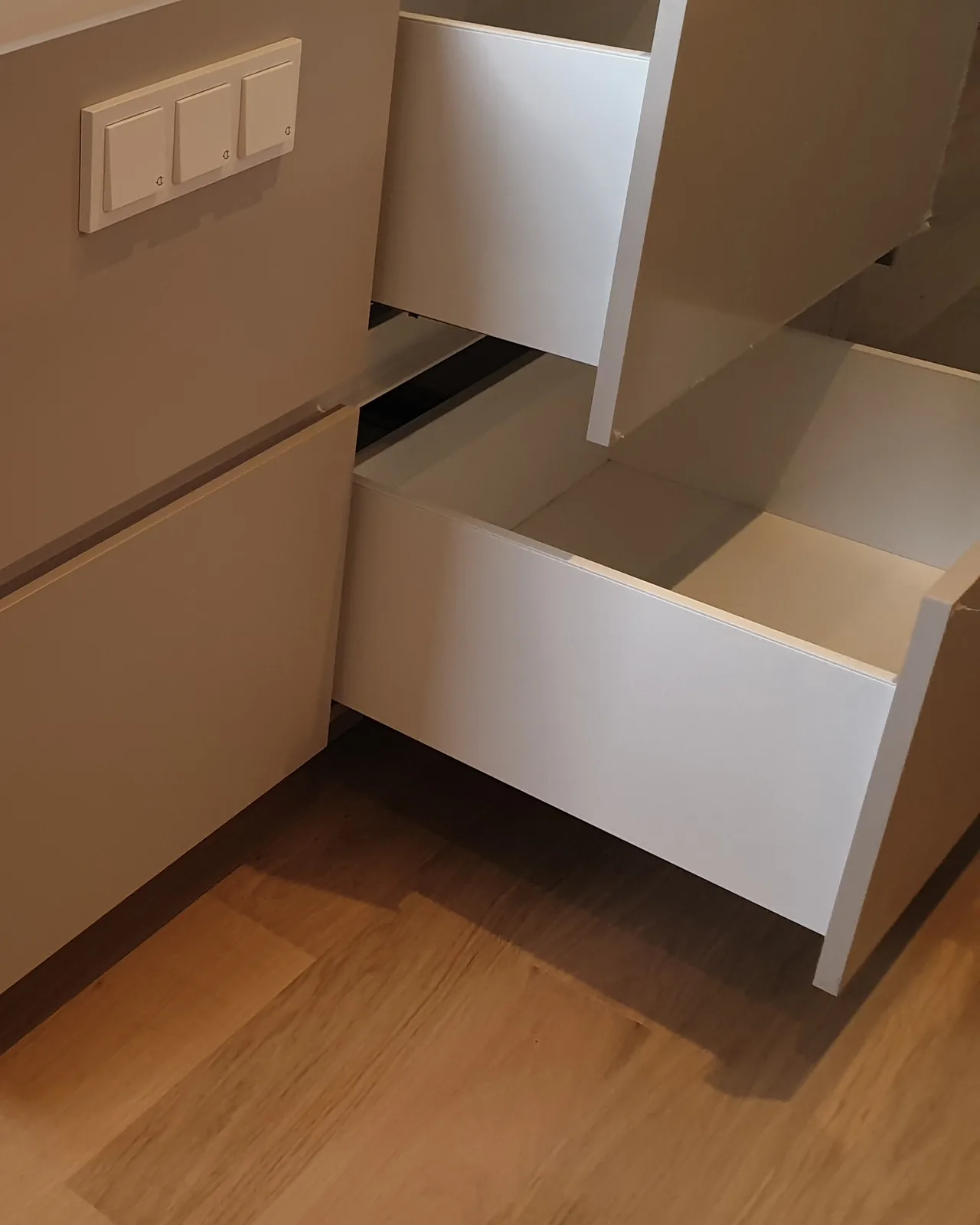
A full-extension drawer is a drawer box or front pull-out whose runner brings the entire box to its full nominal length out in front of the carcass, so 550 mm in a 60 cm deep base unit. The internal pull-out is the same pull-out behind a door: you first open the door (Hettich Sensys, 110 degrees) and then pull out the box. The door with a fixed shelf is the third variant and the norm in the catalogue, because it needs the least hardware. Ergonomically it ends at around 30 cm: whatever stands behind that you can reach only kneeling and without sight of it. Of the 0.36 m² of floor per 60 cm cabinet, behind the door you comfortably use 0.18 m² per level, with a full-extension drawer the whole area.
| Type | Usable depth (60 cm carcass) | Load capacity | Handleless | Price index |
|---|---|---|---|---|
| Door + fixed shelf (Hettich Sensys) | comfortably 30 cm, the rest kneeling | the shelf carries, 18/19 mm with us, long shelves secured by a cross-connector | yes, recessed grip or push-to-open | low |
| Door + internal pull-out (Sensys + AvanTech YOU, 139 mm drawer side) | 550 mm, 2 hand movements | up to 70 kg (XL) | door yes, pull-out behind it with an inner panel | medium |
| Drawer box as a full-extension drawer (AvanTech YOU, 77/101/139 mm drawer side) | 550 mm, 1 hand movement | 10 / 40 / 70 kg (XS / L / XL) | yes, 13 mm visible drawer side, Push to open Silent | medium |
| Tall front pull-out (AvanTech YOU, 187/251 mm drawer side) | 550 mm, 1 hand movement | 70 kg (XL), EN 15338 Level 3 | yes | high |
| Hettich ArciTech (2nd platform, 78/94/126 mm drawer side, front pull-out 186 to 282 mm) | 550 mm, 1 hand movement | depending on the version, EN 15338 Level 3 | yes | medium |
| Partial-extension pull-out with a ball-bearing runner (what you see elsewhere) | the rear part stays in the carcass | 10 kg, EN 15338 Level 1 (20,000 cycles) | limited | low |
| Blum LEGRABOX, MERIVOBOX, TANDEMBOX (what you see elsewhere) | 550 mm | per Blum’s specification | yes | not fitted at Kolev |
Full-extension drawers: which pull-out belongs in which cabinet
The choice of full-extension drawer follows four dimensions, carcass width, front height, load capacity and contents, and for this Hettich supplies five drawer-side heights (77, 101, 139, 187, 251 mm) in three load classes (XS 10 kg, L 40 kg, XL 70 kg). The XL class is available only from a nominal length of 450 mm, so always in a 60 cm deep base unit with a nominal length of 550 mm. The standard behind it is EN 15338: Level 3 stands for 80,000 opening and closing cycles. The load capacity in kilograms applies separately, tested at a 500 mm reference length with a 130 mm front panel on the drawer box and 300 mm on the front pull-out, plus a 72-hour condensation test against corrosion. From that comes the rule per cabinet:
| Contents | Pull-out type | Drawer side | Load capacity |
|---|---|---|---|
| Cutlery, spices, foil | drawer box, top level | 77 or 101 mm | XS to L |
| Plates, bowls, glasses | front pull-out next to the dishwasher | 187 mm | XL 70 kg |
| Pots, pans, roasters | front pull-out under the hob, from 80 cm wide | 251 mm | XL 70 kg |
| Provisions (flour, oil, tinned food) | front pull-out or tall unit with internal pull-outs | 251 or 139 mm | XL 70 kg |
The sink cabinet is the exception: it holds the trap and the waste system, with us the flexible Blanco FLEXON II as standard, behind a door or in a coupled front pull-out, and a second pull-out is not worth it there. In the same 60 cm carcass two or three levels are formed depending on the contents, 139 and 251 mm drawer sides mixed, no “one height for everything”.
The door with internal pull-outs: when it is ergonomically the better choice
The door with internal pull-outs wins for fronts under 45 cm wide, in tall units and everywhere the front should stay calm: one door, one 3 mm gap, behind it two or three pull-outs with a 139 mm drawer side and a 70 kg load capacity. A drawer box under 45 cm becomes visually a narrow upright front, and beneath it the contents fit better behind a door or in a larder pull-out 20 to 40 cm wide (Kesseböhmer Comfort II, 20 kg). In a tall unit the internal pull-out is the right form anyway: behind a 110-degree door you pull each level out separately at reach height and see the contents from above, whereas a front pull-out would place a panel in front of you at chest height. The price is two hand movements instead of one and an open door that projects around 60 cm into the room. In a cooking zone with 2 people that is the reason to use front pull-outs below and internal pull-outs only where the door is seldom open. At Kolev those are tall units, the backs of islands and narrow carcasses next to appliances.
The mistake almost everyone makes
The most common mistake is to treat the full-extension drawer as a surcharge line and to leave the drawer heights to the grid instead of the contents. In the catalogue the 60 cm base unit comes with a door and one shelf, the pull-out is added as an option per cabinet, and whoever saves, saves exactly there: with 10 base units of 2 levels each, that is 3.6 m² of paid-for storage reachable only kneeling. The second mistake is the division, two equally tall pull-outs in every cabinet, whether cutlery or a roaster is meant to go in: a pot with a lid needs the 251 mm drawer side, cutlery the 77 mm one. Whoever forces both into 2 x 187 mm ends up stacking pots or wasting air above the cutlery. The third mistake is the partial-extension pull-out with a ball-bearing runner, 10 kg and Level 1: in the showroom it looks like a full-extension drawer, but it is tested for 20,000 cycles instead of 80,000.
What it costs
A full-extension drawer replaces a pair of hinges and a shelf with two drawer sides, a runner and a 16 mm drawer base, which is why it sits at medium on the price index, and the tall front pull-out with a 70 kg runner at high. In studio offers it usually appears as a surcharge per cabinet, in volume-production kitchens as an equipment line. At Kolev there is no surcharge list per pull-out: the drawer layout is fixed in the video offer and is included in the fixed price, because every carcass is drawn individually anyway and the workshop drawing for a 251 mm front pull-out costs no more than for a door. A kitchen at Kolev starts from €14,999 incl. VAT, including planning, delivery and installation, and full-extension drawers are the norm in it, not an option.
How we do it at Kolev
In almost every kitchen with us runs Hettich AvanTech YOU, white, double-walled, XL 70 kg, EN 15338 Level 3, Silent System as standard, 550 mm nominal length. ArciTech flexi (126/300, 126/450, 126/550) is the second platform for shallow carcasses and nominal lengths from 300 mm, always alongside AvanTech, never instead of it. The drawer box itself is a 16 mm board, the carcass 18/19 mm (profile-compatible with the Scilm Snap-On recessed grip profiles), load-bearing shelves in 18/19 mm Egger E1, long shelves secured with a cross-connector. The drawer layout follows the contents: in the first consultation we ask about pot heights, stacks of plates and the quantity of provisions, and from that come the 139 and 251 mm drawer sides mixed. A typical drawer cabinet with us gets a large drawer with a 251 mm drawer side at the front below and usually two inner drawers above it with a 139 mm drawer side and their own inner front to pull out, all three on the same Actro YOU 70 kg runners from Hettich, three drawers behind one calm front. The workshop drawing is archived. A single pull-out can be remade from it as long as the finish and the fitting are available. Production is in the Manufaktur, our own production facility. From the 3D site survey to the finished, installed kitchen it is 6 to 8 weeks. Which other hardware is standard is set out in the hardware comparison; how the corner is solved, in the previous step, solving the corner.
Frequently asked questions
What is the difference between a full-extension drawer and an internal pull-out?
A full-extension drawer is a drawer box or front pull-out with its own front, whose runner brings the box out to its full nominal length in front of the carcass, 550 mm in a 60 cm deep base unit. An internal pull-out is the same box behind a door: first open the door (Sensys, 110 degrees), then pull. Both use the full depth. The difference lies in the front appearance and in two hand movements instead of one.
How much weight does a full-extension drawer carry?
Hettich AvanTech YOU comes in three classes: XS 10 kg, L 40 kg, XL 70 kg, each including the weight of the box and the front to EN 15338, tested at a 500 mm reference length. The XL class requires nominal lengths of 450 to 650 mm. A front pull-out with pots or provisions needs XL; cutlery manages with XS or L.
Which drawer height for pots and plates?
Pots and provisions belong in a front pull-out with a 251 mm drawer side, plates and bowls in 187 mm, cutlery, spices and foil in a drawer box with 77 or 101 mm. With us the layout is drawn from your contents, not from the grid, which is why the same 60 cm carcass holds two or three levels as needed.
Can full-extension drawers be handleless?
Yes, with a recessed grip profile (with us Scilm Snap-On) or with Push to open Silent, which needs a 2.5 mm gap at the front panel and is synchronised from a carcass width of 600 mm. The AvanTech YOU drawer side shows only 13 mm of edge at the top, which keeps the drawer calm behind a recessed grip profile. Which option suits when is explained in the guide to handleless fronts in Module 6 of this series.
Can an internal pull-out be retrofitted?
An internal pull-out can be retrofitted behind an existing door with a fixed shelf if the carcass allows the nominal length, 550 mm in a 60 cm deep cabinet, and the hinges stay. Replacing a door with a front pull-out, by contrast, means a new front, a new drilling pattern and usually a different gap layout. This is rarely worth it on a kitchen with fronts 15 to 20 years old. Whoever retrofits should insist on EN 15338 Level 3, not the 10 kg ball-bearing pull-out.
Next step: the first consultation
If you want to know which pull-out belongs in which of your cabinets, then let’s talk. In the first consultation we look at your floor plan, your wishes and your budget, directly with the architect, 45 to 60 minutes, for Frankfurt and the Rhine-Main region.
And a piece of advice no kitchen studio likes to give: get three offers and compare them. We are one of them.
Made to measure always also means the made-to-measure kitchen (Maßküche).