Foreword
Hello,
I'm Rusi Kolev, architect and founder of Kolev Architektenküchen. For many years I have been planning and building kitchens in the premium segment — every single one without subcontractors, with my own production, panel by panel.
What I have seen again and again over this time: the most expensive mistakes when buying a kitchen don't happen during installation. They happen in the very first conversations. Long before anyone has paid a single euro.
This short guide is not a sales brochure. It contains five concrete mistakes I see with almost every new client at the start — and which typically cost between 2,000 and 15,000 €, often without the buyer noticing.
If you read this guide in the next five minutes, you will negotiate differently. And you will ask the right questions in your initial consultation — not only of me, but of every other kitchen company you consider.
Best of luck with your project.
— Rusi Kolev
Mistake 1 of 5
The biggest illusion in the kitchen industry. And the most expensive.
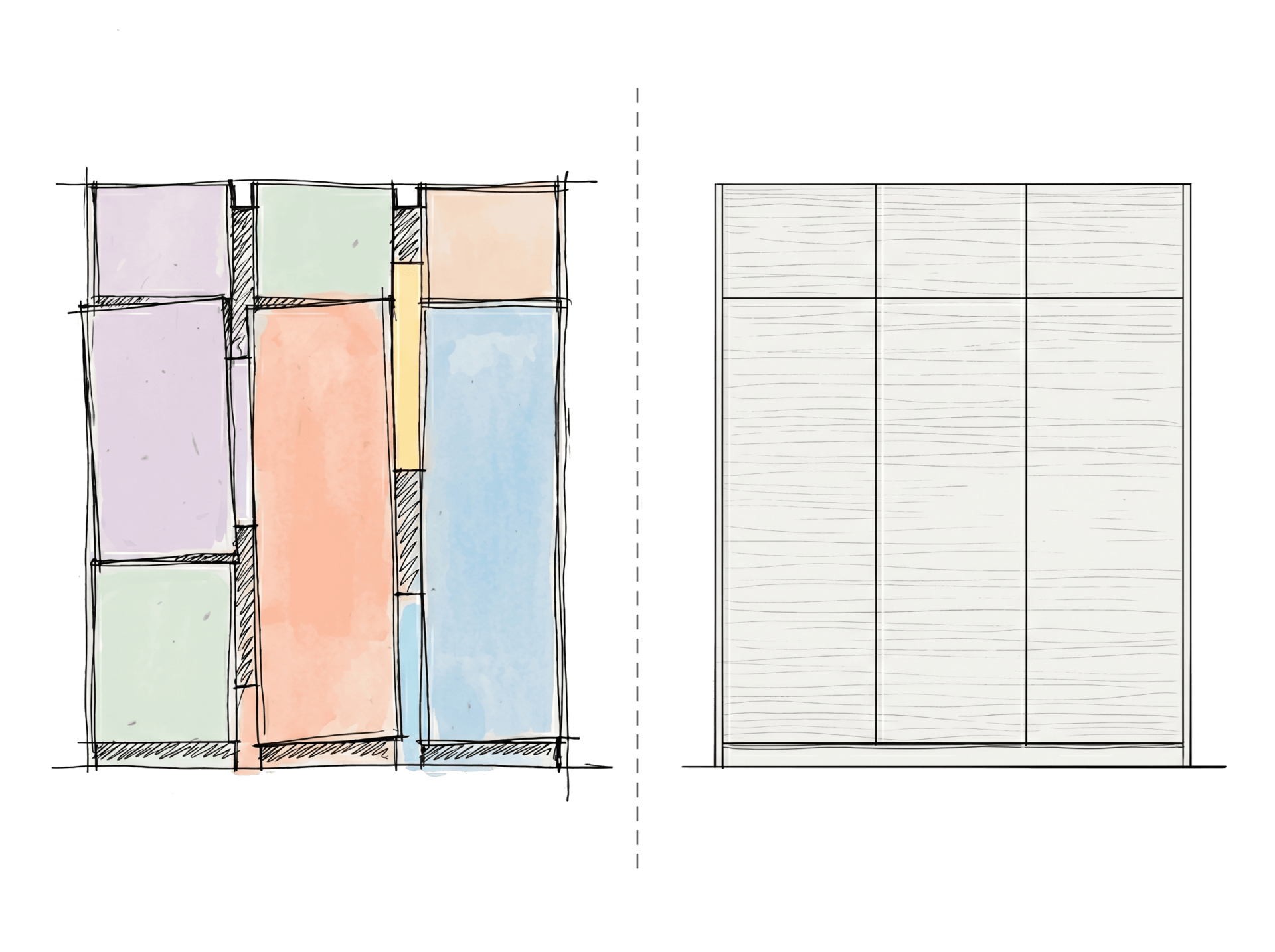
When a kitchen studio says "we build custom", in most cases it means: industrial modules plus filler panels. The actual cabinet bodies — the load-bearing carcases of your kitchen — come from serial production in three or four standard widths. Wherever these modules don't quite fit your room, side fillers or cover panels are used. Between 5 and 25 centimetres per side — depending on how far the room deviates from the next module grid.
This sounds like a technical detail. In truth it means: a "trim" of the front material is visibly placed between the cabinets and your wall. The same on the worktop edge. The same above the wall units.
The result: a kitchen that looks as though it has been placed into a room out of a catalogue — not as if it had been built for that room.
After two weeks you no longer see the kitchen. You see the panels. Every morning.
Before founding Kolev Architektenküchen, I ordered kitchens from classic studios as an architect for my building clients. Every time it bothered me how many filler panels, cover strips and masking pieces were needed just to get standard modules to sit next to each other in the room. That was the very reason I started building kitchens myself.
Every Kolev kitchen is built to the millimetre for your room. No standard module. No filler strip. Air gap to the wall: 3-5 mm — instead of 5-25 cm filler panels pretending the kitchen was custom-built. The carcases are produced in my own workshop, to the actual measurements of your walls, which we measure in 3D before production.
The difference is visible at first glance — and even more at the tenth. When you stand next to your worktop in five years' time, you will either see a clean continuous line or a strip of filler. That decision is made today.
An industrial-with-panels solution looks cheaper at first glance. In truth you pay for unused storage — and for an aesthetic compromise you will see daily for 20 years.
Ask every supplier:
Mistake 2 of 5
You don't know what your hob really costs.
In almost every kitchen studio, what you eventually pay for your BORA hob, your Miele oven or your Quooker tap is not the studio's purchase price. It is the purchase price plus a 40 to 100 % mark-up.
This is industry practice. It is legitimate. Every retail business earns on margin. But most buyers don't know it — and therefore don't negotiate accordingly. If you negotiate over the kitchen price in the studio and the consultant grants you a 3 % "discount", what they have actually done is reduce their appliance mark-up by the same amount. That isn't a concession. It's a reshuffle.
As a direct architect-partner of BORA, Quooker and Elica, I receive these appliances at architect's conditions (around 35 % below RRP). I pass these conditions on in full — no mark-up, no margin.
Example from a real client kitchen:
| Appliance | RRP | Your Kolev price |
|---|---|---|
| BORA X Pure (hob + downdraft) | 3,915 € | 2,545 € |
| Quooker Flex + CUBE | 2,595 € | 1,687 € |
| Your saving on these two appliances alone | 2,278 € |
A typical kitchen contains 4 to 6 brand-name appliances. The difference compared to the studio's mark-up sits between 1,500 and 3,500 € — depending on the appliance package.
This amount is not a discount I'm granting you. It is the manufacturer's condition I pass through as a direct partner — because my business model doesn't include an intermediate margin.
Why is the market so opaque on this point? Because manufacturers don't publish their partner-condition structure. The buyer sees a price in the offer, has no reference, and accepts it as market-standard. A simple test: ask your supplier to show the RRP of every appliance and your price in two separate columns of the offer. Whoever hesitates has something to hide. Whoever does it without discussion has nothing to fear.
Ask every supplier:
Mistake 3 of 5
The offer was 32,000 €. The final invoice was 37,400 €. No one defrauded you — and that is exactly the problem.
The difference didn't arise from a mistake. It arose from line items that weren't in the offer, or only as vague phrasing: "site preparation insufficient" (+800 €), "special-size carcase" (+1,200 €), "material no longer available, replacement more expensive" (+600 €), "fitter hourly rate above flat assumption" (+1,500 €), "extra effort delivering to upper floor" (+700 €). Individually each line sounds plausible. Together they are 5,400 € more than expected.
It is industry practice. That doesn't make it acceptable.
Final invoices that lie significantly above the offer have their own thread in German construction and trade forums. The range goes from 15-20 % overruns — barely tolerable under prevailing case law without a separate disclosure obligation — to individual cases of more than double the original estimate. Not necessarily unlawful. It is the consequence of an offer you signed without a fixed-price binding.
The order confirmation carries a clear amount — you sign. What gets added between your signature and the final invoice you do not know at that point. Three typical items that are vague or simply missing in the offer:
Each of these items is defensible on its own. Together they produce the typical final-invoice gap of 5,400 to 15,000 €.
My final invoice equals the offered sum. Full stop. The installation is listed as a fixed euro amount in the offer — not as "by effort". Genuine special cases of delivery logistics (crane operation, particular access routes) are listed in the offer as conditional line items with euro amounts in advance. You know the maximum before you sign.
Order confirmations from me are copies of the accepted offer, supplemented with the delivery address and bank details. Substantive changes — if there are any — only as a signed amendment, not as silent edits in the running text.
Ask every supplier:
Mistake 4 of 5
"If you sign today, there's an 8 % home-show discount." — That single second is the most expensive in the entire purchase process.
You sit in the studio, the kitchen has been planned, the consultant places the offer in front of you. Then comes the line: only until Sunday. Only because you are here today. Only because the home show is still running. It is the moment when most buyers pay more than necessary, because they have stopped comparing.
The mechanism behind it: salespeople in kitchen studios work on commissions of 1 to 3 % on the order value. They have monthly targets. "Home-show discount", "only until Friday" and "special conditions for current projects" are tools to push the close into the current week. Industrial kitchens are made to order — there is no scarcity. No Siemens oven goes out of programme because you don't sign today. The pressure mechanism is psychological, not logistical.
A kitchen for 25,000 to 80,000 € is a decision you will feel daily for 20 years. No home-show discount in the world is worth as much as three quiet weeks in which you compare, ask and verify. Whoever denies you that time is protecting their margin — not your project.
On public review portals for kitchen studios, the recurring lines are striking: "Better not to sign at all." "The most expensive signature of my life." "Agreements made at the trade show are invalid afterwards — no right of withdrawal, only cancellation fees of 30 %." These are not isolated opinions. It is a recurring pattern at suppliers who work with sales pressure.
Get at least two, better three offers before you sign. Not because the first offers are bad, but because only the third comparison shows where individual items realistically sit — appliance prices, installation flat rates, worktop costs. Without a comparison you have no reference for whether 32,000 € for your configuration is market-appropriate, too high or actually a bargain.
The third comparison is the most valuable. Whoever lets it pass through a hasty close pays the price for it in the final invoice — or in the bad feeling at the last look at the signed document.
My offer is valid for 3 weeks, with no bonus structure, no special conditions for fast signatures. The process explicitly assumes you will obtain further offers. That is not a courtesy — it is logic. Whoever holds up in an informed market comparison has nothing to hide. Whoever pushes you to a quick close has an interest you do not share.
Ask every supplier:
Mistake 5 of 5
Your daughter rams the front with her high chair. What does the repair cost — and how long does it take?
A damaged front is everyday life in a lived-in kitchen. Children, bicycle helmets, the corner blow of a heavily loaded shopping basket — most scratches and dents arise not through negligence but through normal use.
In an industrial kitchen, the repair runs like this: you contact the studio. The studio contacts the manufacturer. The manufacturer checks whether the decor is still in current production. If yes: lead time 6 to 14 weeks for a single front. If no — and decors are regularly discontinued, often after 5 to 8 years — then there is no longer a single replacement front. Then all fronts in a row must be replaced so the visual line stays consistent. A damage with a material value of 200 € turns into a repair of 3,000 € or more.
This is not an exception. It is the structural weakness of a kitchen whose fronts come from an industrial batch produced not for your kitchen, but for a thousand kitchens at once. The manufacturer decides by market logic which decors stay in the programme — not by what your kitchen will need in ten years. When a decor is no longer profitable, it is dropped. Your damage is then your problem.
In German kitchen and renovation forums, similar reports appear regularly — usually with the same key sentence: "The fronts haven't been available from this supplier for a long time." Anyone wanting to replace a single front in an eight-year-old kitchen often faces exactly that line.
Every front goes through my in-house CNC mill, based on the stored construction data of your kitchen. A replacement front can be promptly produced in the same coating, the same dimension, the same profile — as long as the carrier programme is still available. Senosan Supermatt and Decospan Shinnoki have been available as premium programmes for over ten years, with consistent core decors. Supply continuity here is not just a marketing promise but provable history.
I keep the construction data of your kitchen permanently as a BIM file — the complete three-dimensional model of your kitchen, with every dimension, every coating, every profile. That is the decisive difference: I can reproduce your front exactly, even in ten or fifteen years. A studio that ordered an industrial batch cannot.
What architect's conditions on BORA, Quooker and other brand-name manufacturers look like in practice is shown in the appliance catalogue. What a real renovation project in the Frankfurt existing-building stock with three wall constraints looks like is documented in the Frankfurt Renovation reference project. More about me as an architect (AKH).
Ask every supplier:
Frequently asked questions
The five described in this guide: 1) "custom-built" is not always custom-built (industrial modules plus filler panels), 2) hidden margin on appliances (40 to 100 % mark-up instead of architect's conditions), 3) the final-invoice trap (€5,000 to 15,000 above the offered sum), 4) sales pressure and the missing three-offer rule, 5) front damage without BIM data storage (a €200 damage becomes a €3,000 repair). The PDF guide "The Twelve Costliest Mistakes" adds a further seven.
Direct architect-partners of the manufacturers (BORA, Quooker, Elica) receive brand-name appliances around 35 % below RRP. At Kolev Architektenküchen this condition is passed through to the buyer in full — no mark-up, no margin. Studios buying through wholesalers add 40 to 100 % mark-ups on the purchase price. Which appliances are installed at which condition is shown in the appliance catalogue.
A fixed-price commitment guarantees that the final invoice equals the offered sum. Special cases (crane operation, drywall work, atypical screed preparation) are listed in advance as conditional line items with euro amounts in the offer — so the maximum is known before signing. Order confirmations are copies of the accepted offer, not deviating documents. Substantive changes only as a signed amendment.
For industrial kitchens from serial production: if the manufacturer discontinues the decor, no single replacement front is available — all fronts in a row must be replaced, repair €3,000 instead of €200. At Kolev kitchens the construction is stored permanently as a BIM file; replacement fronts are produced via the in-house CNC mill from the consistent carrier programme (Senosan Supermatt, Decospan Shinnoki — over 10 years on the market). What this looks like in a real renovation is shown in the Frankfurt Renovation reference project. Further answers in the detailed FAQ section.
Put the questions to your suppliers. The answers will tell you a great deal.
Then you have just saved yourself a lot of time and money before spending the first euro.
The free initial consultation (60 minutes, by video) is the next step. You ask the questions from this guide, I give you a realistic assessment — honestly, with no sales pressure.
"Everything could be fitted exactly. No filler panels needed."
Jacqueline W. · Google review (translated)
"At other suppliers it would have cost up to twice as much."
Micha S. · Google review (translated)
Your next step
Book your initial consultation —
so your kitchen makes none of these five mistakes.
60 minutes · by video · non-binding · no sales pressure
Best of luck with your project — whether you build with me or with someone else in the end.
Rusi Kolev
Architect (AKH) · Real-Estate Economist (ebs)
Kolev Architektenküchen · kolev-kuechen.de